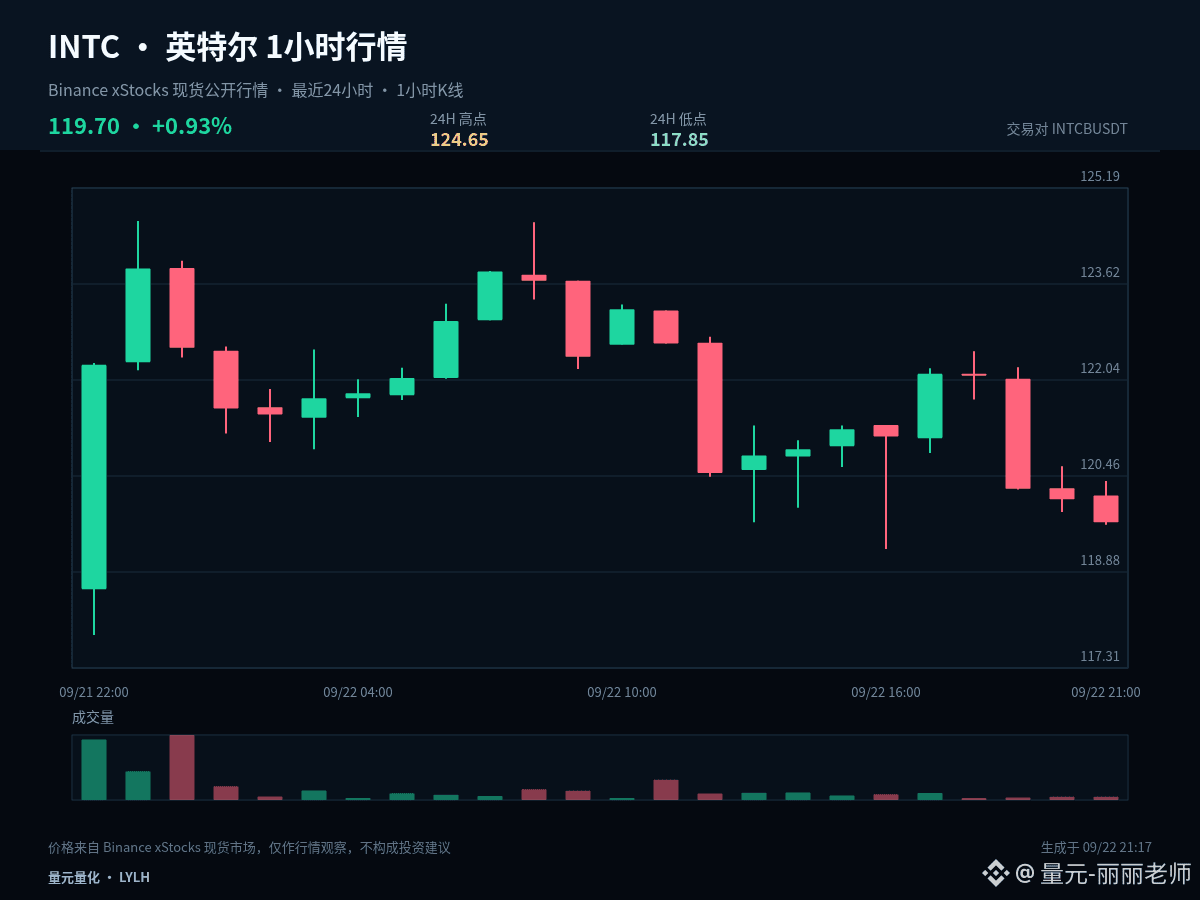
$INTCB #INTC Heat comes first; only after that do you prepare to enter the trade. You also need to assess the position first. In the current 1-hour period: -0.32%, and over the past 24 hours: +4.20%. The space that’s already been traveled can’t be directly treated as the next segment of repeatable space.
$INTCB #INTC At the moment, it is still churning back and forth within the recent 24-hour range, and directional advantage is not obvious. The middle zone is the most demanding for patience—waiting for boundary signals is usually more effective.
In a weak phase, the easiest mistake is to misread a single rebound as a reversal. Until 121.25 is reclaimed, first observe the repair. If it breaks 117.85 again, that indicates there’s still a lack of effective support below.
For execution, set clear conditions: after a break above 124.65, you need confirmation—not chasing just because of a momentary surge. After a dip to 117.85, you should check whether it can quickly reclaim—don’t catch falling prices just because you see weakness. If the mid-range doesn’t offer enough reward-to-risk, waiting itself is part of the strategy.
If you already have positions, manage them in segments based on key levels to avoid making all decisions at once. If you’re currently in cash, wait for breakout confirmation or for a pullback to stabilize. For US stock underlyings, also pay attention to volatility caused by trading-session transitions. Your plan should be based on price conditions, not emotion replacing execution.
Missing one stretch of the market doesn’t automatically cause losses—only chasing the end of volatility without a plan will make your position passive. For short-term positions, the focus isn’t predicting every single candlestick; it’s ensuring that entries, partial reductions, and exits all have a basis. Do less without confirmation; when key levels fail, redo the plan. First control single-trade risk, and then discuss further upside/downside space.
#TokenizedStockPlatformsCouldLaunchNextQuarter
$INTCB #INTC At the moment, it is still churning back and forth within the recent 24-hour range, and directional advantage is not obvious. The middle zone is the most demanding for patience—waiting for boundary signals is usually more effective.
In a weak phase, the easiest mistake is to misread a single rebound as a reversal. Until 121.25 is reclaimed, first observe the repair. If it breaks 117.85 again, that indicates there’s still a lack of effective support below.
For execution, set clear conditions: after a break above 124.65, you need confirmation—not chasing just because of a momentary surge. After a dip to 117.85, you should check whether it can quickly reclaim—don’t catch falling prices just because you see weakness. If the mid-range doesn’t offer enough reward-to-risk, waiting itself is part of the strategy.
If you already have positions, manage them in segments based on key levels to avoid making all decisions at once. If you’re currently in cash, wait for breakout confirmation or for a pullback to stabilize. For US stock underlyings, also pay attention to volatility caused by trading-session transitions. Your plan should be based on price conditions, not emotion replacing execution.
Missing one stretch of the market doesn’t automatically cause losses—only chasing the end of volatility without a plan will make your position passive. For short-term positions, the focus isn’t predicting every single candlestick; it’s ensuring that entries, partial reductions, and exits all have a basis. Do less without confirmation; when key levels fail, redo the plan. First control single-trade risk, and then discuss further upside/downside space.
#TokenizedStockPlatformsCouldLaunchNextQuarter