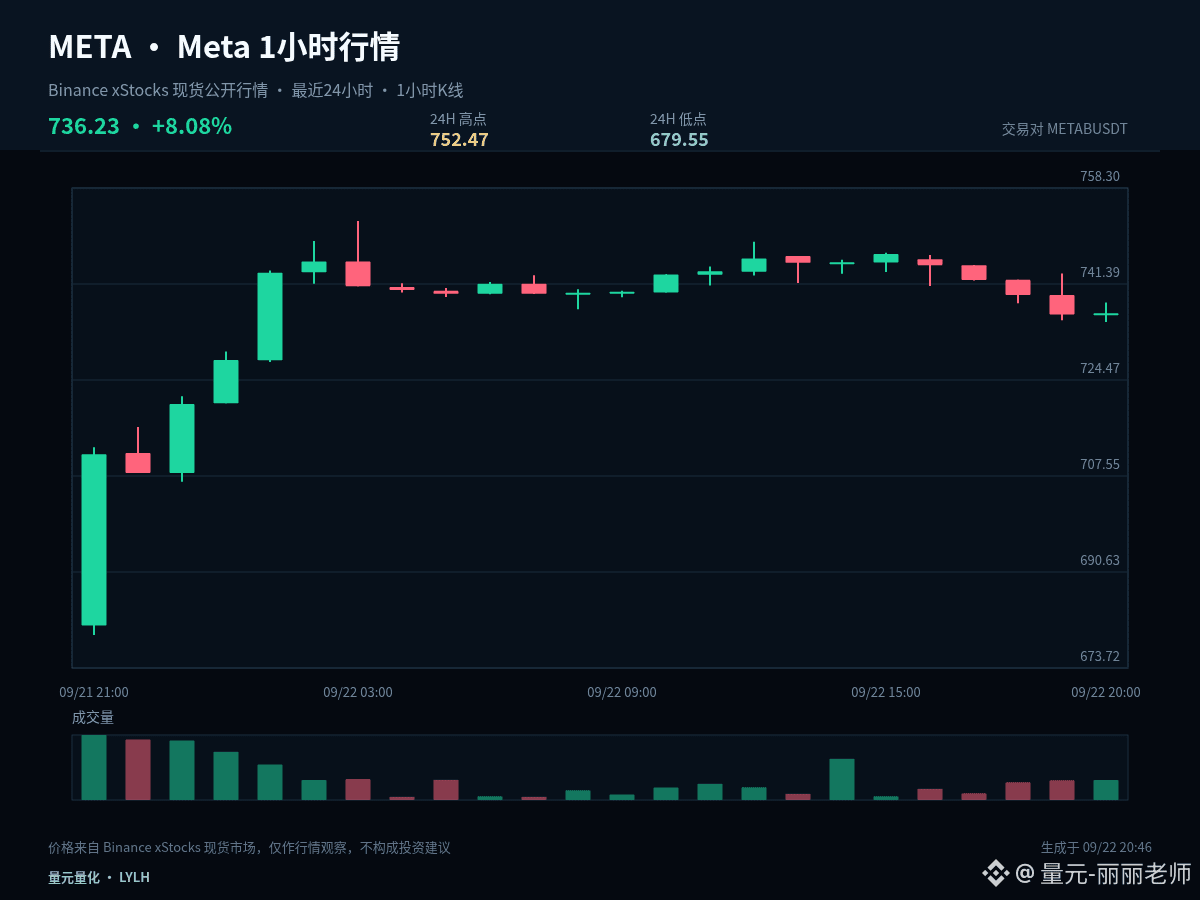
$METAB #META Right now it’s more suitable to first confirm a rebound, rather than pre-defining a reversal. Current price: 736.23. In the last 1 hour: +0.03%, in the last 24 hours: +8.03%. Whether the two time cycles realign in the same direction is the key focus going forward.
At present, the last 1 hour is +0.03% and the last 24 hours is +8.03%, but the two cycles have not formed a sufficiently clear same-direction coordination. In a range-bound market, the tolerance for chasing highs and killing lows is low. It’s better to confirm by the upper boundary for direction and the lower boundary for support/acceptance; the midline should only be used as the line dividing strength and weakness.
If the rebound can reclaim 716.01 and then hold firmly above 752.47, it suggests that buying pressure is starting to change the original weakness. If, after pushing up to the midline, price falls back again—especially if it drops once more toward 679.55—then it looks more like a failed repair, and you shouldn’t continue relying on the expectation of strengthening.
Confirmation that the rebound fails also requires evidence. You can’t immediately chase a short just because price spikes and then retreats. A more reasonable sequence is to observe whether the resistance zone is rejected, whether the lows start moving downward again, and then decide your action based on whether the subsequent rebound can reclaim key levels.
Position management should distinguish between swing/medium-term positions and short-term trades. For existing medium-term holdings, first check whether the structure is broken; don’t let repeated fluctuations of a single 1-hour candlestick repeatedly affect you. For short-term positions, execute around support, resistance, and closing confirmations. If you’re currently in cash/no position, you don’t need to chase price in the middle of the range; waiting for a clearer location usually offers an advantage.
Your trading plan must include invalidation conditions. When your judgment is correct, you can realize gains in stages. When it’s wrong, you must also allow yourself to exit—don’t use adding to positions to mask the fact that the original logic has already changed. The market will keep updating, and your viewpoints should adjust along with price evidence.
#CardanoAddedToX402KitForADAPayments
At present, the last 1 hour is +0.03% and the last 24 hours is +8.03%, but the two cycles have not formed a sufficiently clear same-direction coordination. In a range-bound market, the tolerance for chasing highs and killing lows is low. It’s better to confirm by the upper boundary for direction and the lower boundary for support/acceptance; the midline should only be used as the line dividing strength and weakness.
If the rebound can reclaim 716.01 and then hold firmly above 752.47, it suggests that buying pressure is starting to change the original weakness. If, after pushing up to the midline, price falls back again—especially if it drops once more toward 679.55—then it looks more like a failed repair, and you shouldn’t continue relying on the expectation of strengthening.
Confirmation that the rebound fails also requires evidence. You can’t immediately chase a short just because price spikes and then retreats. A more reasonable sequence is to observe whether the resistance zone is rejected, whether the lows start moving downward again, and then decide your action based on whether the subsequent rebound can reclaim key levels.
Position management should distinguish between swing/medium-term positions and short-term trades. For existing medium-term holdings, first check whether the structure is broken; don’t let repeated fluctuations of a single 1-hour candlestick repeatedly affect you. For short-term positions, execute around support, resistance, and closing confirmations. If you’re currently in cash/no position, you don’t need to chase price in the middle of the range; waiting for a clearer location usually offers an advantage.
Your trading plan must include invalidation conditions. When your judgment is correct, you can realize gains in stages. When it’s wrong, you must also allow yourself to exit—don’t use adding to positions to mask the fact that the original logic has already changed. The market will keep updating, and your viewpoints should adjust along with price evidence.
#CardanoAddedToX402KitForADAPayments