


Bitcoin ETFs Take Nearly $1 Billion, the Most Since October, as Price Nears $86,000
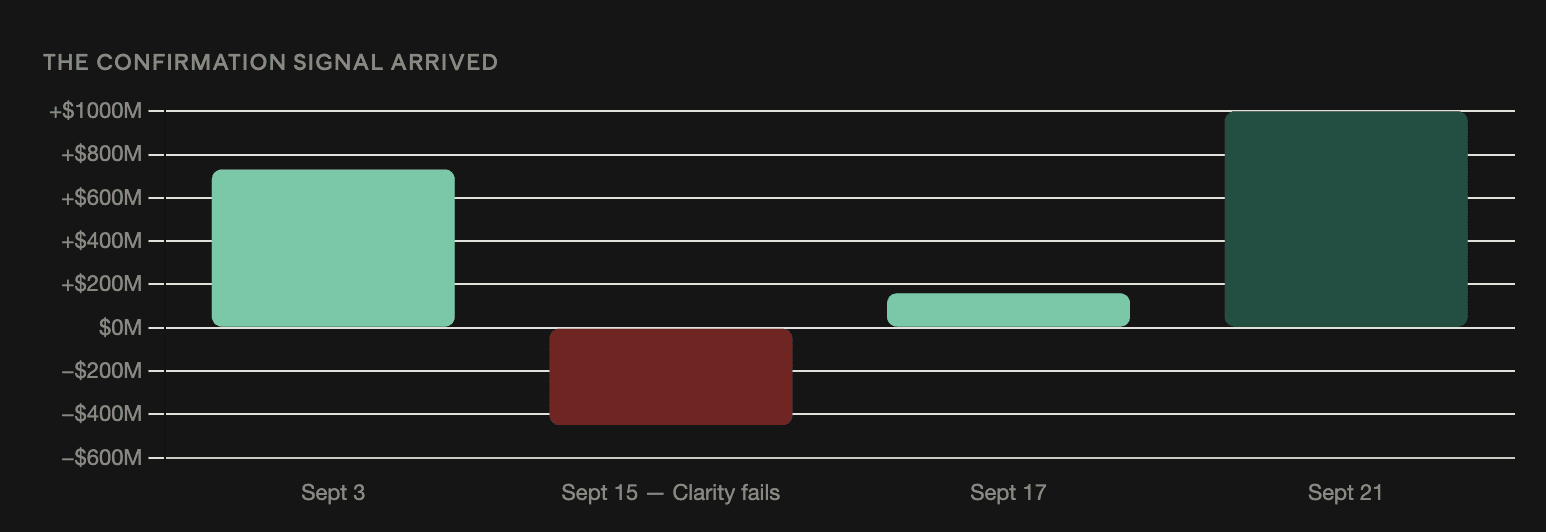
US-listed spot Bitcoin ETFs attracted nearly $1 billion in inflows Monday, their largest single-day haul since October last year.
Bitcoin traded near $86,000 after recovering from Asian-session lows around $85,000, having convincingly broken above its May high on Monday. The CoinDesk 20 Index rose 2.2% over 24 hours.
The Missing Confirmation Arrived
The inflow answers the main objection to the rally.
Through last week, the move from below $75,000 leaned on short liquidations — roughly $300 million in a single hour Monday — rather than spot buying. CryptoQuant's spot demand metric sat at −145,000 BTC, and Nexo Dispatch's Ilya Kalchev named sustained ETF inflows or renewed spot buying as the signals that would confirm a breakout.
A single $1 billion day is the largest institutional bid since October. For scale, the complex's previous standout was $731 million on September 3, and it shed $450 million on September 15 after the Clarity Act failed.
One day does not make a trend. Kalchev's word was "sustained," and the next several sessions will show whether this was a start or a spike.
The May High Was the Level That Mattered
Bitcoin's break above its May high removes a reference point that had been cited as the confirmation level for months.
LMAX Group's Joel Kruger had identified $82,820, the May high, as the level that would confirm the recovery, with a path toward $100,000 above it. Bitcoin rejected below it on September 4 at $82,284.
It has also cleared the $80,000-$82,000 band that held nearly 8% of supply, including the US spot ETF cohort's average cost basis.
The next test is closer than it looks. Glassnode's Frederik Theissen placed a dense long-term holder supply zone between $83,000 and $86,000. At $86,000, Bitcoin sits at its upper edge — where holders who bought in that range can exit at breakeven after months underwater.
Hormuz Is the Structural Change
WTI crude fell more than 2% to below $90, extending its retreat from a recent high of $106.
The trigger was a Kyodo report that Iran was willing to reopen the Strait of Hormuz within seven days if the US eased its blockade.
That is different in kind from last week's moves. Diplomatic signals such as President Trump saying he would "probably" meet Iran's president lower the risk premium. A reopened Hormuz removes the physical constraint that cut Saudi output to 6.238 million barrels per day, the lowest since 1990, and pushed tanker rates above $1 million per day.
Lower oil eases inflation pressure and weakens the case for more Fed hikes. The dot plot already signalled just one more increase in 2026.
"Falling oil prices and US government bond yields, rising global stock markets and optimism regarding US-China negotiations supported risk appetite," said FxPro chief market analyst Alex Kuptsikevich, pointing to a sharp rise in the Nasdaq.
Derivatives Still Read as a Short Squeeze
The futures data tells a less conviction-driven story than the ETF flows.
Total crypto futures volume jumped 38% to $292 billion over 24 hours while open interest rose just 1% to $157 billion, pushing the volume-to-open-interest ratio to nearly 2. Liquidations reached $768 million, mostly shorts.
Every major — BTC, ETH, XRP and SOL — carries a negative 24-hour open-interest-adjusted cumulative volume delta, meaning aggressive sell-side flow outpaced buy-side flow even as prices rose. Tron was among the few exceptions.
The two readings are not contradictory. ETF demand is spot buying through regulated vehicles; futures data captures leveraged traders. The spot bid arrived while the leveraged market was still covering shorts.
Bitcoin futures open interest climbed to 716,000 BTC, the most since August 25 but still below the roughly 750,000 BTC average from April to July. Ether and Solana open interest remains in a downtrend that began in May, even though ether has outperformed Bitcoin this quarter.
Memecoin Leverage Is the Warning Sign
PEPE, DOGE and SHIB were among the 10 best performers over 24 hours as Bitcoin paused.
Dogecoin's open interest surged 10% in a day, the largest jump among the top 10 coins. A consistent rise in memecoin leverage has historically appeared near interim tops, as speculative appetite runs ahead of the underlying move.
XRP open interest rose to 2.46 billion tokens from 2.2 billion, a 12% build on a smaller base.
Coinglass whale bias reads extremely bullish on Bitcoin, bullish on ether and Solana, and bearish on XRP, Dogecoin and gold.
Options Traders Are Reaching for $90,000 and $95,000
Implied volatility remains contained. The 30-day BVIV and EVIV indexes sit within recent ranges and well below the February and early June peaks.
Laser Digital noted the volatility curve has been flattening since last week as realised volatility picked up and spot-vol correlation turned firmly positive — volatility rising alongside price, the pattern of an upside move.
Deribit's front-end risk reversals flipped strongly toward Bitcoin and ether calls late Monday as Bitcoin topped $85,000, though the call bias has since eased.
The busiest Bitcoin options trades over 24 hours were calls at the $95,000 and $90,000 strikes, alongside ether calls from $2,500 to $3,000. Both Bitcoin strikes sit above the 100-week moving average near $89,000.
ZetaChain Holders Voted to Retire Their Own Blockchain
ZetaChain holders voted Sunday to shut down the network and move the ZETA token to Solana — a rare formal decision by a blockchain to stop existing.
The proposal passed with more than 99% in favour on 58% turnout, above the 40% required. One more governance vote is needed before anything moves.
The chain launched in 2023 with $27 million in funding to move value between otherwise incompatible blockchains. Three years later, dozens of teams attack the same problem, and ZETA ranks 313th by market value at about $90 million.
The team cited operating cost. ZetaChain runs on the Cosmos SDK, so every security flaw in that toolkit becomes its problem, requiring coordinated patches across independent operators. In August, Cosmos Labs disclosed attacks on six chains using related software, with about $6 million stolen. ZetaChain was not hit.
Solana was chosen for Anuma, an AI app the team launched in February that carries user context between AI models, which it says has more than 300,000 users. Holders will lock ZETA for credits inside Anuma, turning the token from network security into prepaid app usage.
ZETA doubled from roughly 4 cents into the vote, touched 7 cents, then fell 16% over 24 hours to just under 6 cents. Nearly $117 million traded against a $90 million market value — the entire float turned over more than once in a day.