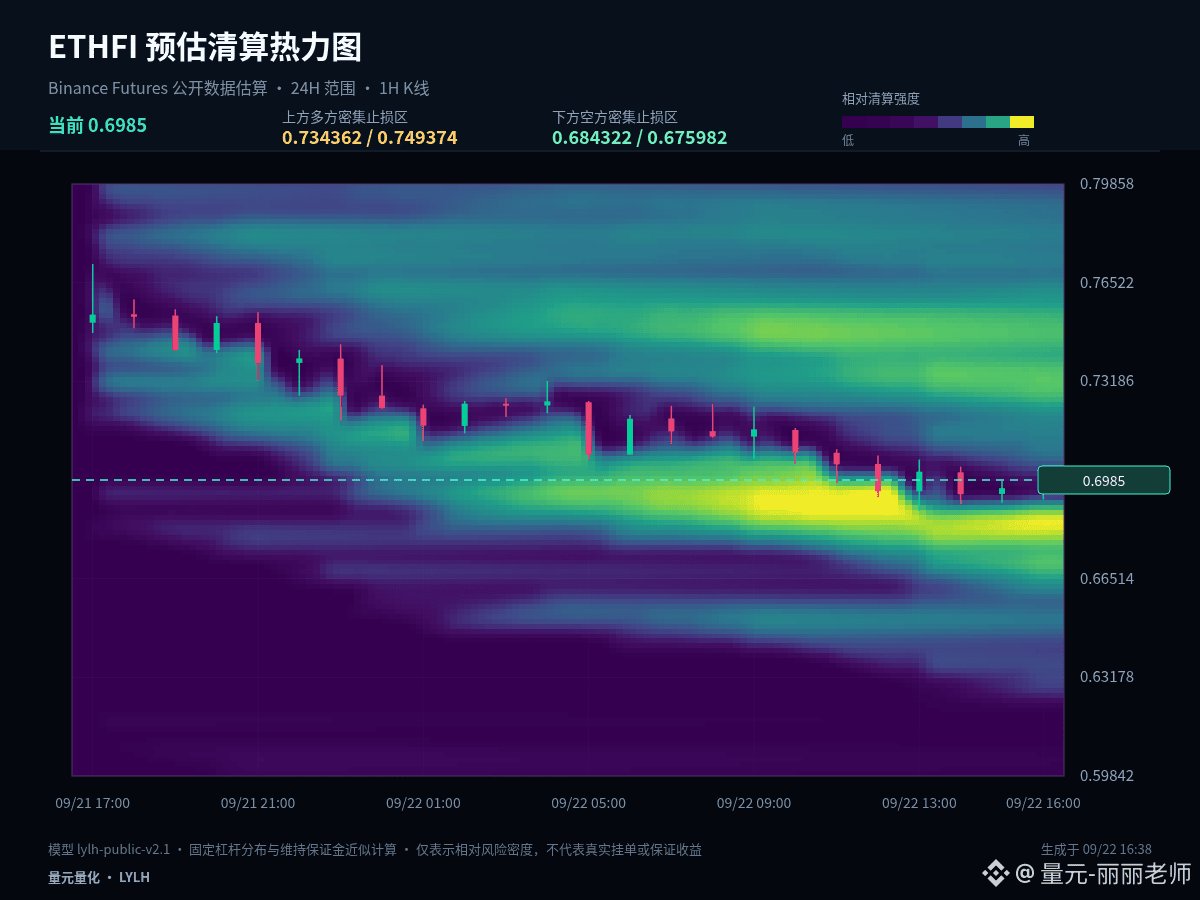
$ETHFI #ETHFI Over the past 24 hours, the high-low amplitude is about 11.9%. The current price is 0.6994. This is not a quiet market suitable for opening a position casually—when volatility expands, you should adjust your position size first, and only then discuss direction.
$ETHFI #ETHFI is currently testing the lower end of the past 24-hour range. It may look like the price is lower, but the real trading value depends on whether the bid support can keep holding, not just on the idea that it’s “cheap.”
The current price is near the lower end of the past 24-hour volatility: 1-hour +0.37%, 24-hour -6.41%. The key to analyzing the lows is not trying to bottom-fish early; it’s watching whether the price can quickly rebound after it breaks down. If it can rebound, it indicates that sell pressure is being absorbed. If it keeps lingering below the lower end, it suggests that weakness has not ended.
I’ll take 0.7301 as the short-term long/short line in the sand: holding above it means the pullback is still within a controllable range. After that, if conditions are met, there may be another test of 0.7717. If there is an effective breakdown below it, don’t rush in—wait for a new stabilizing structure to form around 0.6885.
In a high-volatility phase, the execution principles are: reduce single-trade exposure, avoid chasing prices back and forth in the middle of the range, and write the invalidation conditions before entering. If the market doesn’t provide confirmation, it’s better to do fewer trades than to compensate for uncertainty with a larger position size.
There are three possible ways to handle the next path: if price can effectively hold above 0.7717, wait for a pullback that doesn’t break and then reassess for continuation; if price breaks below 0.6885, prioritize risk control and wait for new support; if it continues to oscillate around 0.7301, treat it as a range turnover and don’t repeatedly chase direction at the midpoint.
A trading plan must include invalidation conditions. If your judgment is correct, you can take profits in stages; if your judgment is wrong, you must also be willing to exit. You can’t use adding to positions to disguise the fact that the original logic has changed. The market will update, and your view should adjust according to the price evidence.
#AgoraGetsPreliminaryOCCApprovalForTrustBank
$ETHFI #ETHFI is currently testing the lower end of the past 24-hour range. It may look like the price is lower, but the real trading value depends on whether the bid support can keep holding, not just on the idea that it’s “cheap.”
The current price is near the lower end of the past 24-hour volatility: 1-hour +0.37%, 24-hour -6.41%. The key to analyzing the lows is not trying to bottom-fish early; it’s watching whether the price can quickly rebound after it breaks down. If it can rebound, it indicates that sell pressure is being absorbed. If it keeps lingering below the lower end, it suggests that weakness has not ended.
I’ll take 0.7301 as the short-term long/short line in the sand: holding above it means the pullback is still within a controllable range. After that, if conditions are met, there may be another test of 0.7717. If there is an effective breakdown below it, don’t rush in—wait for a new stabilizing structure to form around 0.6885.
In a high-volatility phase, the execution principles are: reduce single-trade exposure, avoid chasing prices back and forth in the middle of the range, and write the invalidation conditions before entering. If the market doesn’t provide confirmation, it’s better to do fewer trades than to compensate for uncertainty with a larger position size.
There are three possible ways to handle the next path: if price can effectively hold above 0.7717, wait for a pullback that doesn’t break and then reassess for continuation; if price breaks below 0.6885, prioritize risk control and wait for new support; if it continues to oscillate around 0.7301, treat it as a range turnover and don’t repeatedly chase direction at the midpoint.
A trading plan must include invalidation conditions. If your judgment is correct, you can take profits in stages; if your judgment is wrong, you must also be willing to exit. You can’t use adding to positions to disguise the fact that the original logic has changed. The market will update, and your view should adjust according to the price evidence.
#AgoraGetsPreliminaryOCCApprovalForTrustBank