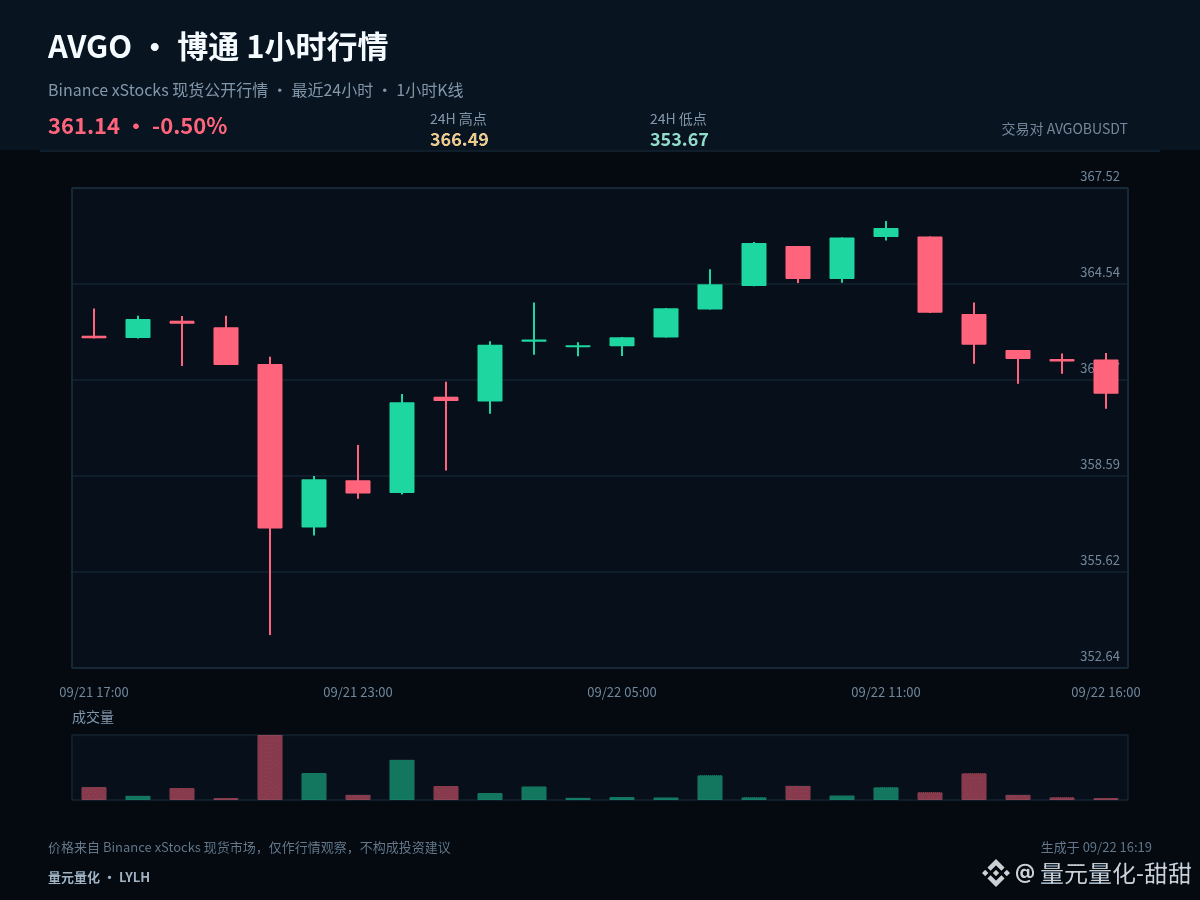
$AVGOB #AVGO If in this round we only keep one observation price, I would choose 360.08. The current price is 361.14; in the past 1 hour it is -0.28%, and in the past 24 hours it is -0.34%. The gain/loss of the central axis can help filter out a lot of intraday noise.
The price has not yet reclaimed 360.08. For now, treat the current rebound as a weak repair; a true turn for strength needs proof from a stable close. If it turns weak again, 353.67 is the next level to observe whether the selling pressure is fading.
Currently, 1 hour is -0.28% and 24 hours is -0.34%. Across these two periods, there hasn’t been sufficiently clear same-direction alignment. In a range-bound market, the margin for error when chasing or cutting is lower. It’s better to use the upper boundary to confirm direction, and the lower boundary to confirm support. The central axis serves only as the line between strength and weakness.
For execution, set clear conditions: after breaking above 366.49, you need confirmation—not chasing just because you see a brief spike. After dipping to 353.67, you need to see whether it can quickly pull back—not catch every drop. When the middle region doesn’t offer enough odds, waiting is also part of the strategy.
For positions you already hold, you can handle them in segments based on key levels to avoid making all decisions at once. Those who are currently in cash should wait for confirmation of a breakout or a pullback that stabilizes. For US stock-related targets, also pay attention to volatility caused by trading session transitions. Your plan should be based on price conditions, not emotion replacing execution.
For the next 1-hour candle: if it closes above 360.08, the structure will be more proactive; if it closes below, continue to be cautious. Which path are you leaning toward right now?
#AIStocksWhatNext
The price has not yet reclaimed 360.08. For now, treat the current rebound as a weak repair; a true turn for strength needs proof from a stable close. If it turns weak again, 353.67 is the next level to observe whether the selling pressure is fading.
Currently, 1 hour is -0.28% and 24 hours is -0.34%. Across these two periods, there hasn’t been sufficiently clear same-direction alignment. In a range-bound market, the margin for error when chasing or cutting is lower. It’s better to use the upper boundary to confirm direction, and the lower boundary to confirm support. The central axis serves only as the line between strength and weakness.
For execution, set clear conditions: after breaking above 366.49, you need confirmation—not chasing just because you see a brief spike. After dipping to 353.67, you need to see whether it can quickly pull back—not catch every drop. When the middle region doesn’t offer enough odds, waiting is also part of the strategy.
For positions you already hold, you can handle them in segments based on key levels to avoid making all decisions at once. Those who are currently in cash should wait for confirmation of a breakout or a pullback that stabilizes. For US stock-related targets, also pay attention to volatility caused by trading session transitions. Your plan should be based on price conditions, not emotion replacing execution.
For the next 1-hour candle: if it closes above 360.08, the structure will be more proactive; if it closes below, continue to be cautious. Which path are you leaning toward right now?
#AIStocksWhatNext