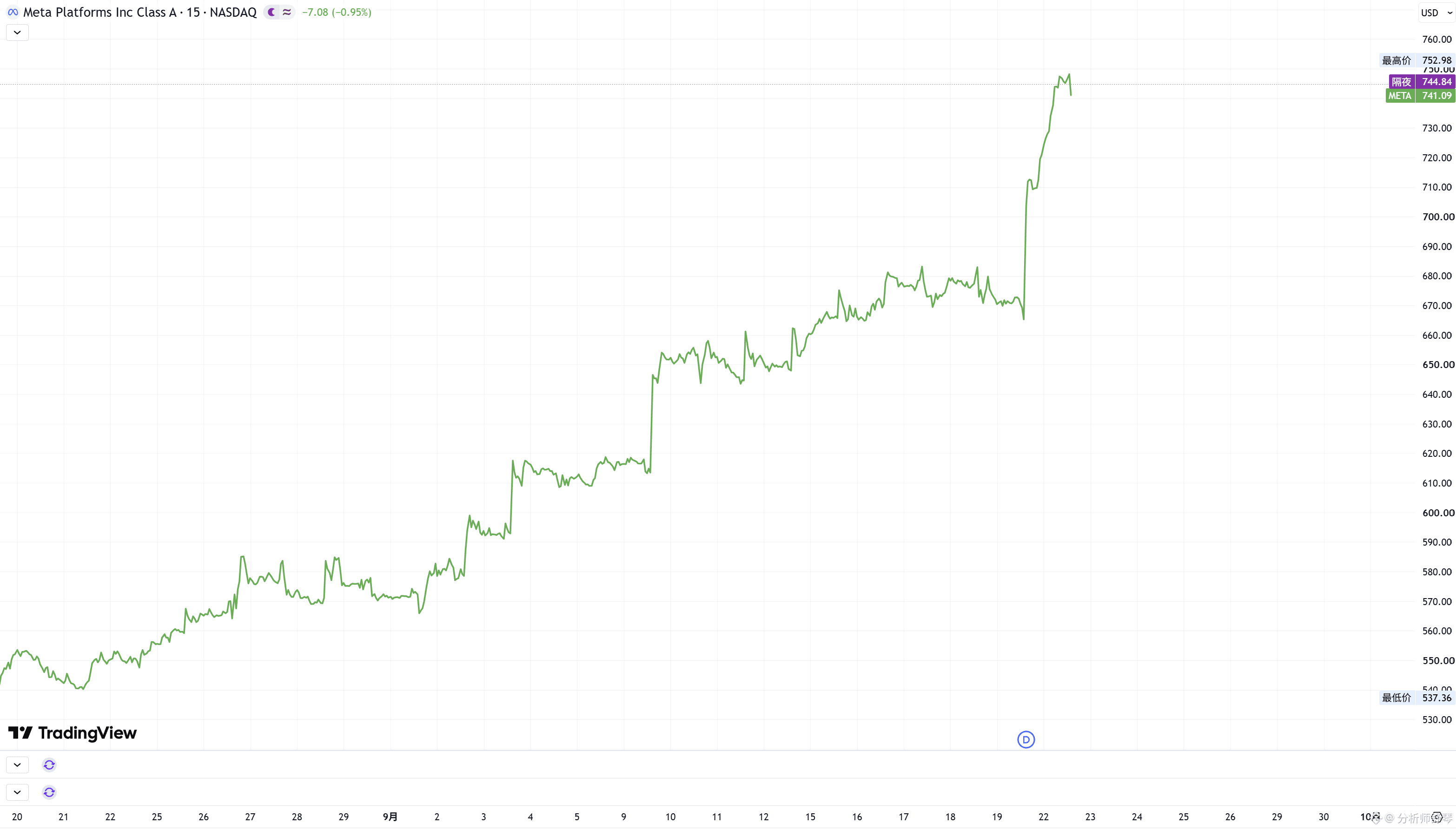
Meta’s one-night surge of 11%, AMD enters the trillion-dollar club—what’s behind it?
Well, look at that! A new AI app launched only 12 days ago made Meta’s market cap jump 11% overnight—and it even helped push AMD into the trillion-dollar club. The source of it all is Meta’s new AI assistant, Muse, which has taken the rankings by storm! AI is once again at the top of the download charts, and investors are once again filled with confidence in AI.
So, the capital markets are getting hyped. Meta closed up 11.43% on Monday, with its market cap surging by roughly $190 billion in a single day. AMD rose 9.95%, and its total market cap closed above $1 trillion for the first time ever. Intel jumped more than 12%—what about NVIDIA? It only rose 2.30%. Got it? In that single night, it was all the CPU side that went up.
Why did it happen to “catch fire” this time?
First, in the past, AI mostly just chatted with you. With Muse, it can actually jump in and get work done. It can read what you post on Facebook and Instagram, know who you are and what you like, and even connect to your Gmail and calendar—then it can open its own browser and click around on webpages for you. In plain terms: the old thing was called a “chatbot.” This one is a “digital worker.” The more capable the agent is, the more workload it can offload onto CPUs. How could chip stocks not fly?
Second, the capital markets have been waiting for this moment for far too long. For the past two years, everyone has been circling one question: AI has burned so much money—so when will it actually pay back? Now Muse is proving that Meta’s cumulative investment of around $200 billion in AI hasn’t been in vain.
Translated into real human language: the money wasn’t wasted, and the path was right.
But don’t get carried away just yet. According to third-party data, Muse launched on September 8, and in its first six days it racked up over 902,000 downloads—well ahead of the previous Meta AI’s 773,000 downloads over the same period. Sounds impressive? But consider this: ChatGPT’s weekly active users are on the scale of 100 million (a 1 billion-level ballpark). That’s a two-order-of-magnitude gap in between. And there’s still an entire validation step missing between topping the free charts and users being willing to pay to renew.
Also, don’t forget: Amazon has already blocked Muse. No matter how capable your agent is, if the platform won’t let you in, you still can’t go anywhere.
When an agent evolves from “one conversation” into a continuously running, credentialed, actionable virtual machine, the underlying computing structure changes: tokens go to the GPU, but tool calls, sandboxing, and browser sessions all run on the CPU. This is the day when the market cast its vote with real money.
AMD, yes!
Well, look at that! A new AI app launched only 12 days ago made Meta’s market cap jump 11% overnight—and it even helped push AMD into the trillion-dollar club. The source of it all is Meta’s new AI assistant, Muse, which has taken the rankings by storm! AI is once again at the top of the download charts, and investors are once again filled with confidence in AI.
So, the capital markets are getting hyped. Meta closed up 11.43% on Monday, with its market cap surging by roughly $190 billion in a single day. AMD rose 9.95%, and its total market cap closed above $1 trillion for the first time ever. Intel jumped more than 12%—what about NVIDIA? It only rose 2.30%. Got it? In that single night, it was all the CPU side that went up.
Why did it happen to “catch fire” this time?
First, in the past, AI mostly just chatted with you. With Muse, it can actually jump in and get work done. It can read what you post on Facebook and Instagram, know who you are and what you like, and even connect to your Gmail and calendar—then it can open its own browser and click around on webpages for you. In plain terms: the old thing was called a “chatbot.” This one is a “digital worker.” The more capable the agent is, the more workload it can offload onto CPUs. How could chip stocks not fly?
Second, the capital markets have been waiting for this moment for far too long. For the past two years, everyone has been circling one question: AI has burned so much money—so when will it actually pay back? Now Muse is proving that Meta’s cumulative investment of around $200 billion in AI hasn’t been in vain.
Translated into real human language: the money wasn’t wasted, and the path was right.
But don’t get carried away just yet. According to third-party data, Muse launched on September 8, and in its first six days it racked up over 902,000 downloads—well ahead of the previous Meta AI’s 773,000 downloads over the same period. Sounds impressive? But consider this: ChatGPT’s weekly active users are on the scale of 100 million (a 1 billion-level ballpark). That’s a two-order-of-magnitude gap in between. And there’s still an entire validation step missing between topping the free charts and users being willing to pay to renew.
Also, don’t forget: Amazon has already blocked Muse. No matter how capable your agent is, if the platform won’t let you in, you still can’t go anywhere.
When an agent evolves from “one conversation” into a continuously running, credentialed, actionable virtual machine, the underlying computing structure changes: tokens go to the GPU, but tool calls, sandboxing, and browser sessions all run on the CPU. This is the day when the market cast its vote with real money.
AMD, yes!