


By giving users a digital rig to configure and a community to contribute to, MiniQ is building its identity around ongoing involvement.
What gives someone a reason to return to a Web3 project after the first visit?
For MiniQ, the answer begins with a digital rig. Participants can explore components, compare configurations and learn how their choices affect power, capacity and pool access. Around that experience, the project envisions a community that shares knowledge and helps shape future development.
This makes MiniQ an interesting example of a broader product question: how can a digital-asset ecosystem create meaningful participation beyond owning its native token?
A Rig Becomes a Reason to Learn
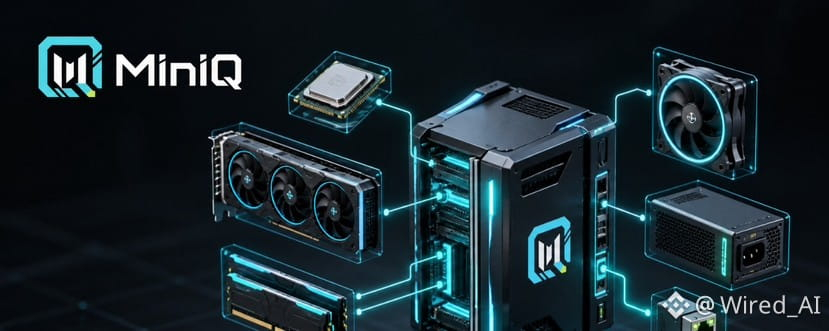
MiniQ organizes its experience around a modular digital mining rig. Six component categories—Q-Core, GPU, RAM, Cooling, PSU and Network—give participants different ways to develop a configuration.
The components have distinct functions. Some contribute power, others change efficiency or capacity, and Network determines access to additional pools. Understanding one part therefore leads naturally to questions about the others.
A participant considering a higher-tier component must also think about the rig’s heat budget. Someone interested in another pool needs to examine Network eligibility. A configuration with more power may carry different costs from one designed around lower maintenance.
These relationships create opportunities for learning through use. The product gives participants a set of decisions to explore, with a calculator that shows how changes affect the overall build.
The rig remains a digital platform construct. Its familiar hardware vocabulary helps explain MiniQ’s mechanics, but does not establish ownership of physical mining equipment.
The Value of a Shared Learning Experience
A configurable product can also give a community something concrete to discuss.
Participants can explain how components interact, share approaches to planning a build and help newcomers interpret the terminology. A useful guide might clarify the difference between direct and effective power. Another might explain why trial components and free workshop access have separate time limits.
For MiniQ, these everyday contributions could become an important part of community development. Educational content, translations, product feedback and testing can make the experience more accessible as participation grows.
That creates a practical standard for community value: does involvement help someone understand the product, make an informed choice or resolve a problem?
Membership numbers can indicate reach. The quality of shared knowledge can reveal something about the experience people find after joining.
Progression Needs Clear Boundaries
MiniQ uses familiar progression mechanics, including equipment slots, tiers and upgrades. These can make an unfamiliar subject easier to approach, provided the economic meaning remains visible.
Its internal power unit, QP, is central to that distinction. QP measures capability and participation within MiniQ’s rules. It is separate from MNQ, the ecosystem’s native digital asset, and should not be interpreted as a guaranteed amount of income.
The same care applies to reward estimates. A calculator can explain the consequences of a configuration under stated conditions, while actual settlement depends on the applicable pool rules, participation and deductions.
For a product built around progression, clarity matters. Participants should understand what an upgrade changes, what it costs and which outcomes remain variable. A satisfying interface should support those decisions without making continuous spending feel necessary.
Community Leadership Requires Visible Responsibilities
MiniQ describes itself as a community-run Web3 ecosystem without a registered company. Its vision includes contributions from participants, developers, educators and other people supporting the project.
That structure makes the relationship between participation and authority especially important.
Helping a community grow is different from holding a formal vote over its treasury or technical parameters. Similarly, owning MNQ does not automatically establish governance rights. Such rights depend on mechanisms that are implemented and documented.
A credible community model therefore needs visible responsibilities alongside open discussion. Participants should be able to understand who maintains the product, who can change its rules and how important decisions are communicated.
Building a Community Around a Useful Product
MiniQ’s community ambitions will ultimately be tested by the experience it delivers.
A digital rig can provide an accessible starting point. Clear explanations can help participants understand it. Reliable records and transparent operating rules can give the community a stronger basis for evaluating the system.
Together, those elements offer a path toward sustained involvement: people return because they have something useful to learn, explore or contribute.
That is the opportunity behind MiniQ’s approach. Its longer-term identity will depend on how well the product and the community develop together.
Learn more at miniq-mining.com.