On September 22, gold’s rebound met resistance and fell into consolidation and repair
After the U.S. Federal Reserve’s rate decision landed last week, gold first saw a sharp drop. As U.S. inflation eased and the market once again worried about recession risk, the gold price found some support at lower levels and quickly surged. However, as U.S. Treasury yields rose again, bullish momentum clearly weakened. Gold then repeatedly oscillated and washed within the range of $4,400 to $4,320.
Yesterday, after the Asian session opened, gold continued Friday’s downtrend. Then, during the European session, it moved slightly sideways. Before the U.S. session, I reminded you that the evening trading would be a choppy, range-bound行情. Before the U.S. session opened, gold made a modest rebound to around $4,375, then pulled back and quickly tested support around the $4,320 level. After that, it once again moved upward in a choppy pattern, and this morning, after the market opened, it tested the $4,375 resistance again.
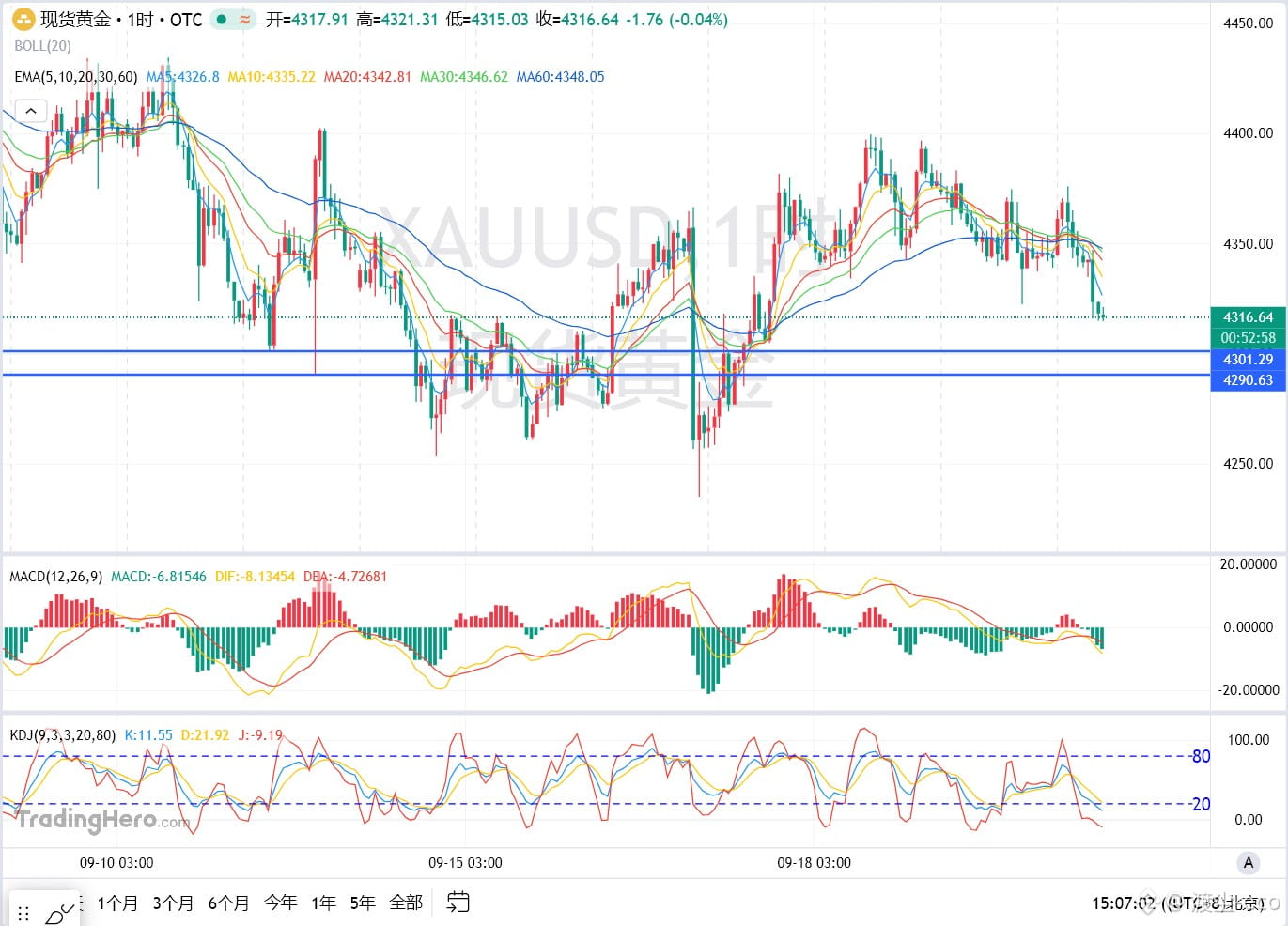
Today, after the Asian session opened, gold’s走势 was similar to yesterday’s Asian session. In the early part of the session, gold fell under pressure near $4,375. During the Asian session, it directly broke below yesterday’s range low. At present, the lowest point touched is around $4,315. Gold has entered a broader consolidation range. Today, focus on the European session price action. If the European session can continue the weak downward move, the downside space will open further. For intraday, watch the $4,300–$4,290 support area at the bottom.
In addition, the current market is not a one-way trend; it is in a consolidation, correction, and repair phase. What operations really test is sensitivity to shifts in long/short positioning as the行情 changes.
The above analysis is for reference only and does not constitute any investment advice. Financial markets are volatile; investing involves risk, and you should exercise caution when entering the market.#黄金 #伦敦金 $XAUT
After the U.S. Federal Reserve’s rate decision landed last week, gold first saw a sharp drop. As U.S. inflation eased and the market once again worried about recession risk, the gold price found some support at lower levels and quickly surged. However, as U.S. Treasury yields rose again, bullish momentum clearly weakened. Gold then repeatedly oscillated and washed within the range of $4,400 to $4,320.
Yesterday, after the Asian session opened, gold continued Friday’s downtrend. Then, during the European session, it moved slightly sideways. Before the U.S. session, I reminded you that the evening trading would be a choppy, range-bound行情. Before the U.S. session opened, gold made a modest rebound to around $4,375, then pulled back and quickly tested support around the $4,320 level. After that, it once again moved upward in a choppy pattern, and this morning, after the market opened, it tested the $4,375 resistance again.
Today, after the Asian session opened, gold’s走势 was similar to yesterday’s Asian session. In the early part of the session, gold fell under pressure near $4,375. During the Asian session, it directly broke below yesterday’s range low. At present, the lowest point touched is around $4,315. Gold has entered a broader consolidation range. Today, focus on the European session price action. If the European session can continue the weak downward move, the downside space will open further. For intraday, watch the $4,300–$4,290 support area at the bottom.
In addition, the current market is not a one-way trend; it is in a consolidation, correction, and repair phase. What operations really test is sensitivity to shifts in long/short positioning as the行情 changes.
The above analysis is for reference only and does not constitute any investment advice. Financial markets are volatile; investing involves risk, and you should exercise caution when entering the market.#黄金 #伦敦金 $XAUT