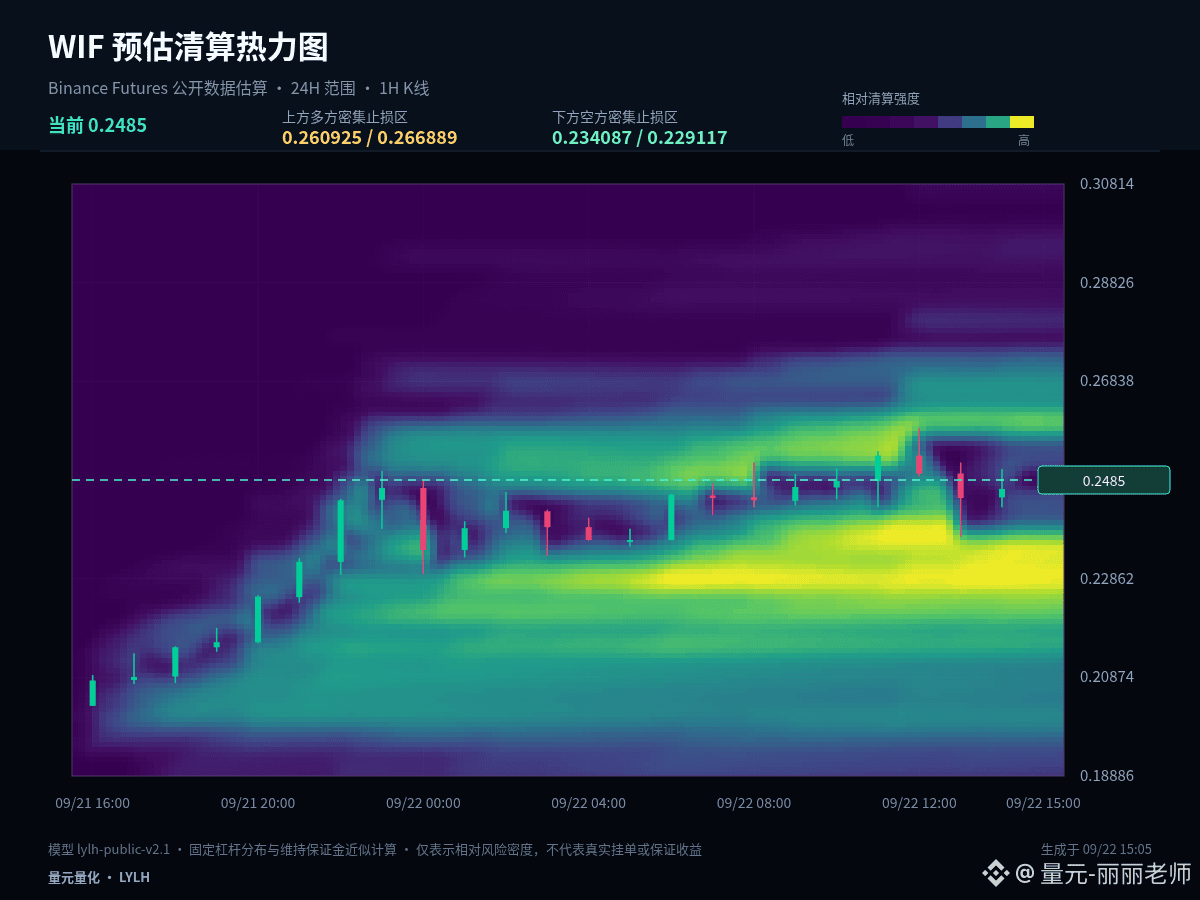
$WIF #WIF heat picks up before preparing to enter; more importantly, you first need to evaluate the position. The current 1-hour change is +0.65%, and the 24-hour change is +22.2%. The space that has already been run cannot be directly treated as the next segment’s replicable space.
$WIF #WIF is still repeatedly trading back and forth within the last-24-hours range, and there isn’t an obvious directional advantage. The middle zone tests patience the most; waiting for boundary/level signals is usually more effective.
The pace is more favorable for the longs: after returning to around 0.23095 and seeing selling pressure weaken, then try again for 0.2587. If it doesn’t pull back and instead accelerates upward, the risk-reward of chasing the price will decrease.
For the next path, handle it in three ways: if it moves up and effectively holds above 0.2587, wait for a pullback that doesn’t break before reassessing continuation; if it breaks down below 0.2032, prioritize controlling risk and waiting for new support; if it keeps oscillating around 0.23095, treat it as range trading and don’t repeatedly chase direction in the middle.
For those who already have positions, the key is to manage based on whether support fails, rather than being dragged along by every fluctuation. For those with no position, prioritize waiting for a breakout with a pullback, or support confirmation. Spot can be added in batches; for futures, shorten the decision chain—first fix the stop-loss level, then decide whether to participate.
Missing a segment of the行情 won’t directly cause losses; only chasing at the end of volatility without a plan will make your position passive. The focus in futures is not to predict every single candlestick, but to ensure that entry, reducing exposure, and exiting all have a rationale. Do less without confirmation; when a key level fails, redo the plan—control single-trade risk first, then talk about further upside space.
#AppleGoogleSeekStablecoinTokenizedDepositTalent
$WIF #WIF is still repeatedly trading back and forth within the last-24-hours range, and there isn’t an obvious directional advantage. The middle zone tests patience the most; waiting for boundary/level signals is usually more effective.
The pace is more favorable for the longs: after returning to around 0.23095 and seeing selling pressure weaken, then try again for 0.2587. If it doesn’t pull back and instead accelerates upward, the risk-reward of chasing the price will decrease.
For the next path, handle it in three ways: if it moves up and effectively holds above 0.2587, wait for a pullback that doesn’t break before reassessing continuation; if it breaks down below 0.2032, prioritize controlling risk and waiting for new support; if it keeps oscillating around 0.23095, treat it as range trading and don’t repeatedly chase direction in the middle.
For those who already have positions, the key is to manage based on whether support fails, rather than being dragged along by every fluctuation. For those with no position, prioritize waiting for a breakout with a pullback, or support confirmation. Spot can be added in batches; for futures, shorten the decision chain—first fix the stop-loss level, then decide whether to participate.
Missing a segment of the行情 won’t directly cause losses; only chasing at the end of volatility without a plan will make your position passive. The focus in futures is not to predict every single candlestick, but to ensure that entry, reducing exposure, and exiting all have a rationale. Do less without confirmation; when a key level fails, redo the plan—control single-trade risk first, then talk about further upside space.
#AppleGoogleSeekStablecoinTokenizedDepositTalent