

Many people, when trading, only look at profit and loss, and rarely calculate fees separately. If you look at a single trade, the fee might be only a few U, so you don’t really feel it. But the problem is that it doesn’t end after one charge—it happens every time you trade.
When your trading frequency is high, what’s really worth looking at isn’t “how much this one trade got deducted,” but how much you’ve been charged cumulatively over a month or even a year.
First, remember the simplest formula: trading volume × fee rate = fee.
The key isn’t how much money you have in your account, but how much trading volume you actually generate. For example: your account has only 1,000 U, but you frequently open and close positions—if your accumulated turnover in a month is 1,000,000 U, then the fees will ultimately be calculated based on that 1,000,000 U trading volume. This is why high-frequency traders especially need to pay attention to trading costs.
Let’s give a more intuitive example
For easier calculation, assume each time you open a position is a 10,000 U position size, and use a 0.05% fee rate as an example.
Opening a position: 10,000 × 0.05% = 5 U. Then when closing the position, if the position size is still about 10,000 U: another ~5 U.
That is, for one complete cycle of “open position + close position,” the fees are roughly: 10 U.
Once frequency increases, the gap shows up:
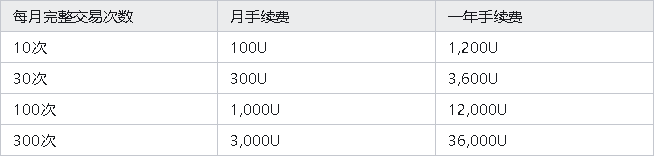
This is just a calculation example to illustrate the principle. In reality, the actual fee rates are influenced by factors like the platform, Maker/Taker, VIP level, and so on.
But it shows a very real problem: if the number of trades increases by 10x, and all other conditions stay the same, fees will basically increase by about 10x as well.
What’s even worse is that small-profit strategies are the easiest for fees to eat up.
For example, you place a trade with a position size of 10,000 U. You got the market direction right, and in the end you earned: 30 U.
It looks profitable. But if this round of opening and closing paid a total of 10 U in fees, then what you truly have left is: 30 - 10 = 20 U. That means one-third of the profit turns directly into trading costs.
What if this trade only earns 10 U?
After deducting fees, there may be basically little left. So for many high-frequency strategies, the real problem isn’t necessarily “you judged wrong”—it’s that per-trade profit is too thin to cover long-term trading costs.
Leverage will further amplify this issue
This is also where many beginners easily miscalculate.
For example, if your principal is only 1,000 U. After using 10x leverage, your actual position size may reach 10,000 U. Fees usually aren’t based on your 1,000 U principal, but on the value of the actual traded position.
Therefore: even if the principal doesn’t change, it doesn’t mean fees didn’t change. The larger the position size and the more frequent the trades, the greater the cumulative traded volume will be. That’s also why some accounts may appear to have not much capital, yet in a month they can generate tens of thousands to even millions of U in trading volume.
Maker and Taker widen the gap
Once trading frequency increases, even a slight difference in fee rates can become very noticeable when accumulated over the long term.
For example, just for demonstration: Maker fee rate: 0.02%; Taker fee rate: 0.05%.
If in a month you trade 1,000,000 U
All Maker: 1,000,000 × 0.02% = 200 U
All Taker: 1,000,000 × 0.05% = 500 U
With the same traded volume, the difference in one month can be: 300 U; and in one year: 3,600 U. So high-frequency traders should not only look at how much they’ve traded, but also check whether their trades are mostly Maker or mostly Taker.
Why do so many people feel like, “I didn’t lose that much, yet my balance keeps dropping”?
Sometimes the problem is right here. Today you open 5 times, tomorrow you open 10 times, and each trade’s fee looks insignificant. But after you add up the data for a month or even a year, what you see may not be dozens of U—it could be hundreds, thousands, or even more.
Moreover, besides trading fees, contract users may also incur other costs such as funding fees, slippage, and more.
So the true trading outcome should be viewed as: trading profit - fees - funding fees - costs like slippage = actual result. Not just whatever a single order shows as “profit.”
In the end
Trading frequency in itself is neither absolutely good nor bad. What really matters is: can your trading returns cover the extra costs added by high-frequency trading?
If a strategy makes a lot per trade and fees are a very small portion, the impact may be limited.
But if your pattern is inherently high-frequency, small-profit, and involves frequent entry and exit, then even if the fees are only a few tenths of a percent, the long-term accumulation may become a very important cost component in your strategy.
So for people who trade frequently, rather than only studying “which direction the next order will go,” it’s better to occasionally open your trading records and check: how much total volume did you trade this month? And how much total fees did you pay?
Sometimes, after calculating these two numbers, it’s more meaningful than researching how to make one more trade.