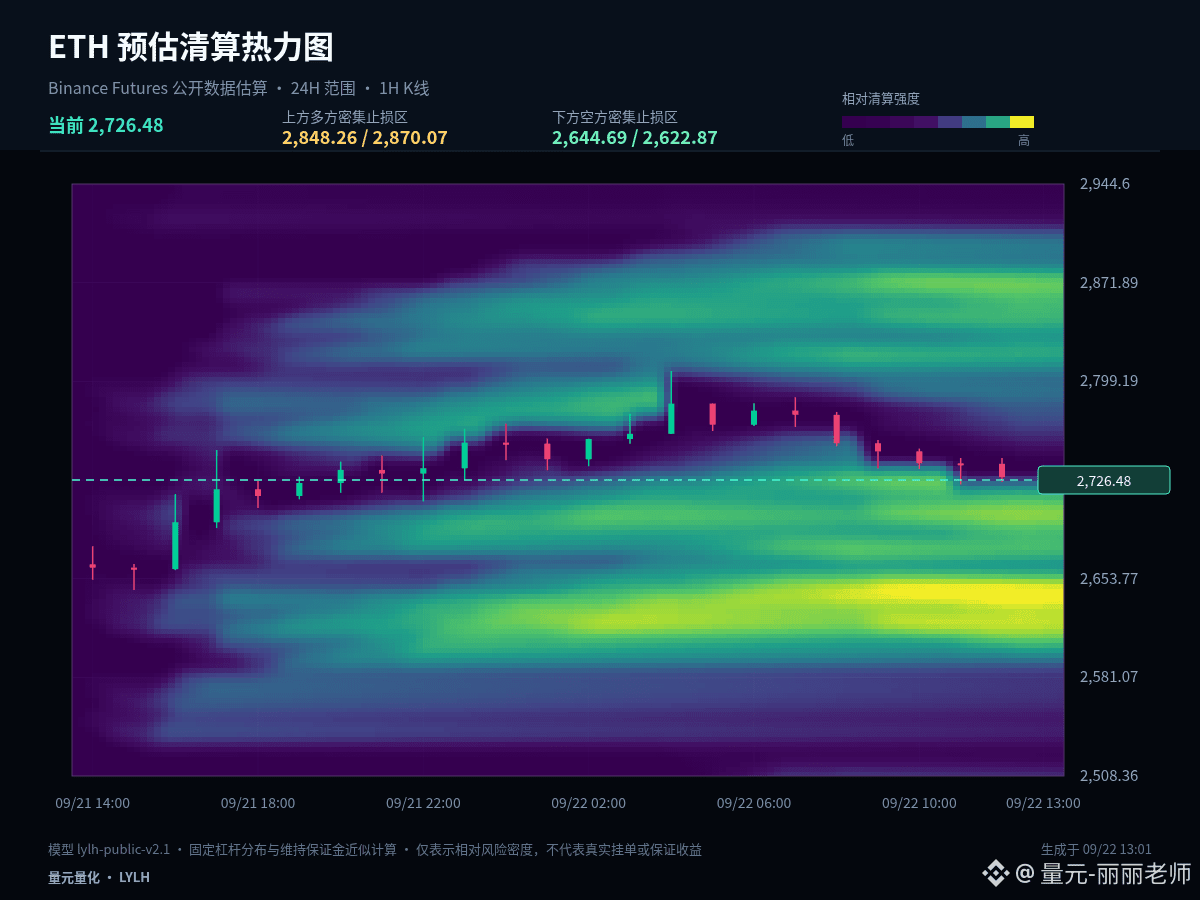
$ETH #ETH It currently looks more like a range with turnover—there’s no need to explain every 1-hour candlestick as a new trend. Current price: 2,727.01; 1-hour: -0.09%; 24-hour: +2.41%.
With the current 1-hour (-0.09%) and 24-hour (+2.41%), the two cycles have not formed a sufficiently clear alignment in the same direction. In a range market, the margin for chasing and cutting is lower. It’s more suitable to use the upper boundary confirmation for direction, and lower boundary confirmation for support/resumption; the midline should be treated only as the line dividing strength and weakness.
Upper boundary: 2,807.34; lower boundary: 2,646.58; midline: 2,726.96. Watch for breakout quality near the upper boundary; watch for support near the lower boundary. Around the midline, reduce frequent trading—because it isn’t far enough from either side, and both direction and risk-reward are not clear.
The signals truly worth acting on are: after a price breaks a boundary, it’s willing to stay within the new range; or after probing the boundary downward, it quickly snaps back. Without such confirmation, continue treating it as consolidation, and don’t change the overall plan due to brief intraday fluctuations.
For people who already hold positions, the focus is to manage based on whether support has failed—not to get dragged around by every move. For those with no position, prioritize waiting for a breakout with a retest, or for support confirmation. Spot can be scaled in batches; for futures/contracts, shorten the decision chain: decide the stop-loss level first, then decide whether to participate.
The key with contracts isn’t to predict every candlestick—it’s to ensure there’s a basis for entry, reducing exposure, and exiting. If there’s no confirmation, do less. If key levels fail, redo the plan: control single-trade risk first, then talk about further upside/downside potential.
#ECBStartsBlockchainEuroSettlement
With the current 1-hour (-0.09%) and 24-hour (+2.41%), the two cycles have not formed a sufficiently clear alignment in the same direction. In a range market, the margin for chasing and cutting is lower. It’s more suitable to use the upper boundary confirmation for direction, and lower boundary confirmation for support/resumption; the midline should be treated only as the line dividing strength and weakness.
Upper boundary: 2,807.34; lower boundary: 2,646.58; midline: 2,726.96. Watch for breakout quality near the upper boundary; watch for support near the lower boundary. Around the midline, reduce frequent trading—because it isn’t far enough from either side, and both direction and risk-reward are not clear.
The signals truly worth acting on are: after a price breaks a boundary, it’s willing to stay within the new range; or after probing the boundary downward, it quickly snaps back. Without such confirmation, continue treating it as consolidation, and don’t change the overall plan due to brief intraday fluctuations.
For people who already hold positions, the focus is to manage based on whether support has failed—not to get dragged around by every move. For those with no position, prioritize waiting for a breakout with a retest, or for support confirmation. Spot can be scaled in batches; for futures/contracts, shorten the decision chain: decide the stop-loss level first, then decide whether to participate.
The key with contracts isn’t to predict every candlestick—it’s to ensure there’s a basis for entry, reducing exposure, and exiting. If there’s no confirmation, do less. If key levels fail, redo the plan: control single-trade risk first, then talk about further upside/downside potential.
#ECBStartsBlockchainEuroSettlement