


Author: Gemini, Deep Tide TechFlow
More often than not, our reaction to the crypto market is that price charts lead, and the rationale comes afterward.
After prices rise, everyone starts talking about a project’s fundamentals and shining points, believing that some factor drove the rally; and the most popular point this year is clearly revenue.
Over the past year, the market has started to worship the “protocol revenue” metric, trying to value crypto assets using the P/E logic of traditional finance.
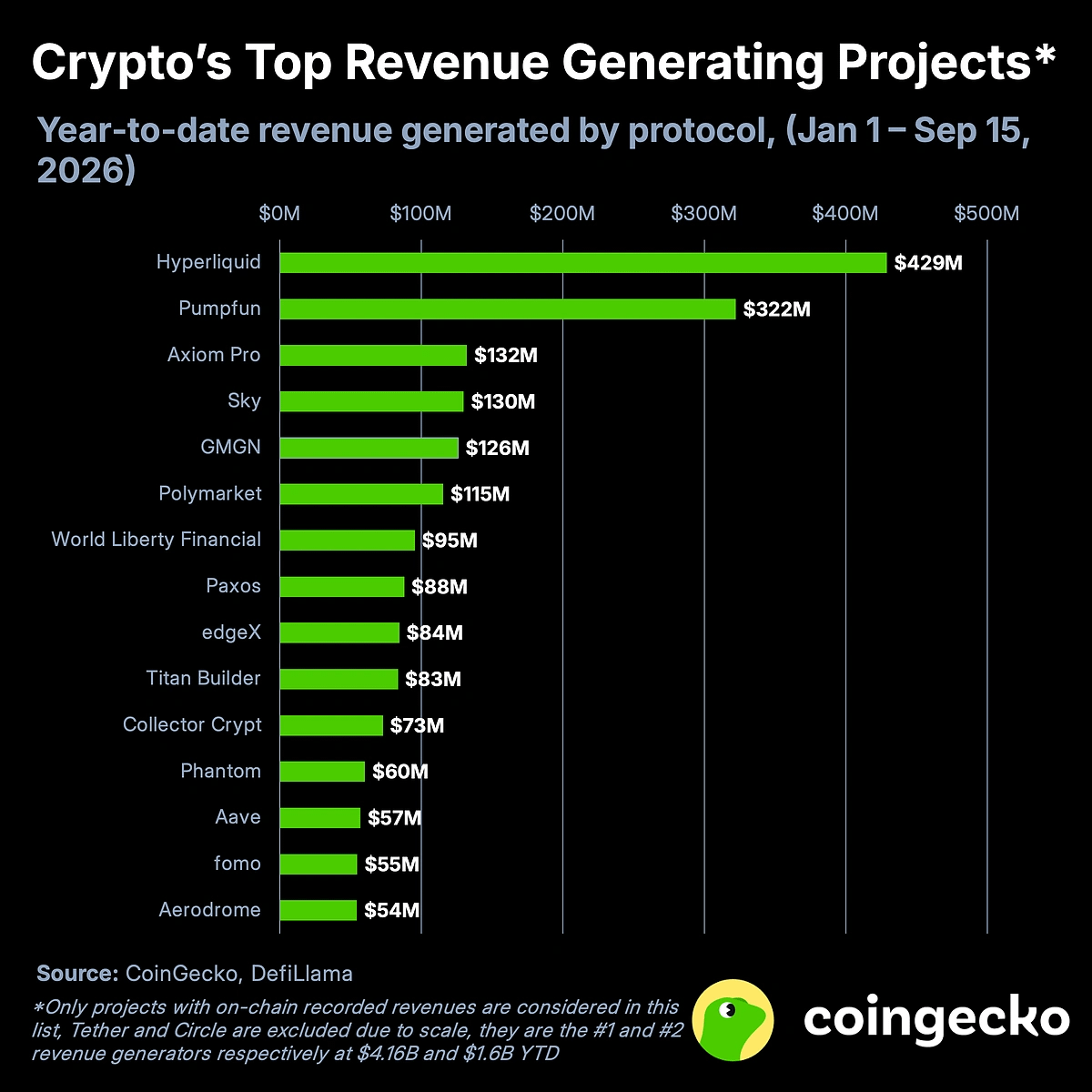
A 2026 revenue ranking released by CoinGecko reveals a highly tempting figure: in the first eight and a half months of this year, non-stablecoin issuers in the crypto market generated a total of $3.4 billion in revenue, with the top fifteen taking 56%.
However, if you put these protocols’ astonishing revenues alongside the token prices from the same period, you’ll find a harsh truth: the protocols are raking in huge profits, while some token holders in the secondary market may be experiencing an endless grind down.
The data at the very top of the rankings proves that, in a crypto market driven by existing balances and positional competition, there are only two kinds of strong, real demand:
Leverage trading and extreme speculation.
Hyperliquid and Pump.fun take the top two spots with annual revenues of USD 429 million and USD 322 million, respectively. Together, the two absorb 22.1% of total revenue across the entire network.
But the most Alpha-worthy findings on the leaderboard are not the underlying protocols themselves—rather, Axiom Pro (USD 132 million) and GMGN (USD 126 million), ranked third and fifth.
These two projects are not traditional on-chain smart contracts at all—they are trading terminals. Axiom Pro relies on integrating with Hyperliquid to provide convenient derivatives trading, while GMGN relies on cutting into users via the Memecoin hype on Pump.fun and Robinhood.
In today’s crypto market, value capture has become painfully obvious. “Fat frontend” players are directly taking users’ real trading fees, and their ability to attract liquidity from traffic sources has already surpassed most of the long-established DeFi protocols.
Why is half of the projects on the leaderboard “none of your business”?
When you try to “buy an income-generating protocol,” you must realize that among the top fifteen projects on the leaderboard, nearly half have no underlying assets that can actually absorb these revenue expectations—or their revenue structure has no meaningful link to on-chain tokens at all.
For example, Paxos (USD 87.93 million) ranked eighth and World Liberty Financial (USD 95.37 million) ranked seventh. Their massive revenues are essentially “off-chain asset interest spreads,” meaning they profit from the interest on real-world assets. This net profit belongs to the issuing entity, and on-chain token holders have no right to receive dividends. Similarly, Phantom (wallet, ranked 12) and Titan Builder (MEV, ranked 10) have excellent cash-flow business models. They don’t need to raise funds by issuing tokens, so there’s naturally no mechanism for secondary-market token prices to price in those revenues.
Valuation traps: a double squeeze from value capture and FDV
For projects that have truly issued tokens, the level of revenue is not the only yardstick that determines the token price.
Compared to the data since the beginning of the year, HYPE has surged by about 218%, and PUMP is also up about 83.6%. But Sky (nearly USD 130 million in revenue), another top-tier project on the list, is only up slightly by 0.8% over the same period; Aave (USD 56.81 million in revenue) is down 17.8%; and World Liberty Financial’s WLFI has even crashed by more than 61%.
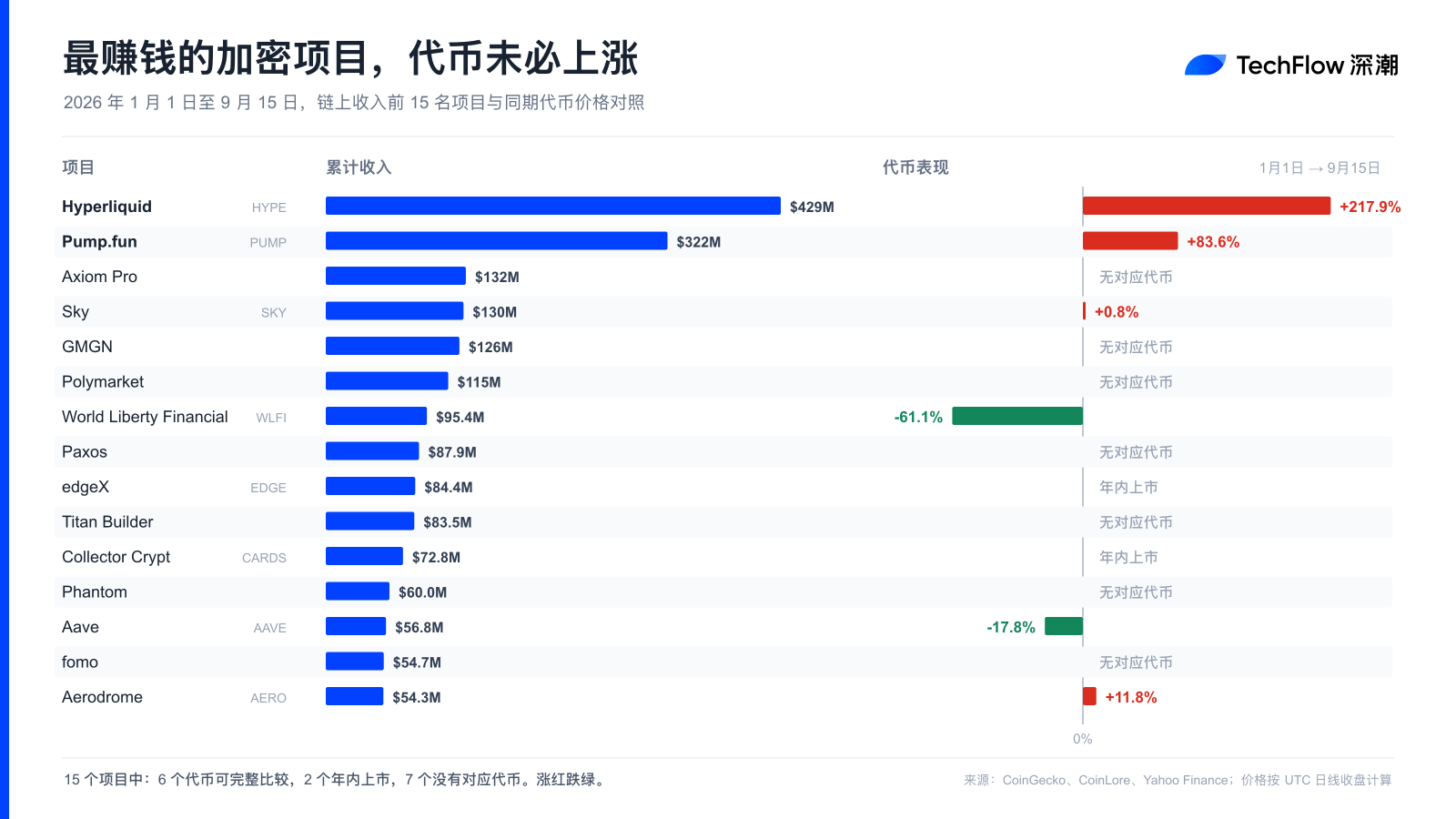
This divergence stems from a break in “value capture.” Protocol fees are one thing; where that money flows is another. If tens of millions of dollars in revenue all settle into the project team’s treasury and don’t get converted into real buy pressure through buybacks, burns, or distributions to stakers, then this revenue provides no real support for the token price.
Moreover, many high-revenue projects are in a high-inflation phase, releasing massive unlock supply in the secondary market at very high fully diluted valuation (FDV). When the constant new sell pressure far outweighs the buyback demand generated by revenue, the reported dollar income is simply powerless to prevent price declines.
So don’t blindly worship “protocol revenue” on a data dashboard. Before traders back high-revenue protocols, they should not only look at how much they earned, but also how that money is earned—and most importantly, whether this money is distributed to token holders.