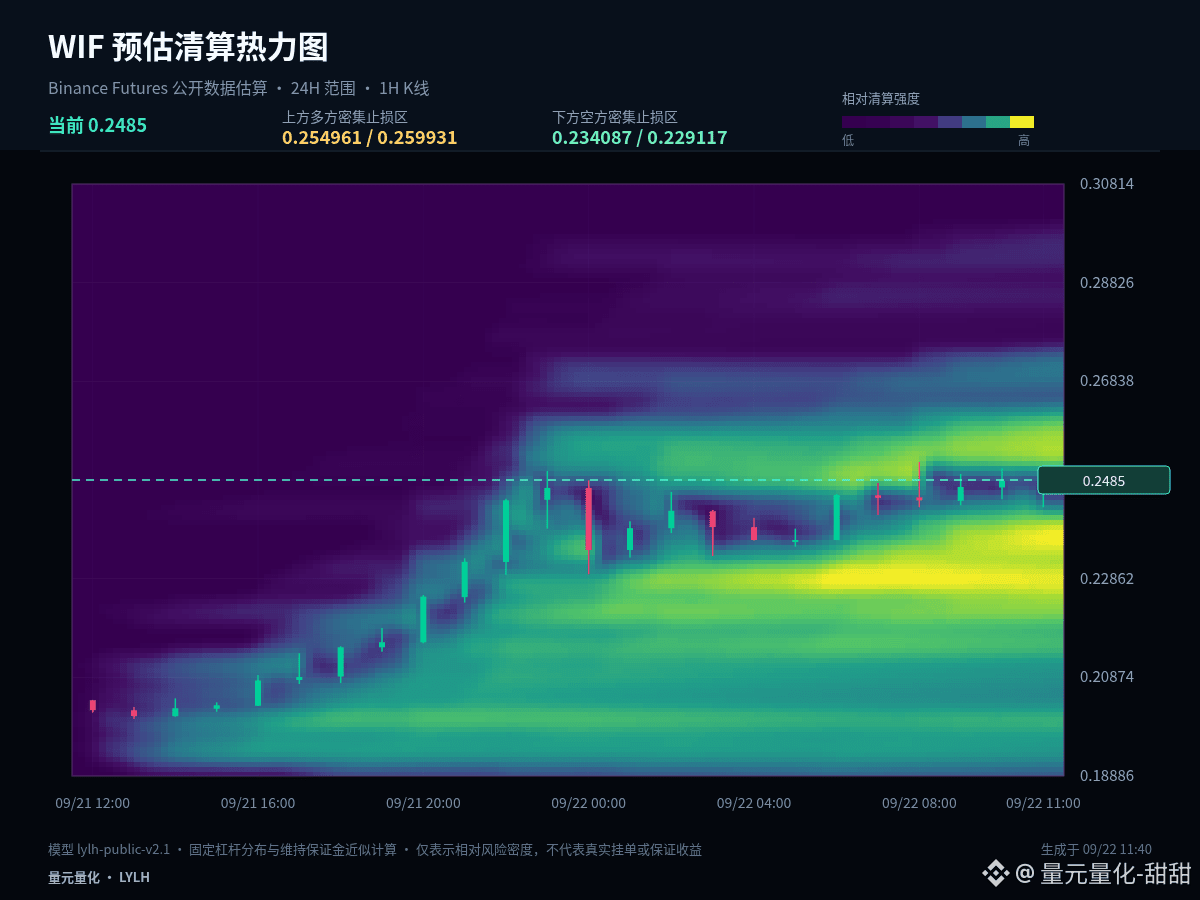
$WIF #WIF It’s only after the momentum heats up that you prepare to enter, and you first need to assess the position. Current performance: +0.04% over the last 1 hour, +21.9% over the last 24 hours. The space that has already been covered can’t be directly treated as the next segment that can be copied again.
$WIF #WIF It’s once again approaching the high of the past 24 hours. The closer you are to the pressure zone, the more important the closing price and the subsequent pullback are. A breakout during the session doesn’t by itself mean it has stabilized.
For the bulls, the more favorable rhythm is: return to around 0.22645, let selling pressure weaken, and then attempt 0.2522 again. If you don’t pull back and instead accelerate, the risk-reward ratio of chasing prices declines.
In execution, set clear conditions: after breaking above 0.2522, you need confirmation—not just seeing a sudden spike and chasing. If it dips to 0.2007, you need to see whether it can quickly reclaim—not just reacting to the first drop. If the mid-range offers insufficient odds, waiting itself is also part of the strategy.
For those who already hold a position, the focus is managing based on whether support has truly failed, rather than being carried along by every fluctuation. For those with no position, prioritize waiting for a breakout-and-retest or support confirmation. Spot positions can be built in batches; for contracts, shorten the decision chain—first determine the stop-loss level, then decide whether to participate.
Missing one segment of the market doesn’t automatically mean a loss. It’s the lack of a plan and chasing at the tail end of volatility that makes positions passive. Risk control should still be placed before the conclusion: execute only when conditions are met, reassess promptly when price invalidates. The larger the volatility, the more restrained you should be with single-position sizing. The above is a scenario walkthrough based on current 1-hour and 24-hour data, and does not constitute a promise of returns.
#AppleGoogleSeekStablecoinTokenizedDepositTalent
$WIF #WIF It’s once again approaching the high of the past 24 hours. The closer you are to the pressure zone, the more important the closing price and the subsequent pullback are. A breakout during the session doesn’t by itself mean it has stabilized.
For the bulls, the more favorable rhythm is: return to around 0.22645, let selling pressure weaken, and then attempt 0.2522 again. If you don’t pull back and instead accelerate, the risk-reward ratio of chasing prices declines.
In execution, set clear conditions: after breaking above 0.2522, you need confirmation—not just seeing a sudden spike and chasing. If it dips to 0.2007, you need to see whether it can quickly reclaim—not just reacting to the first drop. If the mid-range offers insufficient odds, waiting itself is also part of the strategy.
For those who already hold a position, the focus is managing based on whether support has truly failed, rather than being carried along by every fluctuation. For those with no position, prioritize waiting for a breakout-and-retest or support confirmation. Spot positions can be built in batches; for contracts, shorten the decision chain—first determine the stop-loss level, then decide whether to participate.
Missing one segment of the market doesn’t automatically mean a loss. It’s the lack of a plan and chasing at the tail end of volatility that makes positions passive. Risk control should still be placed before the conclusion: execute only when conditions are met, reassess promptly when price invalidates. The larger the volatility, the more restrained you should be with single-position sizing. The above is a scenario walkthrough based on current 1-hour and 24-hour data, and does not constitute a promise of returns.
#AppleGoogleSeekStablecoinTokenizedDepositTalent