


Original | Odaily Planet Daily (@OdailyChina)
By Azuma (@azuma_eth)

With the U.S. Securities and Exchange Commission (SEC) formally issuing the relevant exemption documents, asset tokenization has become the most conspicuous main line in this round of crypto market recovery.
Over the past few years, traditional financial assets—from U.S. Treasuries and funds to stocks—have increasingly been moved onto the blockchain. Meanwhile, Ondo, backed by an earlier strategic layout and a faster execution pace, quickly secured a leading position on the track. However, just as Ondo’s bet on its chosen direction began to take off, the project suddenly ran into a problem that was completely out of the business plan—its founder unexpectedly passed away, and the ensuing battle over control of the founder’s estate is gradually evolving into a complex dispute involving corporate governance, family members, and even courts across state lines.
The story begins in May of this year.
Founder dies suddenly; De Bode takes over as CEO
This May, Ondo founder Nathan Allman unexpectedly and unexpectedly passed away at the age of just 32.
At the time of Nathan’s death, he was not only Ondo’s founder and CEO, but also the company’s only director and controlling shareholder. His sudden passing left Ondo with a very direct question—who would take over the company?
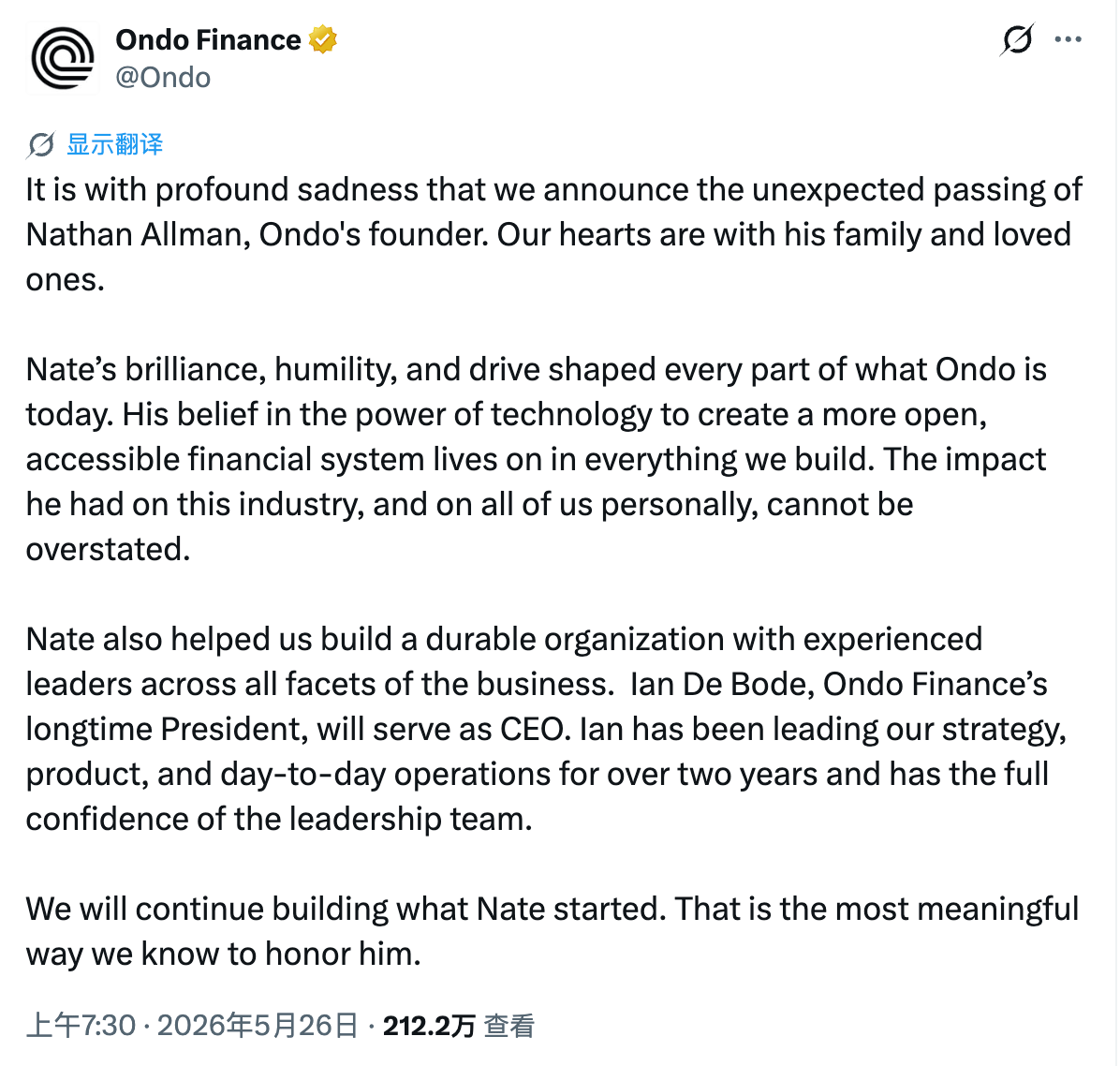
On May 26, Ondo’s official statement confirmed Nathan’s death and announced that Ian De Bode, who had long served as president, would take over as CEO. The company’s wording at the time was quite explicit: De Bode had been responsible for the company’s strategy, products, and day-to-day operations for the past two years and had earned the full trust of the management team, who would lead Ondo to continue advancing Nathan’s legacy.
From the company’s operational perspective, this appears to be a smooth management transition. The problem, however, is that while a CEO can be replaced, the founder’s equity cannot be passed on through a mere company announcement—and that founder equity is precisely the key to the company’s long-term stable operations.
More importantly, Nathan’s death was so sudden that he left no will outlining plans for the aftermath.
Parents’ involvement begins the battle for control
After Nathan’s death, the court ruled that his mother, Kathleen Allman, and his father, Lawrence Allman, were the legal heirs. According to subsequent lawsuit filings, Nathan’s estate includes his controlling interests in Ondo, as well as a large number of ONDO tokens—some already unlocked and some that will be unlocked gradually over the next several years.
In June, the Hawaii court appointed Kathleen as the personal representative of Nathan’s estate. Shortly afterward, she began to get involved in Ondo’s corporate governance.
The parties’ conflict quickly became public. In July, Kathleen announced that she would reorganize Ondo’s board as a shareholder and appointed herself as the company’s chair and interim CEO, while also trying to remove De Bode from his related positions. Tahnee Towill, Nathan’s sister, was also appointed to the board by Kathleen.
Kathleen then filed a lawsuit in the Delaware Court of Chancery, alleging that De Bode, after Nathan’s death, assumed the role of CEO without valid board authorization and attempted to further consolidate her own control.
One point of dispute involves the compensation package and equity incentives De Bode received after Nathan’s death. According to the lawsuit filings from Kathleen’s side, the package includes a $900,000 annual salary and bonus, a $1 million signing bonus, and 26 million restricted ONDO tokens, for a total value of more than $11 million. Kathleen’s side argues that the arrangements are invalid and asks the court to confirm that the appointments and award arrangements have no legal effect.
De Bode denies the related allegations and says Kathleen’s lawsuit lacks any basis, while also stating that the company has received support from major stakeholders and investors.
By this point, what was originally intended to be a routine management handover had formally turned into a fight for control of the company.
De Bode strikes back; a “mole” appears within the family
Things were already complicated, but in September a new twist emerged in the struggle. De Bode also recruited an unexpected “ally.”
On September 16, Lani Clinton, Nathan’s half-sister (same mother, different father), and Ondo’s early investor David Chen (previously proposed for the board by De Bode) jointly applied to the Hawaii court, seeking to impose a limited guardianship over the portion of Nathan’s estate inherited by Kathleen.
In the petition, Lani raised a series of allegations about her mother Kathleen’s cognitive capacity, long-term alcohol use, and financial management behavior, and argued that Kathleen may no longer be able to properly manage this portion of the estate. In addition to claiming that her mother had a decades-long history of “pathological alcoholism,” Lani also asked the court to obtain her mother’s medical records and conduct an assessment for dementia.
The petition also mentioned Kathleen’s lavish lifestyle over the long term, including that she had purchased—or attempted to purchase—a Zeelander yacht worth about $4 million in Florida; traveling by private jet; requesting that Ondo reimburse a six-figure expense for a flight from Hawaii to California; staying at luxury accommodations costing about $4,000 per night...
Chen also disclosed a text message from Kathleen. Just nine days after her son died, Kathleen had tried to get money from the company: “Hi, I believe everything will work out over time, but what I’m most concerned about right now is cash flow, liquidity! The sooner the better! For example, I currently have a $200,000 invoice from a Newport pool builder. I really want to buy that… yacht and things like that.”
Because the estate represented by Kathleen includes Ondo’s controlling interests and a large number of ONDO tokens, these allegations ultimately also directly relate to Ondo’s control.
It should be emphasized that the statements above are currently one-sided allegations in the lawsuit and not facts that have been found by the court. Kathleen’s side currently denies the related allegations, saying there is no factual basis for them. Kathleen also believes that this lawsuit is merely a further move by De Bode’s camp in the battle for company control—De Bode and Chen are colluding to replace her with a more compliant trustee.
So a corporate governance dispute that originally revolved around the CEO appointment began to turn into two legal battle lines intertwined with each other: on one side, the fight over control of Ondo in Delaware; on the other, a dispute in Hawaii over management rights of Nathan’s estate… and in truth, both sides are fighting over the same core asset—the Ondo equity and token interests Nathan left behind.
The fight is not over yet; hope the project is doing well
To date, this fight has not ended. According to a court order in early September, De Bode continues to serve as Ondo’s acting CEO and retains a seat on the board; a new lawsuit that appeared in mid-September further made the dispute within the Allman family even more public.
Ondo continues to move forward with its asset tokenization business. More and more traditional assets—such as U.S. Treasury securities, funds, and stocks—are entering the blockchain, and the industry itself is still developing rapidly.
For a project at the forefront of this sector, however, the founder’s sudden death has already had far more impact than just a management reshuffle. Company control, inheritance of an estate, and family relationships are all intertwined, and there is no clear answer yet where it will ultimately lead. But for all ONDO token holders, it’s obvious that we would not want to see a great project that is rapidly developing get slowed down by this unexpected estate battle.