GitHub has recently suddenly gone viral with a pretty interesting AI Browser Agent.
Its name is Jev Ultrafast.
The project only appeared on September 16, and within about 15 hours it had fewer than 1,000 Stars.
A few days later:
9/16: under 1,000 Stars
↓
9/21: about 6,800
↓
Now: over 10,000 Stars
In just 6 days, the growth rate is extremely outrageous.
But what’s really worth paying attention to isn’t its GitHub Stars—it’s the very different choice it made for an AI Browser Agent.
Right now, most AI Browser Agents operate web pages in roughly this way:
Take a screenshot
→ AI looks at the screen
→ Find buttons
→ Click
→ Take another screenshot
→ Judge the next step again
This approach is intuitive, but it also means a lot of visual processing, model reasoning, and operational cost.
Jev thinks differently.
It doesn’t need the AI to keep “watching the screen.” Instead, it directly organizes the webpage DOM and interactive elements into a structured Action Space.
What the model sees is more like:
Button A
Input field B
Option C
Then it only needs to decide what action to execute next.
The LLM is called only when text actually needs to be generated.
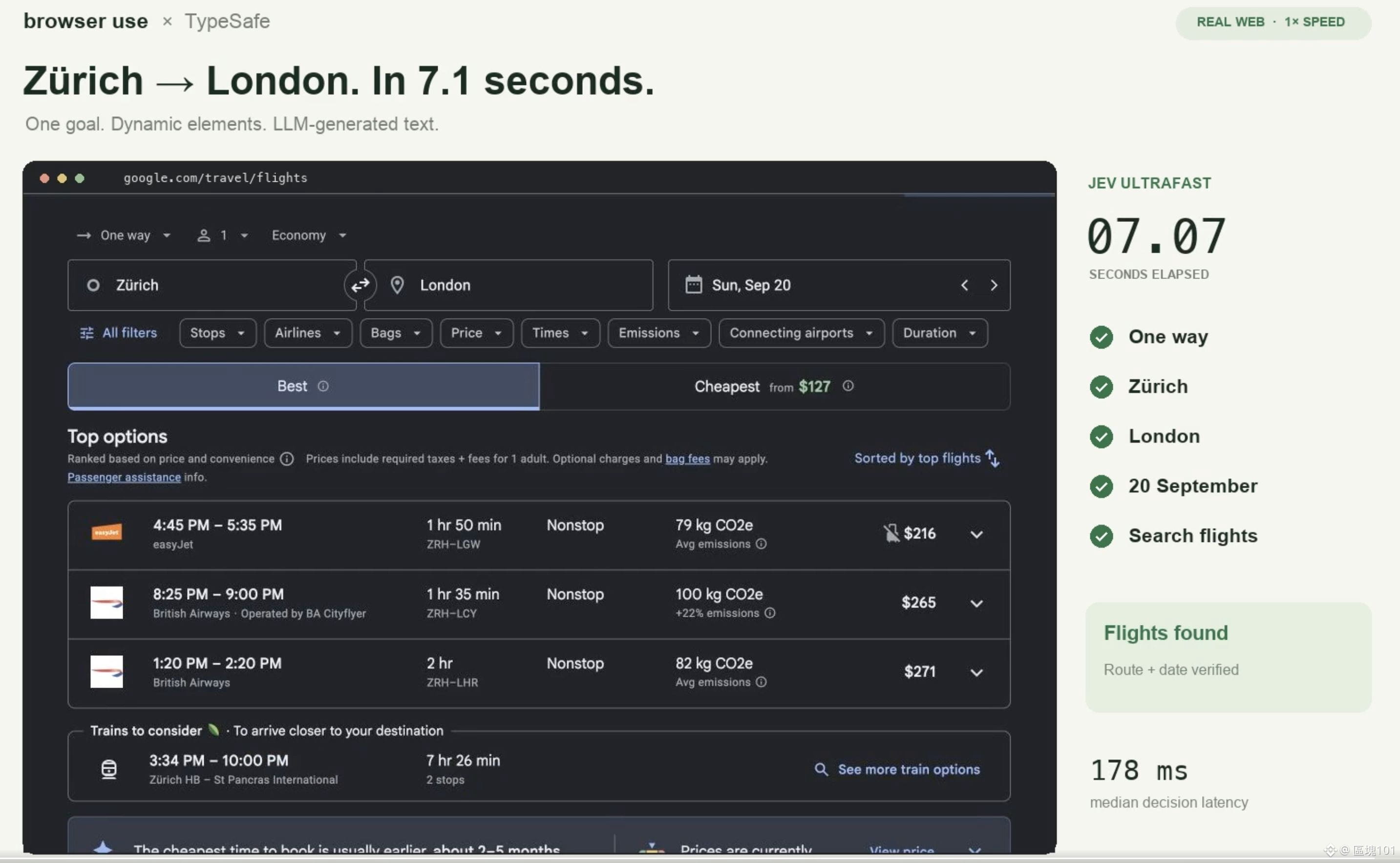
In an official demo—Google Flights —the search from Zurich to London completes in about 7.1 seconds.
The official published tests also show that for some tasks, the browser protocol calls can be reduced significantly.
This is what makes me find it so interesting.
In the past, whenever people talked about AI Agents, almost all the attention went to:
Is the model smarter?
But after deploying agents at scale, another question may be even more important:
When completing a task, how many times does the model need to reason, how many Tokens, how many seconds, and how much money?
If a Browser Agent can do the same work with fewer “looks” and fewer “thoughts,”
then the next round of Agent competition might not be just about Intelligence.
It’s about:
Efficiency.
Its name is Jev Ultrafast.
The project only appeared on September 16, and within about 15 hours it had fewer than 1,000 Stars.
A few days later:
9/16: under 1,000 Stars
↓
9/21: about 6,800
↓
Now: over 10,000 Stars
In just 6 days, the growth rate is extremely outrageous.
But what’s really worth paying attention to isn’t its GitHub Stars—it’s the very different choice it made for an AI Browser Agent.
Right now, most AI Browser Agents operate web pages in roughly this way:
Take a screenshot
→ AI looks at the screen
→ Find buttons
→ Click
→ Take another screenshot
→ Judge the next step again
This approach is intuitive, but it also means a lot of visual processing, model reasoning, and operational cost.
Jev thinks differently.
It doesn’t need the AI to keep “watching the screen.” Instead, it directly organizes the webpage DOM and interactive elements into a structured Action Space.
What the model sees is more like:
Button A
Input field B
Option C
Then it only needs to decide what action to execute next.
The LLM is called only when text actually needs to be generated.
In an official demo—Google Flights —the search from Zurich to London completes in about 7.1 seconds.
The official published tests also show that for some tasks, the browser protocol calls can be reduced significantly.
This is what makes me find it so interesting.
In the past, whenever people talked about AI Agents, almost all the attention went to:
Is the model smarter?
But after deploying agents at scale, another question may be even more important:
When completing a task, how many times does the model need to reason, how many Tokens, how many seconds, and how much money?
If a Browser Agent can do the same work with fewer “looks” and fewer “thoughts,”
then the next round of Agent competition might not be just about Intelligence.
It’s about:
Efficiency.