Forex 101 · Day 3: Spread — the hidden cost you pay every time you open a trade
In the first two days, we covered pips and currency pair quotes. Today we’ll break down the piece that new traders most easily overlook: the spread.
One-sentence definition:
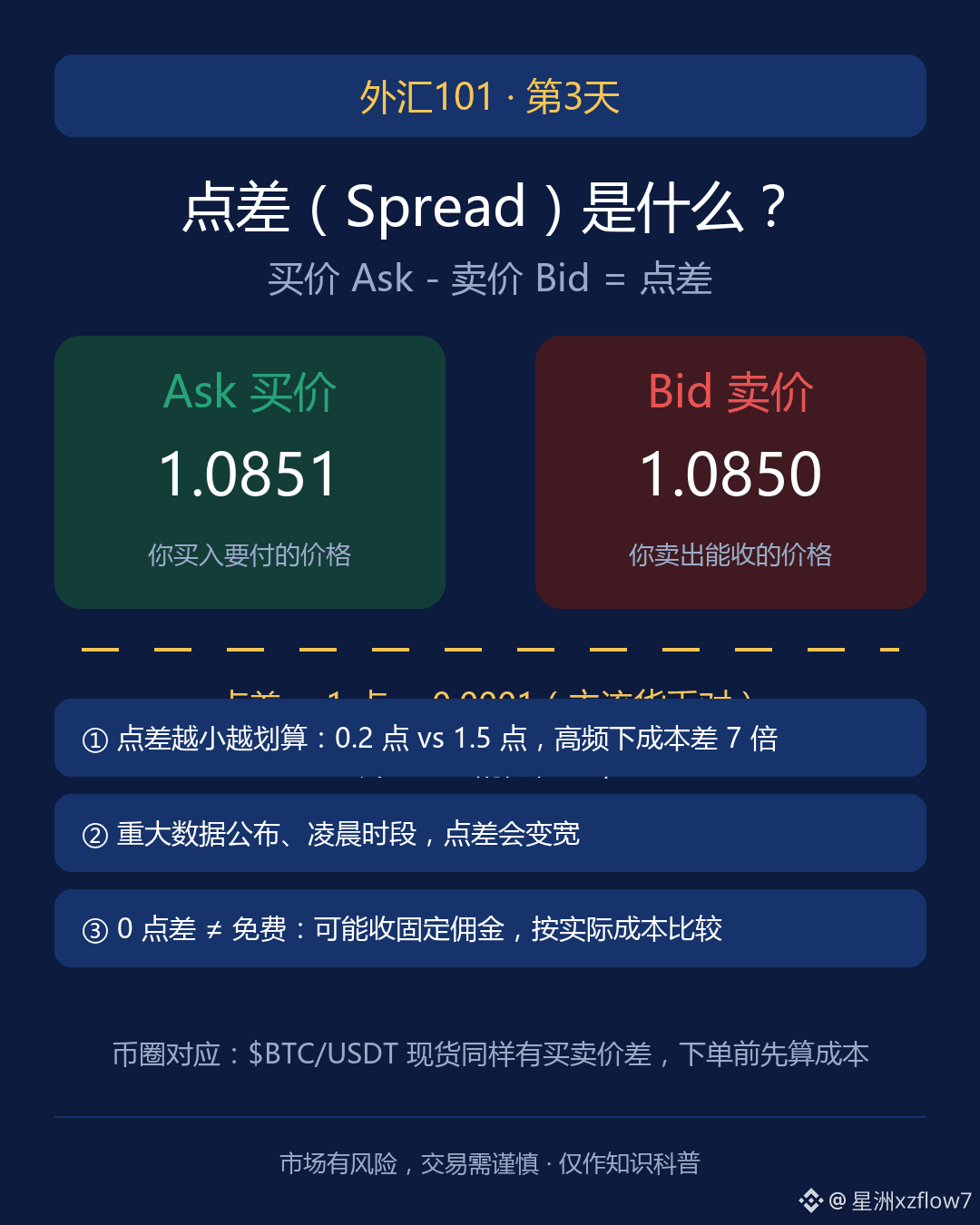
Spread = Ask price − Bid price.
For an EUR/USD quote of 1.0850 / 1.0851, the spread is 1 pip (0.0001). For major currency pairs, the spread is commonly 1–3 pips.
Why does it matter?
The spread is a cost created the instant you open a position—you haven’t made any profit yet, and it already takes a chunk out of your account. With the same strategy, a 0.2-pip account versus a 1.5-pip account can differ by several times in cost after high-frequency trading.
Three things to remember:
① The smaller the spread, the better: Major pairs are usually 1–3 pips; less-traded (minor) currencies often have wider spreads. Don’t only look at the exchange rate—calculate cost.
② During major data releases, the handover between Europe and the U.S., and in the early-morning hours, spreads widen—so opening trades costs you more.
③ Don’t get too excited about “0 spread”: Many brokers switch to fixed commission fees. You need to check the total bill—0 spread ≠ free.
Quick note about crypto: The BTC/USDT spot market also has a bid/ask spread (the gap between Bid and Ask). Before you place an order, weigh the implicit cost.
Title alternatives (5 angles):
1. Question-based: Why can spreads on the same platform be so different?
2. Reveal-based: Every time you open a trade, you first lose the money from this spread
3. Value-based: 0.2 pip vs 1.5 pips — a 7x difference in high-frequency trading costs
4. Controversial: Are “0 spread” accounts really free?
5. Suspense-based: Why does the spread suddenly widen right after major news hits?
Tomorrow we’ll cover: Trade direction — going long or going short. If your direction is wrong, the spread loss accelerates.
What do you think? Let’s chat in the comments.
井外汇 井Forex 井Exness 井点差 井基础知识
In the first two days, we covered pips and currency pair quotes. Today we’ll break down the piece that new traders most easily overlook: the spread.
One-sentence definition:
Spread = Ask price − Bid price.
For an EUR/USD quote of 1.0850 / 1.0851, the spread is 1 pip (0.0001). For major currency pairs, the spread is commonly 1–3 pips.
Why does it matter?
The spread is a cost created the instant you open a position—you haven’t made any profit yet, and it already takes a chunk out of your account. With the same strategy, a 0.2-pip account versus a 1.5-pip account can differ by several times in cost after high-frequency trading.
Three things to remember:
① The smaller the spread, the better: Major pairs are usually 1–3 pips; less-traded (minor) currencies often have wider spreads. Don’t only look at the exchange rate—calculate cost.
② During major data releases, the handover between Europe and the U.S., and in the early-morning hours, spreads widen—so opening trades costs you more.
③ Don’t get too excited about “0 spread”: Many brokers switch to fixed commission fees. You need to check the total bill—0 spread ≠ free.
Quick note about crypto: The BTC/USDT spot market also has a bid/ask spread (the gap between Bid and Ask). Before you place an order, weigh the implicit cost.
Title alternatives (5 angles):
1. Question-based: Why can spreads on the same platform be so different?
2. Reveal-based: Every time you open a trade, you first lose the money from this spread
3. Value-based: 0.2 pip vs 1.5 pips — a 7x difference in high-frequency trading costs
4. Controversial: Are “0 spread” accounts really free?
5. Suspense-based: Why does the spread suddenly widen right after major news hits?
Tomorrow we’ll cover: Trade direction — going long or going short. If your direction is wrong, the spread loss accelerates.
What do you think? Let’s chat in the comments.
井外汇 井Forex 井Exness 井点差 井基础知识