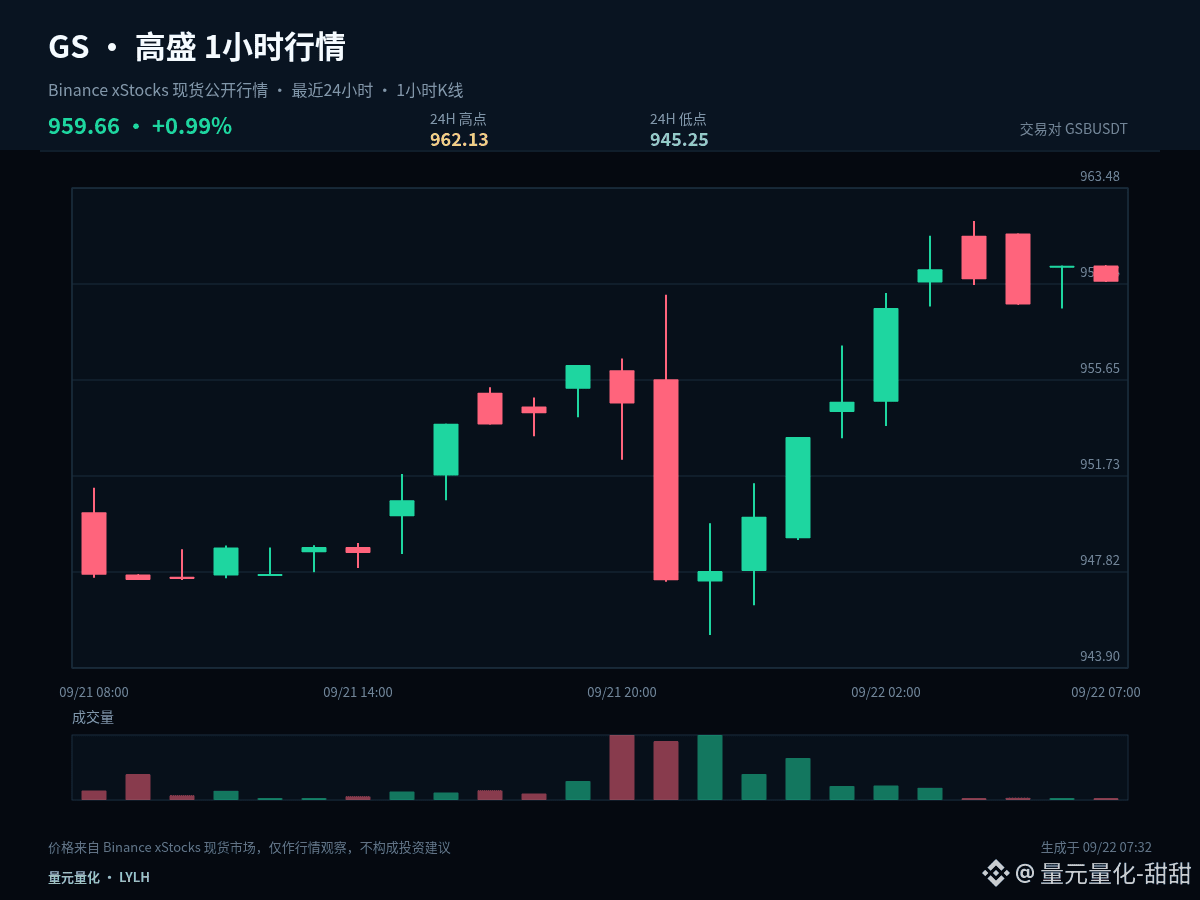
$GSB #GS Current price 959.66, 1 hour -0.07%, 24 hours +1.01%. Rather than deciding long or short first, list the possible paths and the corresponding actions clearly.
The current price is close to the upper band of the last 24 hours’ range: 1 hour -0.07%, 24 hours +1.01%. The most important thing at the high end is to confirm the market’s acceptance after a breakout. If price can stay above the upper band, it indicates the market is recognizing a higher range; if it only briefly pierces and then quickly reclaims, you need to guard against a false breakout.
The first scenario is upward: price needs to break above 962.13 and form a stable close above it, then only a valid confirmation occurs if a pullback does not break it. The second scenario is downward: once 945.25 is lost and any rebound cannot be recovered, it suggests insufficient support; you should prioritize defense rather than rushing to add to your position.
If price continues to hover between 962.13 and 945.25, 953.69 should be treated only as a short-term discretionary reference for control. There is no clear advantage in the middle of the range—don’t force an entry just to feel involved; wait for the market to show direction.
Position management must distinguish between swing (medium-term) and day-trade (short-term). For existing swing positions, first assess whether the structure is broken—don’t let repeated fluctuations of a single 1-hour candlestick repeatedly influence you. Short-term positions should be executed around support, resistance, and confirmation by closes. If you’re currently flat, there’s no need to chase price in the middle of the range; waiting for a clearer location is usually more advantageous.
A trading plan must include invalidation conditions. If your judgment is correct, you can realize profits in stages; if your judgment is wrong, you must be allowed to exit. Don’t use averaging-in (adding positions) to conceal that the original logic has already changed. The market will update, and your viewpoint should adjust according to the price evidence.
#ECBStartsBlockchainEuroSettlement
The current price is close to the upper band of the last 24 hours’ range: 1 hour -0.07%, 24 hours +1.01%. The most important thing at the high end is to confirm the market’s acceptance after a breakout. If price can stay above the upper band, it indicates the market is recognizing a higher range; if it only briefly pierces and then quickly reclaims, you need to guard against a false breakout.
The first scenario is upward: price needs to break above 962.13 and form a stable close above it, then only a valid confirmation occurs if a pullback does not break it. The second scenario is downward: once 945.25 is lost and any rebound cannot be recovered, it suggests insufficient support; you should prioritize defense rather than rushing to add to your position.
If price continues to hover between 962.13 and 945.25, 953.69 should be treated only as a short-term discretionary reference for control. There is no clear advantage in the middle of the range—don’t force an entry just to feel involved; wait for the market to show direction.
Position management must distinguish between swing (medium-term) and day-trade (short-term). For existing swing positions, first assess whether the structure is broken—don’t let repeated fluctuations of a single 1-hour candlestick repeatedly influence you. Short-term positions should be executed around support, resistance, and confirmation by closes. If you’re currently flat, there’s no need to chase price in the middle of the range; waiting for a clearer location is usually more advantageous.
A trading plan must include invalidation conditions. If your judgment is correct, you can realize profits in stages; if your judgment is wrong, you must be allowed to exit. Don’t use averaging-in (adding positions) to conceal that the original logic has already changed. The market will update, and your viewpoint should adjust according to the price evidence.
#ECBStartsBlockchainEuroSettlement