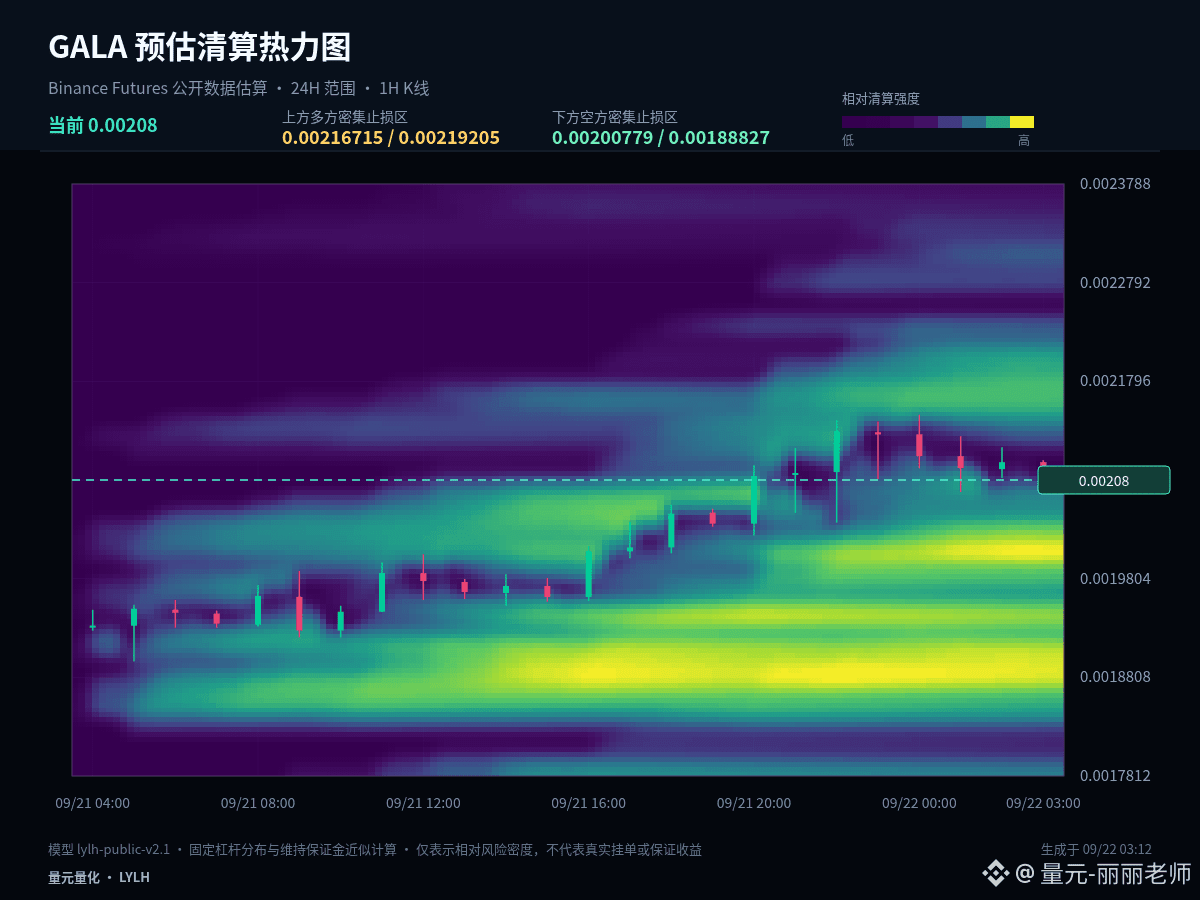
$GALA #GALA In a strong market, pullbacks often reveal the real order flow more clearly than an accelerated rally. Currently, over the past 1 hour it is -0.86%, and over the past 24 hours +7.93%. We need to judge whether this is a normal cooldown or a weakening of the structure.
From the perspective of timeframe alignment, the 24-hour change remains +7.93%, while the 1-hour has fallen to -0.86%, which looks more like a cooling-off within an upward structure. If the pullback does not break key support, it is typically just normal rotation. If support is lost and the rebound lacks strength, near-term momentum will shift from bulls to bears.
The 1-hour has already shown a retest. First, watch whether 0.001901 can form stable support. If price can quickly reclaim 0.0020315, it suggests the pullback is still manageable. If the rebound fails and the low keeps moving lower, then you cannot continue to rely on the strong-market logic.
My scenario planning is not a single bet on one direction. If price breaks above 0.002162 and can hold, it means the upside room is reopened. If it breaks below 0.001901 and cannot reclaim it on a bounce, that indicates the structure is weakening further. If price is moving within the range between the two, continue to observe the closing behavior on both sides of 0.0020315.
For those holding positions, the key is to manage based on whether support truly fails—not to get carried away by every fluctuation. For those on the sidelines, prioritize waiting for a breakout with a retest, or for support confirmation. Spot positions can be added in batches; for derivatives, shorten the decision chain: first determine the stop-loss level, then decide whether to participate.
The focus of derivatives is not to predict every single K-line, but to ensure there is rationale for entry, trimming, and exit. If there is no confirmation, do less; if key levels fail, redo the plan. Control single-trade risk first, and then discuss potential upside later.
#SolanaCutsTargetSlotTimeTo250ms
From the perspective of timeframe alignment, the 24-hour change remains +7.93%, while the 1-hour has fallen to -0.86%, which looks more like a cooling-off within an upward structure. If the pullback does not break key support, it is typically just normal rotation. If support is lost and the rebound lacks strength, near-term momentum will shift from bulls to bears.
The 1-hour has already shown a retest. First, watch whether 0.001901 can form stable support. If price can quickly reclaim 0.0020315, it suggests the pullback is still manageable. If the rebound fails and the low keeps moving lower, then you cannot continue to rely on the strong-market logic.
My scenario planning is not a single bet on one direction. If price breaks above 0.002162 and can hold, it means the upside room is reopened. If it breaks below 0.001901 and cannot reclaim it on a bounce, that indicates the structure is weakening further. If price is moving within the range between the two, continue to observe the closing behavior on both sides of 0.0020315.
For those holding positions, the key is to manage based on whether support truly fails—not to get carried away by every fluctuation. For those on the sidelines, prioritize waiting for a breakout with a retest, or for support confirmation. Spot positions can be added in batches; for derivatives, shorten the decision chain: first determine the stop-loss level, then decide whether to participate.
The focus of derivatives is not to predict every single K-line, but to ensure there is rationale for entry, trimming, and exit. If there is no confirmation, do less; if key levels fail, redo the plan. Control single-trade risk first, and then discuss potential upside later.
#SolanaCutsTargetSlotTimeTo250ms