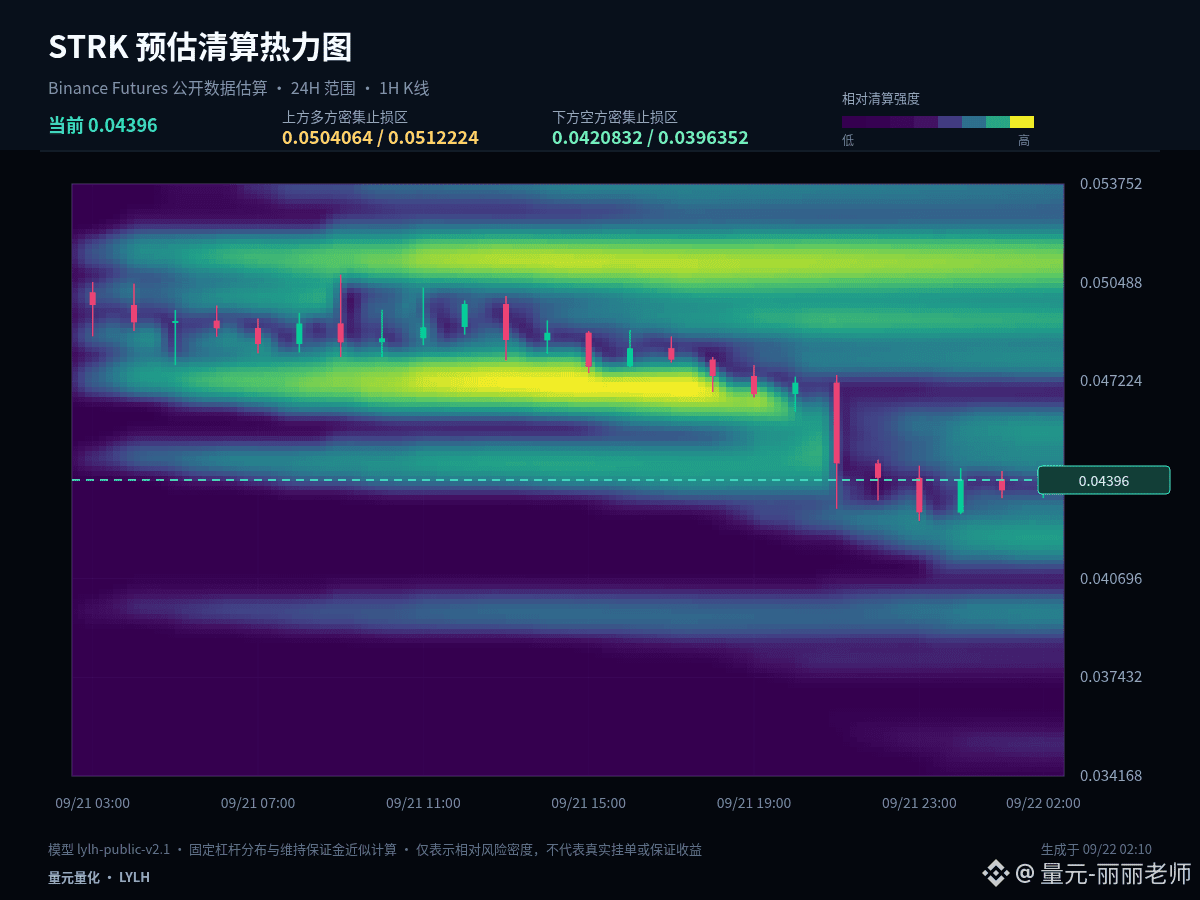
$STRK #STRK Current price 0.04396. This time I’m not only looking at the bullish/bearish move range—I’ve overlaid the 1-hour structure with the estimated liquidation distribution to see which side is more likely to search for liquidity next.
Based on cycle alignment: 24 hours is -10.8%, and 1 hour has returned to +0.73%. The short-term is repairing, but the larger timeframe hasn’t fully turned stronger yet. For now, I treat it as a rebound scenario. Only after it reclaims the key overhead resistance and completes a valid retest can the assessment be upgraded to a trend reversal.
In the estimated liquidation distribution, the dense stop-loss cluster for longs above is concentrated around 0.0504064, while the dense stop-loss cluster for shorts below is concentrated around 0.0420832. The highlighted areas indicate where potential liquidity is more concentrated, and they don’t directly equal the reversal point. Whether we see reaction depends on the speed after price touches those zones, how long it stays, and whether it can reclaim—those are what determine how capital responds.
On the price structure: 0.04669 is the intraday mid-axis. The usual resistance and support are 0.05074 and 0.04264, respectively. Use the heatmap price levels to monitor potential liquidity, and key K-line levels to confirm the structure. When both align, the reference value is higher; when they don’t, rely on the actual price response.
For execution, set clear conditions: after a breakout above 0.05074, you need confirmation—not to chase just because of a momentary spike. After a dip below 0.04264, you need to see whether it can quickly reclaim—not to buy just because it falls. If there isn’t enough reward/risk in the middle zone, waiting is also part of the strategy.
Risk control still comes before the conclusion: execute only when the conditions appear, and re-evaluate immediately if the price invalidates. The higher the volatility, the more tightly you should control single-position sizing. The above is a market projection based on the current 1-hour and 24-hour data, and does not constitute any promise of returns.
If the next 1-hour candle closes above 0.04669, the structure will become more proactive; if it closes below, we stay cautious. Which path are you leaning toward right now?
#SouthAfricaProposesCryptoExchangeControls
Based on cycle alignment: 24 hours is -10.8%, and 1 hour has returned to +0.73%. The short-term is repairing, but the larger timeframe hasn’t fully turned stronger yet. For now, I treat it as a rebound scenario. Only after it reclaims the key overhead resistance and completes a valid retest can the assessment be upgraded to a trend reversal.
In the estimated liquidation distribution, the dense stop-loss cluster for longs above is concentrated around 0.0504064, while the dense stop-loss cluster for shorts below is concentrated around 0.0420832. The highlighted areas indicate where potential liquidity is more concentrated, and they don’t directly equal the reversal point. Whether we see reaction depends on the speed after price touches those zones, how long it stays, and whether it can reclaim—those are what determine how capital responds.
On the price structure: 0.04669 is the intraday mid-axis. The usual resistance and support are 0.05074 and 0.04264, respectively. Use the heatmap price levels to monitor potential liquidity, and key K-line levels to confirm the structure. When both align, the reference value is higher; when they don’t, rely on the actual price response.
For execution, set clear conditions: after a breakout above 0.05074, you need confirmation—not to chase just because of a momentary spike. After a dip below 0.04264, you need to see whether it can quickly reclaim—not to buy just because it falls. If there isn’t enough reward/risk in the middle zone, waiting is also part of the strategy.
Risk control still comes before the conclusion: execute only when the conditions appear, and re-evaluate immediately if the price invalidates. The higher the volatility, the more tightly you should control single-position sizing. The above is a market projection based on the current 1-hour and 24-hour data, and does not constitute any promise of returns.
If the next 1-hour candle closes above 0.04669, the structure will become more proactive; if it closes below, we stay cautious. Which path are you leaning toward right now?
#SouthAfricaProposesCryptoExchangeControls