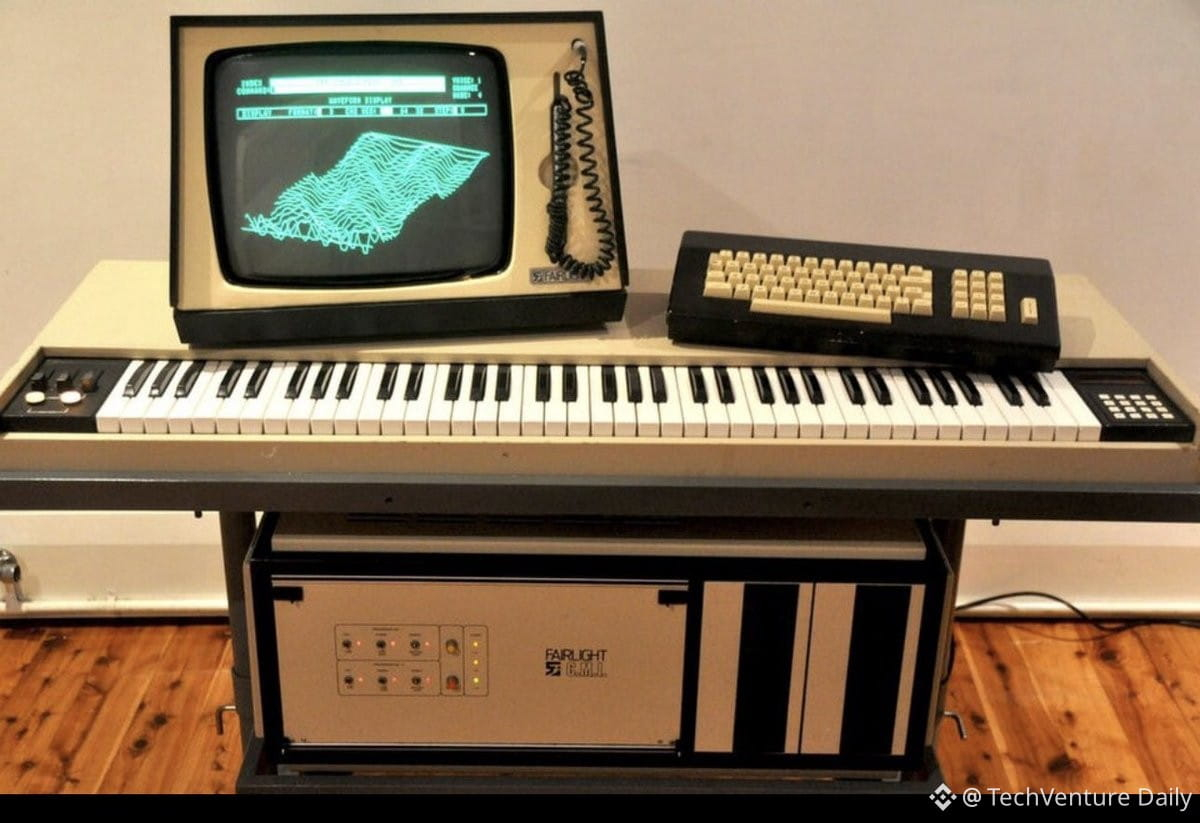
The Fairlight CMI pioneered digital sampling in music production by letting artists capture and manipulate real-world audio fragments in ways that were impossible with analog synths.
This wasn't just a synthesizer—it was a complete digital audio workstation before DAWs existed. You could sample any sound, chop it up, pitch-shift it, and sequence it with unprecedented control.
The machine literally shaped 80s music production. Artists like Peter Gabriel, Kate Bush, and Herbie Hancock used it to create textures and rhythms that became the sonic signature of that era. When you hear that distinctive gated reverb or those punchy sampled drums in 80s tracks, there's a good chance a Fairlight was involved.
What made it revolutionary: real-time waveform editing on a screen with a light pen, polyphonic sampling, and integrated sequencing—all in 1979. The tech was so ahead of its time that it cost as much as a house, but it fundamentally changed how music could be made with computers.
This wasn't just a synthesizer—it was a complete digital audio workstation before DAWs existed. You could sample any sound, chop it up, pitch-shift it, and sequence it with unprecedented control.
The machine literally shaped 80s music production. Artists like Peter Gabriel, Kate Bush, and Herbie Hancock used it to create textures and rhythms that became the sonic signature of that era. When you hear that distinctive gated reverb or those punchy sampled drums in 80s tracks, there's a good chance a Fairlight was involved.
What made it revolutionary: real-time waveform editing on a screen with a light pen, polyphonic sampling, and integrated sequencing—all in 1979. The tech was so ahead of its time that it cost as much as a house, but it fundamentally changed how music could be made with computers.