Kraken in this move seems to be directly connecting the “compliant entry point” to on-chain perpetuals.
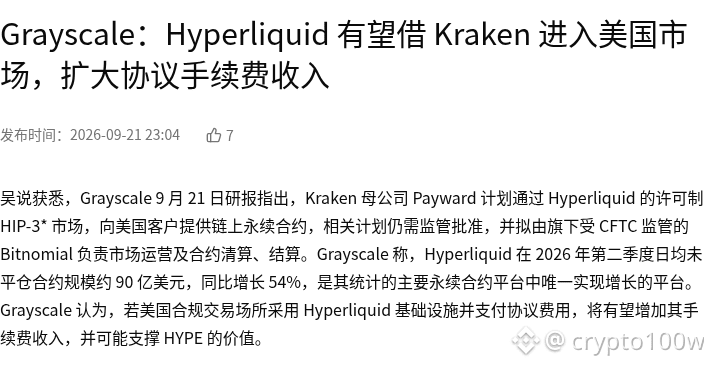
Wu Blockchain cites a Sept. 21 research report from Grayscale, saying that Kraken’s parent company, Payward, plans to offer on-chain perpetual contracts to U.S. customers via Hyperliquid’s license-based HIP-3 market. The plan still requires regulatory approval, and Bitnomial—its subsidiary regulated by the CFTC—is expected to handle market operations and contract clearing and settlement. Grayscale also noted that Hyperliquid’s average daily open interest in the second quarter of 2026 is about $9 billion, up 54% year over year. Among the major perpetual platforms it tracks, Hyperliquid is the only one that has achieved growth.
If this path really works, protocol fees, HIP-3 deployers’ revenue, and the “U.S. entry” narrative for HYPE would all be magnified. On the other hand, before the regulatory node is actually in place, such expectations are more likely to show up first in market sentiment. Which would you rather see first: the real trading volume brought by the “U.S. compliant entry,” or the progress of regulatory approvals?
Figure 1: Kraken plans to bring on-chain perpetuals to the U.S. via Hyperliquid · Source: partial screenshot of the page
Image source: https://www.wublock123.com/news/grayscale-hyperliquid-kraken-us-market-fees-68758
Wu Blockchain cites a Sept. 21 research report from Grayscale, saying that Kraken’s parent company, Payward, plans to offer on-chain perpetual contracts to U.S. customers via Hyperliquid’s license-based HIP-3 market. The plan still requires regulatory approval, and Bitnomial—its subsidiary regulated by the CFTC—is expected to handle market operations and contract clearing and settlement. Grayscale also noted that Hyperliquid’s average daily open interest in the second quarter of 2026 is about $9 billion, up 54% year over year. Among the major perpetual platforms it tracks, Hyperliquid is the only one that has achieved growth.
If this path really works, protocol fees, HIP-3 deployers’ revenue, and the “U.S. entry” narrative for HYPE would all be magnified. On the other hand, before the regulatory node is actually in place, such expectations are more likely to show up first in market sentiment. Which would you rather see first: the real trading volume brought by the “U.S. compliant entry,” or the progress of regulatory approvals?
Figure 1: Kraken plans to bring on-chain perpetuals to the U.S. via Hyperliquid · Source: partial screenshot of the page
Image source: https://www.wublock123.com/news/grayscale-hyperliquid-kraken-us-market-fees-68758