
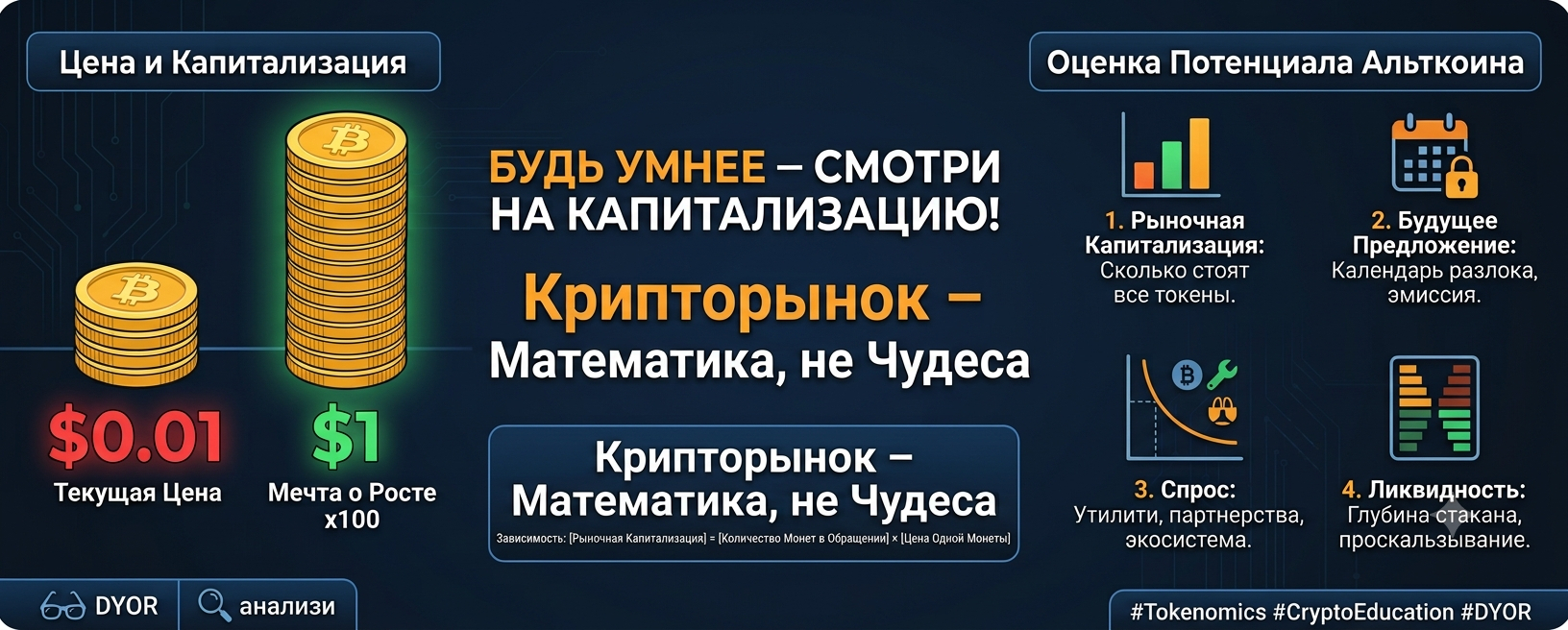

🧮 Coin for $0.01: how real is the growth to $1?
“It’s worth just a cent, the potential for x100 is obvious!” — a classic trap for crypto beginners.
Let’s look at simple tokenomics math using an example coin with an issuance of 100 billion tokens:
🔹 At a price of $0.01, the market capitalization (Market Cap) is $1 billion
🔹 With $0.10, the market cap will grow to $10 billion
🔹 With $1, the market cap will already reach $100 billion
It seems that $1 is a small number, but $100 billion is the level of the top-3 world assets.
That’s why comparing tokens only by the price of one unit (Unit Bias) is meaningless without taking into account the circulating supply (Circulating Supply).
What to look at before buying:
✅ Market Cap: the actual total value of all coins in the market right now.
✅ FDV (Fully Diluted Valuation): the market cap assuming all the planned tokens are unlocked (protection against hard supply inflation).
✅ Utility and demand: does the token have real use in the ecosystem, or is it just a speculative trinket.
✅ Order book depth and liquidity: whether you can exit the asset with a large volume without crashing the price.
💡 Important fact: the inflow of real money into an asset is not equal to capitalization growth 1-to-1. Market cap is only the latest trade price multiplied by the number of tokens. With low liquidity, market cap can jump by $1 billion even from buying for just a few hundred thousand dollars (and likewise crash to zero).
Which metric do you prioritize in fundamental analysis of a token? Share in the comments! 👇
Disclaimer: This material is not financial or investment advice. Always do your own research (DYOR).
#CryptoEducation #BinanceSquare #Tokenomics #DYOR #MarketCap