#欧洲央行启动区块链欧元结算
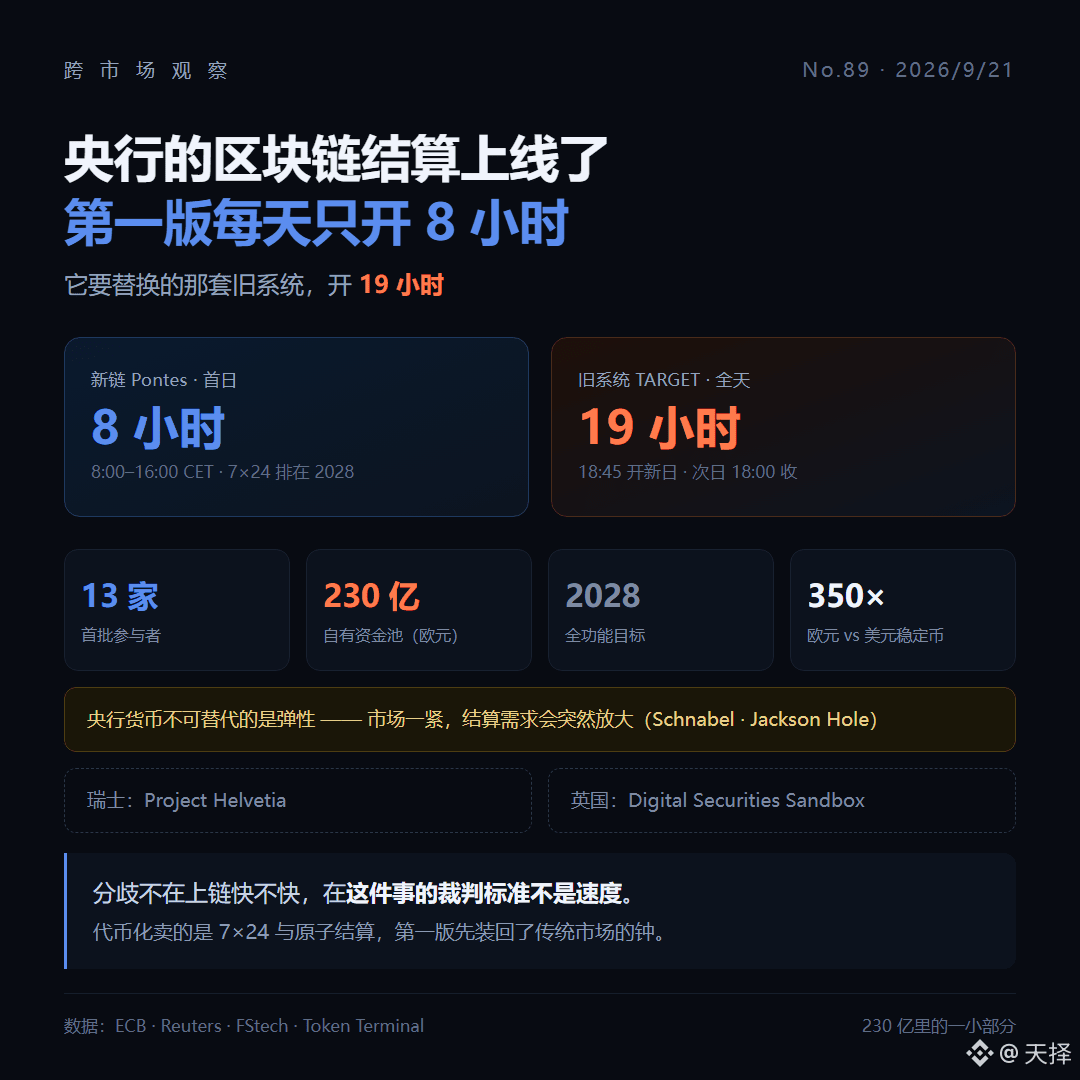
The European Central Bank’s blockchain settlement system went live on Monday, operating just 8 hours per day.
The old system it needs to connect with runs 19 hours.
▪️ On day one: 8:00–16:00 CET only; “7×24” is listed in the 2028 roadmap
▪️ The first batch of 13 firms: Deutsche Bank, Santander, Société Générale, plus operators such as Clearstream
▪️ €850 million in euro stablecoins, $298.7 billion in dollar stablecoins—a difference of 350x
The disagreement isn’t about how fast things are put on-chain; it’s about who the “referee” standards hinge on—speed is not the key. Schnabel said it plainly at Jackson Hole: what central bank money can’t be replaced by is resilience—when the market tightens, settlement demand expands, and pools privately controlled can’t handle it.
The ECB is both the operator and a source of liquidity, and it also plans to use part of its own €23 billion to buy tokenized bonds. Retail digital euro is still stuck in legislation; Lagarde wants the EU to finish the talks by the end of 2026.
There’s no direct spillover to BTC. But the rationale the ECB gave is worth noting: if dollar stablecoins are widely used for settlement in Europe, Europe would lose control over monetary policy. The key indicator isn’t the size of euro stablecoins—it’s how many euro settlements actually use central bank money.
When it comes to settlement-asset judgment, do you bet on speed—or on the ability to expand the balance sheet under pressure?$BTC
The European Central Bank’s blockchain settlement system went live on Monday, operating just 8 hours per day.
The old system it needs to connect with runs 19 hours.
▪️ On day one: 8:00–16:00 CET only; “7×24” is listed in the 2028 roadmap
▪️ The first batch of 13 firms: Deutsche Bank, Santander, Société Générale, plus operators such as Clearstream
▪️ €850 million in euro stablecoins, $298.7 billion in dollar stablecoins—a difference of 350x
The disagreement isn’t about how fast things are put on-chain; it’s about who the “referee” standards hinge on—speed is not the key. Schnabel said it plainly at Jackson Hole: what central bank money can’t be replaced by is resilience—when the market tightens, settlement demand expands, and pools privately controlled can’t handle it.
The ECB is both the operator and a source of liquidity, and it also plans to use part of its own €23 billion to buy tokenized bonds. Retail digital euro is still stuck in legislation; Lagarde wants the EU to finish the talks by the end of 2026.
There’s no direct spillover to BTC. But the rationale the ECB gave is worth noting: if dollar stablecoins are widely used for settlement in Europe, Europe would lose control over monetary policy. The key indicator isn’t the size of euro stablecoins—it’s how many euro settlements actually use central bank money.
When it comes to settlement-asset judgment, do you bet on speed—or on the ability to expand the balance sheet under pressure?$BTC