


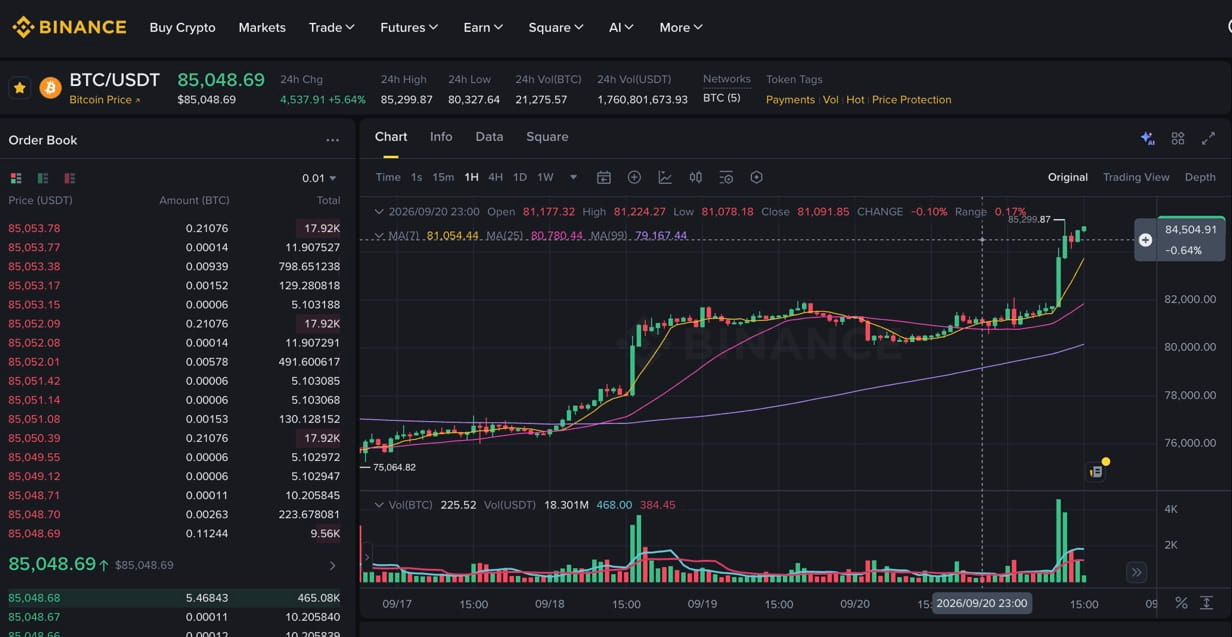
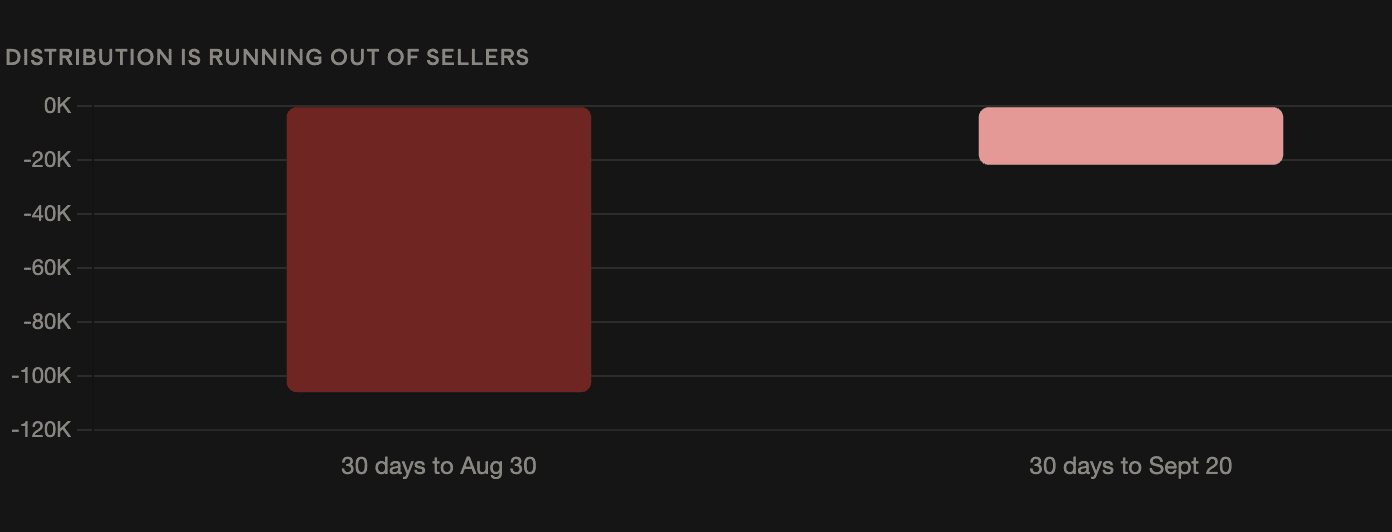
Bitcoin broke through the $80,000-$82,000 supply wall Monday on ~$300M in short liquidations, reaching $85,000 — now inside the long-term holder supply zone at $83,000-$86,000. LTH selling slowed 80% in three weeks, with most recent sales at a loss — the exhaustion signal that marks late-stage capitulation. Chicago Fed's Goolsbee said rates may need to rise further if inflation stays above 2%, keeping the one-more-hike path alive. Bessent defended the Treasury buyback expansion, saying the 30-year yield has not risen sharply since — a claim Druckenmiller publicly disputed. The SEC's tokenized stock trading window opens Tuesday.
Bitcoin Hashrate Turns Higher as Price Clears $85,000
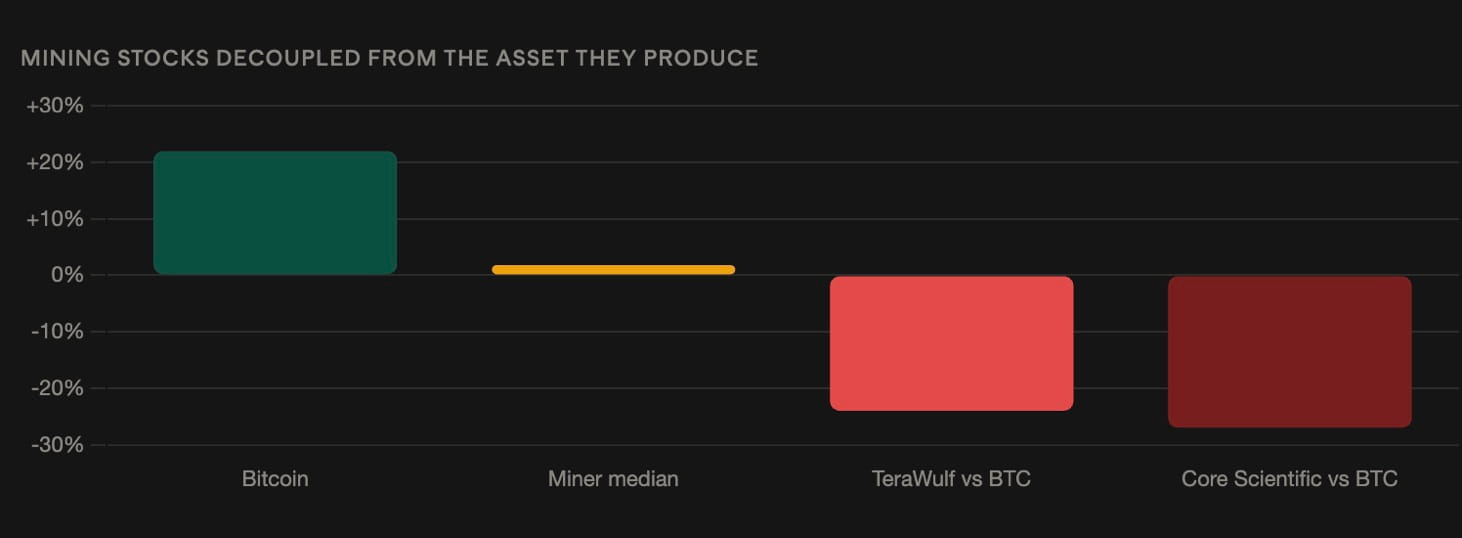
Bitcoin's network hashrate has rebounded after a sustained downtrend, coinciding with price reaching $85,000. The mechanism is direct: a 13% price move from $75,000 to $85,000 raises miner revenue per unit of computing power by roughly the same margin, pushing marginal machines back above breakeven. Mining stocks badly lagged the August rally — top-10 mining median +1.8% versus Bitcoin +22% — with Core Scientific trailing by 27% and TeraWulf by 24%, as AI sentiment headwinds offset Bitcoin's gains for the hybrid miners. Rising hashrate is self-limiting: difficulty adjusts every ~2 weeks to maintain 10-minute block times, so a sustained hashrate increase erodes per-machine revenue until the next price move. Bitcoin has now cleared the $80,000-$82,000 supply band; the next resistance is the 100-week moving average near $89,000.
Bitcoin Starts the Week at $85,000 as SEC Tokenized Stock Trading Opens: Crypto Week Ahead
The SEC's conditional five-year exemption window opens September 22, allowing select institutional venues to pilot tokenized stock trading on public blockchains — the first concrete deliverable from the agency-led approach that replaced the failed CLARITY Act. Markets partially priced it: Coinbase +5% Thursday and +2% Friday, Securitize +7%, Bullish +3%. The week's macro risk is consumer sentiment: University of Michigan's final September reading lands Thursday at a forecast 47.8 — below the June 2022 historic low of 50.0 — against a backdrop of higher energy costs and the Fed's first hike since 2023. New home sales Wednesday are forecast at 700,000 versus 739,000 prior. Three token unlocks this week: Humanity unlocks 14.7% of circulating supply ($20.8M) September 23, TON unlocks 1.3% ($51.2M) September 22, Canton 0.38% ($17.17M) September 21.
Chicago Fed's Austan D. Goolsbee Says Rates May Need to Rise If Inflation Stays Above 2%
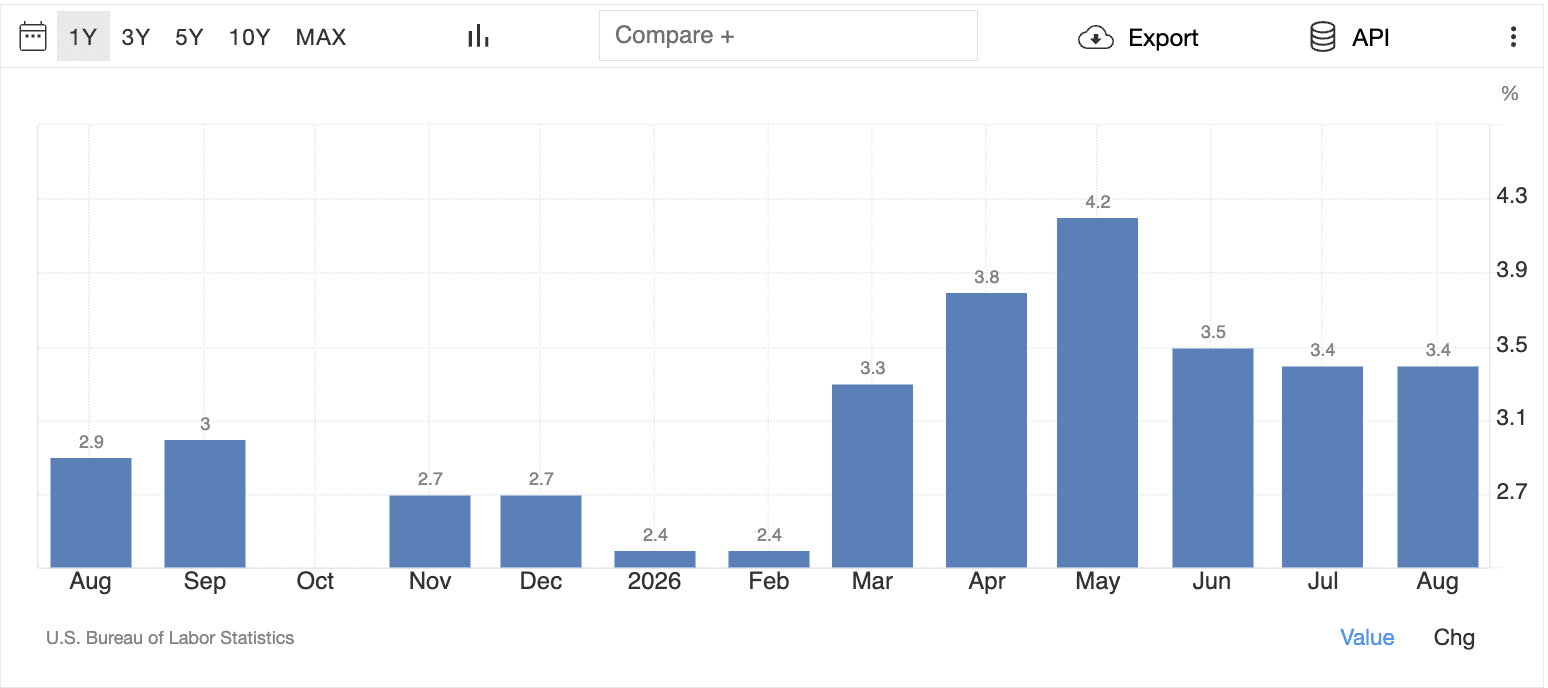
Chicago Fed President Austan Goolsbee said rates may need to rise further if inflation does not return to 2%, while staying open to the possibility that current pressures stem from a fading supply shock. He wants evidence the supply shock is genuinely dissipating — which positions him as data-dependent rather than pre-committed in either direction. His framing aligns with Warsh's "discipline not a decision" framework: the Fed's dot plot median points to one more hike in 2026, but the threshold remains incoming data. For Bitcoin, a Fed that requires evidence of disinflation before pausing means Friday's oil moves and next month's CPI carry more weight than any individual official's statement.
Long-Term Bitcoin Holders Cut Selling by 80% as Price Reaches Their Breakeven Zone
Long-term holder net Bitcoin distribution fell from 105,900 BTC on August 30 to 21,700 BTC on September 20 — an 80% slowdown over three weeks. Most coins sold last week moved at a loss, which is unusual for the most patient cohort in the market and typically marks late-stage capitulation: once these holders sell, that supply is gone. Glassnode researcher Frederik Theissen had placed a dense LTH supply concentration at $83,000-$86,000 — exactly where Bitcoin now trades. Holders who bought in that range and waited through the drawdown are at breakeven and some will exit, making distribution slowdown through this zone the key confirmation signal. The rally has been short-liquidation driven (~$300M in one hour Monday) rather than spot demand driven; CryptoQuant's spot demand metric sat at -145,000 BTC last week. Nexo's Ilya Kalchev identified sustained ETF inflows or renewed spot buying as the remaining confirmation signals needed.
U.S. Treasury Secretary Bessent Says 30-Year Yield Has Not Risen Sharply Since Debt Buyback Expansion
Treasury Secretary Bessent said the 30-year yield has not risen sharply since the Treasury expanded its buyback program — implicitly defending the intervention's effectiveness. He declined to say whether he agrees with the Fed's rate hike. The 30-year hit 5.40% this month — its highest since June 2007 — before easing alongside oil's four-session decline. Bessent's framing suggests he views current long-end levels as contained by the buyback program rather than as evidence it failed. Stanley Druckenmiller — who mentored Bessent — publicly called the intervention a mistake, arguing governments defending prices against fundamentals always lose. The tension between the two readings will be tested if oil reverses and yields resume their ascent toward the month's highs.