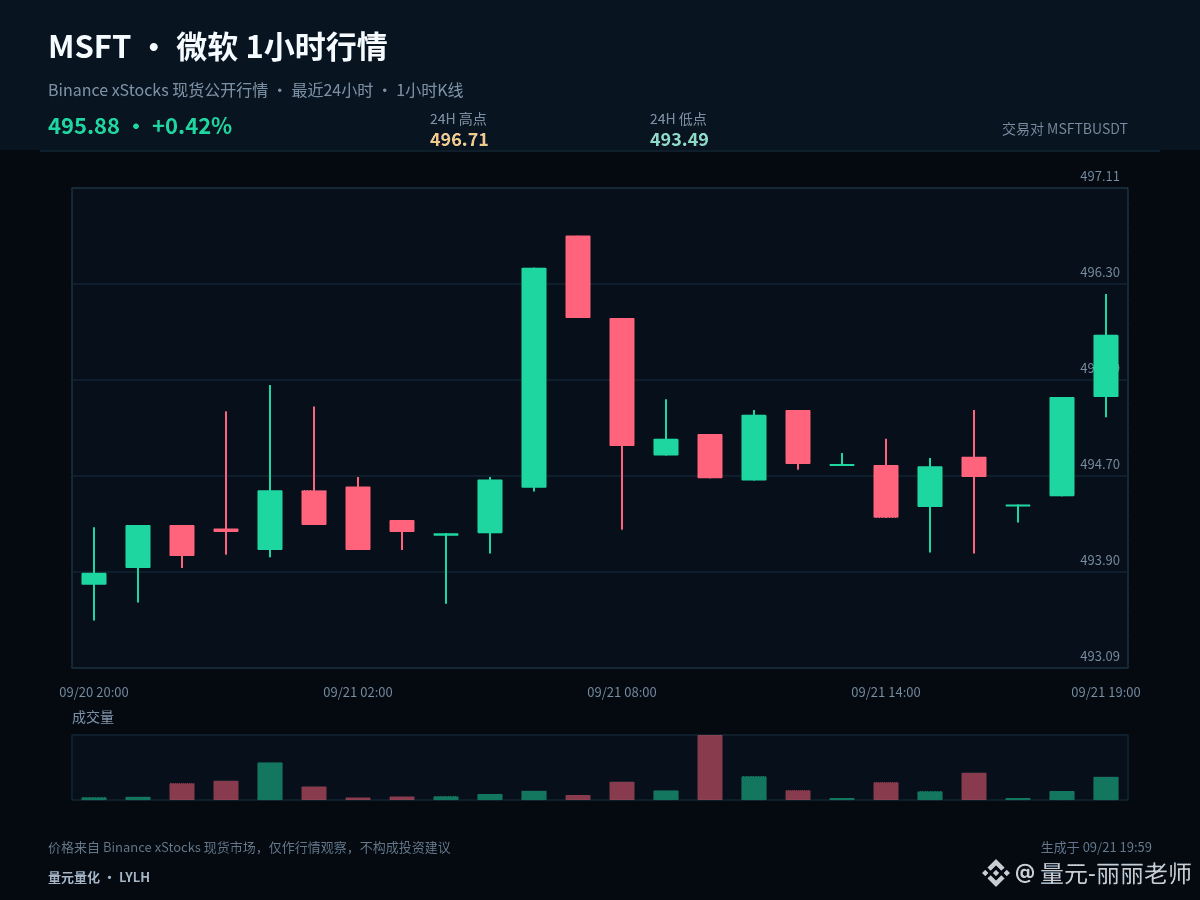
$MSFTB #MSFT From a layout perspective, the key is not to chase already-occurred fluctuations, but to determine in advance the position you are willing to wait for. Current price: 495.88, 1 hour: +0.10%, 24 hours: +0.42%.
Current 1 hour: +0.10%, 24 hours: +0.42%. In these two time windows, there isn’t enough clear alignment in the same direction. In a range-bound market, the tolerance for chasing and killing moves is lower; it’s more suitable to use an upper boundary confirmation for direction, and a lower boundary confirmation for pullback/absorption. The midline should only be used as the line dividing strength and weakness.
The first observation zone is 495.1, used to judge whether a typical pullback has ended. The second observation zone is 493.49, used to judge whether a deeper retracement can form support/absorption. On the upside, pay attention to 496.71; after a breakout, a pullback confirmation is needed to avoid mistaking a brief penetration for the trend already having opened.
Position management should distinguish between swing (mid-term) and short-term trades. For existing swing positions, first check whether the structure is broken; don’t be repeatedly affected by single 1-hour candlesticks. For short-term positions, execute based on support, resistance, and closing confirmations. Those with no position don’t need to chase price in the middle of the range; waiting for a clearer spot is often more advantageous.
The meaning of scaling in/out is not to continuously average down costs, but to control the timing while the structure remains valid. Once a key support fails, you should stop the original layout plan and wait for a new price range to form.
The focus of short-term positioning is not to predict every candlestick, but to ensure that entries, reducing exposure, and exits are all backed by evidence. Do less without confirmation; when a key level fails, redo the plan. First control single-trade risk, then talk about the subsequent upside potential.
#ECBStartsBlockchainEuroSettlement
Current 1 hour: +0.10%, 24 hours: +0.42%. In these two time windows, there isn’t enough clear alignment in the same direction. In a range-bound market, the tolerance for chasing and killing moves is lower; it’s more suitable to use an upper boundary confirmation for direction, and a lower boundary confirmation for pullback/absorption. The midline should only be used as the line dividing strength and weakness.
The first observation zone is 495.1, used to judge whether a typical pullback has ended. The second observation zone is 493.49, used to judge whether a deeper retracement can form support/absorption. On the upside, pay attention to 496.71; after a breakout, a pullback confirmation is needed to avoid mistaking a brief penetration for the trend already having opened.
Position management should distinguish between swing (mid-term) and short-term trades. For existing swing positions, first check whether the structure is broken; don’t be repeatedly affected by single 1-hour candlesticks. For short-term positions, execute based on support, resistance, and closing confirmations. Those with no position don’t need to chase price in the middle of the range; waiting for a clearer spot is often more advantageous.
The meaning of scaling in/out is not to continuously average down costs, but to control the timing while the structure remains valid. Once a key support fails, you should stop the original layout plan and wait for a new price range to form.
The focus of short-term positioning is not to predict every candlestick, but to ensure that entries, reducing exposure, and exits are all backed by evidence. Do less without confirmation; when a key level fails, redo the plan. First control single-trade risk, then talk about the subsequent upside potential.
#ECBStartsBlockchainEuroSettlement