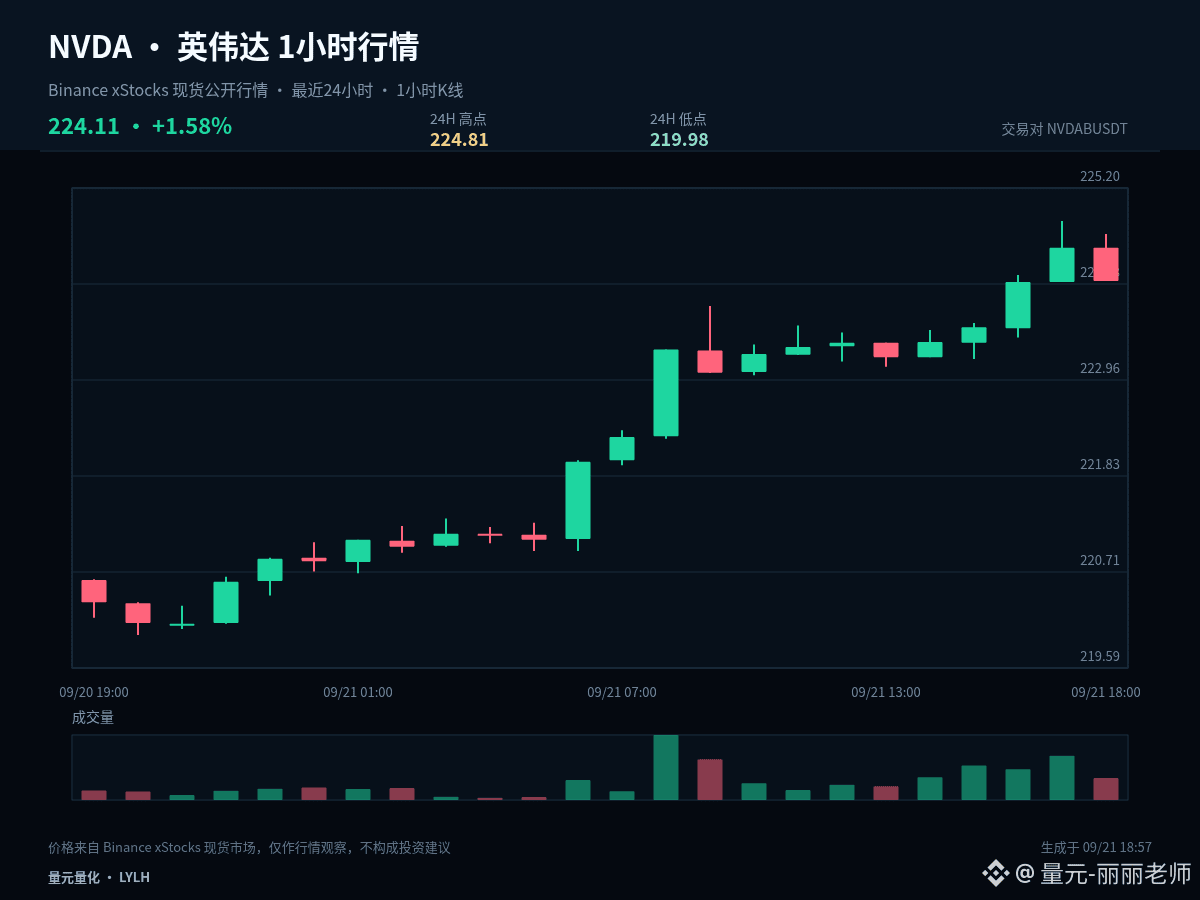
$NVDAB #NVDA Currently it is more suitable to first confirm a rebound, rather than define a reversal in advance. The current price is 224.11. In 1 hour: -0.17%, in 24 hours: +1.58%. Whether the two timeframes turn to move in the same direction again is the key focus for the next stage.
The current price is near the upper band of the past 24 hours’ range, with -0.17% in the 1-hour window and +1.58% in the 24-hour window. The most important thing at the highs is to confirm the market’s acceptance after a breakout: if the price can stay above the upper band, it indicates the market is acknowledging a higher range; if it only briefly pierces and then quickly reclaims, you need to guard against a false breakout.
If the rebound can reclaim 222.395 and then further hold above 224.81, it suggests that buy-side momentum is starting to shift away from the prior weakness. If the price rises to the midline and then falls again—especially if it breaks back down toward 219.98—then it looks more like a failed attempt at repair, and you should not keep using a bullish-strength expectation.
Even confirmation that the rebound has failed still requires evidence. You shouldn’t immediately chase a short position just because of one push-up that then reverses. A more reasonable sequence is to observe whether the resistance level is rejected, whether the lows start moving lower again, and then decide your action based on whether the subsequent pullback can reclaim key levels.
Position management should distinguish between swing/medium-term and short-term trades. For existing medium-term positions, first assess whether the structure is broken; don’t let repeated fluctuations on a single 1-hour candlestick constantly sway you. For short-term positions, execution should be based around support, resistance, and close confirmation. If you’re currently in cash, there’s no need to chase price in the middle of the range—waiting for a clearer location usually provides an advantage.
For short-term positions, the focus is not to predict every candlestick, but to ensure there are grounds for entries, trimming, and exits. If there’s no confirmation, do less. If key levels fail, redo the plan: control risk per trade first, and only then discuss potential upside/downside room.
#CanaryFilesSecondAmendmentForStakedSEIETF
The current price is near the upper band of the past 24 hours’ range, with -0.17% in the 1-hour window and +1.58% in the 24-hour window. The most important thing at the highs is to confirm the market’s acceptance after a breakout: if the price can stay above the upper band, it indicates the market is acknowledging a higher range; if it only briefly pierces and then quickly reclaims, you need to guard against a false breakout.
If the rebound can reclaim 222.395 and then further hold above 224.81, it suggests that buy-side momentum is starting to shift away from the prior weakness. If the price rises to the midline and then falls again—especially if it breaks back down toward 219.98—then it looks more like a failed attempt at repair, and you should not keep using a bullish-strength expectation.
Even confirmation that the rebound has failed still requires evidence. You shouldn’t immediately chase a short position just because of one push-up that then reverses. A more reasonable sequence is to observe whether the resistance level is rejected, whether the lows start moving lower again, and then decide your action based on whether the subsequent pullback can reclaim key levels.
Position management should distinguish between swing/medium-term and short-term trades. For existing medium-term positions, first assess whether the structure is broken; don’t let repeated fluctuations on a single 1-hour candlestick constantly sway you. For short-term positions, execution should be based around support, resistance, and close confirmation. If you’re currently in cash, there’s no need to chase price in the middle of the range—waiting for a clearer location usually provides an advantage.
For short-term positions, the focus is not to predict every candlestick, but to ensure there are grounds for entries, trimming, and exits. If there’s no confirmation, do less. If key levels fail, redo the plan: control risk per trade first, and only then discuss potential upside/downside room.
#CanaryFilesSecondAmendmentForStakedSEIETF