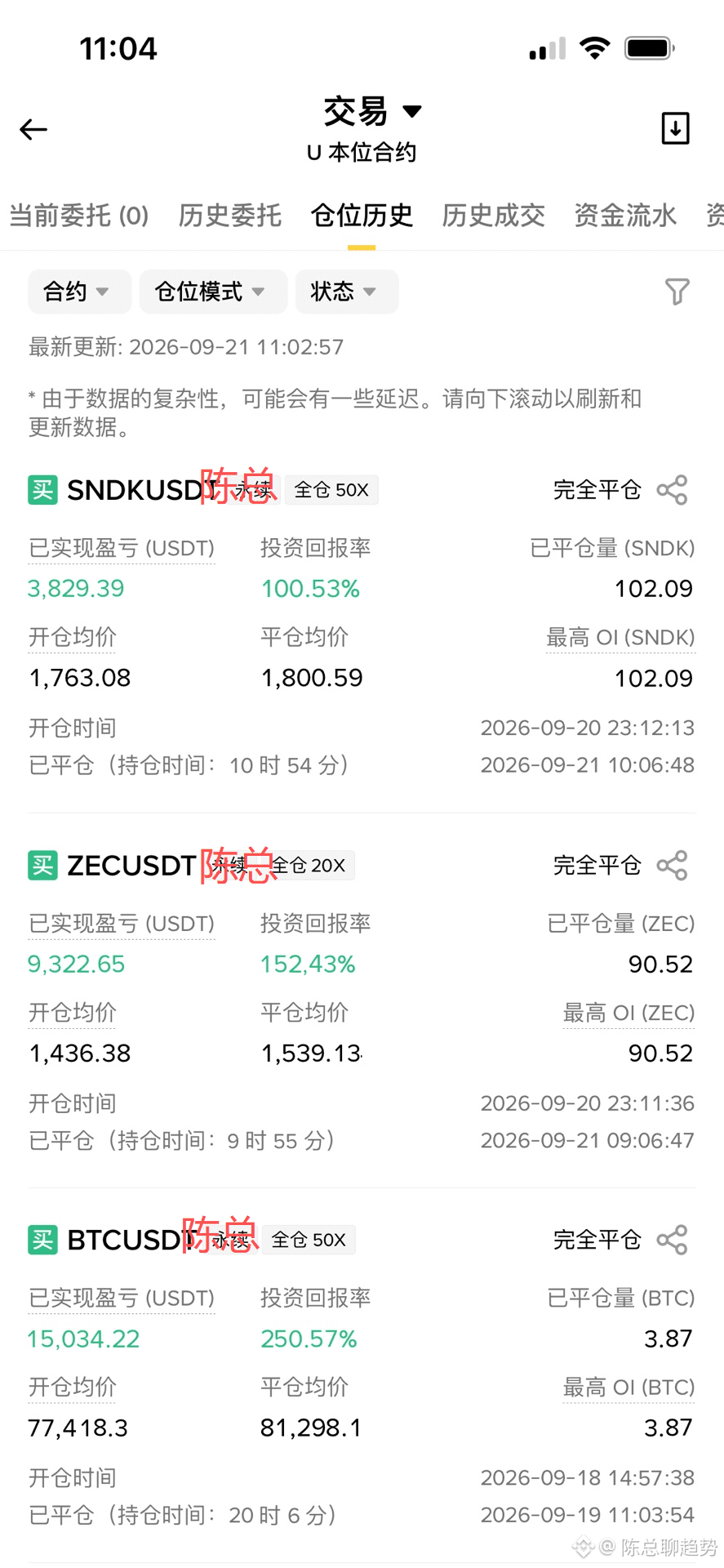
Lost 300,000 U and ended up with only 10,000 U. In five months, not only did she recover her losses—she made an extra 50,000.
This year, a female fan from Shanghai found me, and it left a deep impression on me. Before, due to a contract liquidation, she lost 300,000 U; her account was left with only 10,000.
When we were on the phone, her voice was trembling. She told me she felt like she’d never turn her life around in this lifetime.
Five months later, she came to report good news: every cent she’d lost was back, and she had earned another 50,000 U on top.
The method sounds pretty simple—almost a bit old-fashioned to the point of being “naive.” But it precisely captures the underlying logic of making profits in the crypto market.
I pulled up her trading history and looked—everything was classic beginner mistakes: chasing after price rises, holding on when it falls, going all-in as soon as emotions kicked in, with absolutely no rules.$ZEC
I told her to stop for a week and not touch anything, then break down the losing trades one by one and review them.
Only after she calculated it herself did she get scared: 90% of the losses came from just two issues—she couldn’t control her hands, and stop-loss was never more than lip service.
I set two iron rules for her: no single trade can lose more than 5%, and if total losses in a day reach 10%, she must take a forced break. No matter how good the market looks after that, she won’t trade.
Then I only allowed her to enter at key positions for BTC and ETH, with the stop-loss set just outside those key levels—1.5% away. No wishful thinking.
If she reaches 5% profit, she pulls out the principal first, and keeps the profits to continue running the trade—because even if the price later drops back, as long as the principal hasn’t moved, the risk drops straight to the bottom.$SNDK
In the end, I added one small move: from the 10,000 U, she split out 2,000 U and selected three smaller coins. It wasn’t random. For each one, she verified two things:
On-chain, big funds were still holding and hadn’t withdrawn—while the exchange’s trading volume kept shrinking. That basically signals that someone is quietly accumulating.
In three months, 10,000 became 150,000. In five months, she completely filled the hole and still ended up with an extra 50,000.
10,000 U was never a dead end. Most people are killed by the idea of “just get back to even as fast as possible”—the more desperate you are, the more you break.
If you want to know how to crawl back step by step from the bottom, come talk to me. Wang Zong has always been
This year, a female fan from Shanghai found me, and it left a deep impression on me. Before, due to a contract liquidation, she lost 300,000 U; her account was left with only 10,000.
When we were on the phone, her voice was trembling. She told me she felt like she’d never turn her life around in this lifetime.
Five months later, she came to report good news: every cent she’d lost was back, and she had earned another 50,000 U on top.
The method sounds pretty simple—almost a bit old-fashioned to the point of being “naive.” But it precisely captures the underlying logic of making profits in the crypto market.
I pulled up her trading history and looked—everything was classic beginner mistakes: chasing after price rises, holding on when it falls, going all-in as soon as emotions kicked in, with absolutely no rules.$ZEC
I told her to stop for a week and not touch anything, then break down the losing trades one by one and review them.
Only after she calculated it herself did she get scared: 90% of the losses came from just two issues—she couldn’t control her hands, and stop-loss was never more than lip service.
I set two iron rules for her: no single trade can lose more than 5%, and if total losses in a day reach 10%, she must take a forced break. No matter how good the market looks after that, she won’t trade.
Then I only allowed her to enter at key positions for BTC and ETH, with the stop-loss set just outside those key levels—1.5% away. No wishful thinking.
If she reaches 5% profit, she pulls out the principal first, and keeps the profits to continue running the trade—because even if the price later drops back, as long as the principal hasn’t moved, the risk drops straight to the bottom.$SNDK
In the end, I added one small move: from the 10,000 U, she split out 2,000 U and selected three smaller coins. It wasn’t random. For each one, she verified two things:
On-chain, big funds were still holding and hadn’t withdrawn—while the exchange’s trading volume kept shrinking. That basically signals that someone is quietly accumulating.
In three months, 10,000 became 150,000. In five months, she completely filled the hole and still ended up with an extra 50,000.
10,000 U was never a dead end. Most people are killed by the idea of “just get back to even as fast as possible”—the more desperate you are, the more you break.
If you want to know how to crawl back step by step from the bottom, come talk to me. Wang Zong has always been