
As someone who’s been roaming CEX to DeFi for 5 years, honestly I’m not against Binance Earn. It’s actually good because it brings all the asset management tools into one place. But the more menus there are, the easier it is for users to pick the wrong option.
The issue is, “Earn” is a slippery word. It sounds like your money is working on its own. In reality, you’re the one who has to do the thinking first before placing your assets.
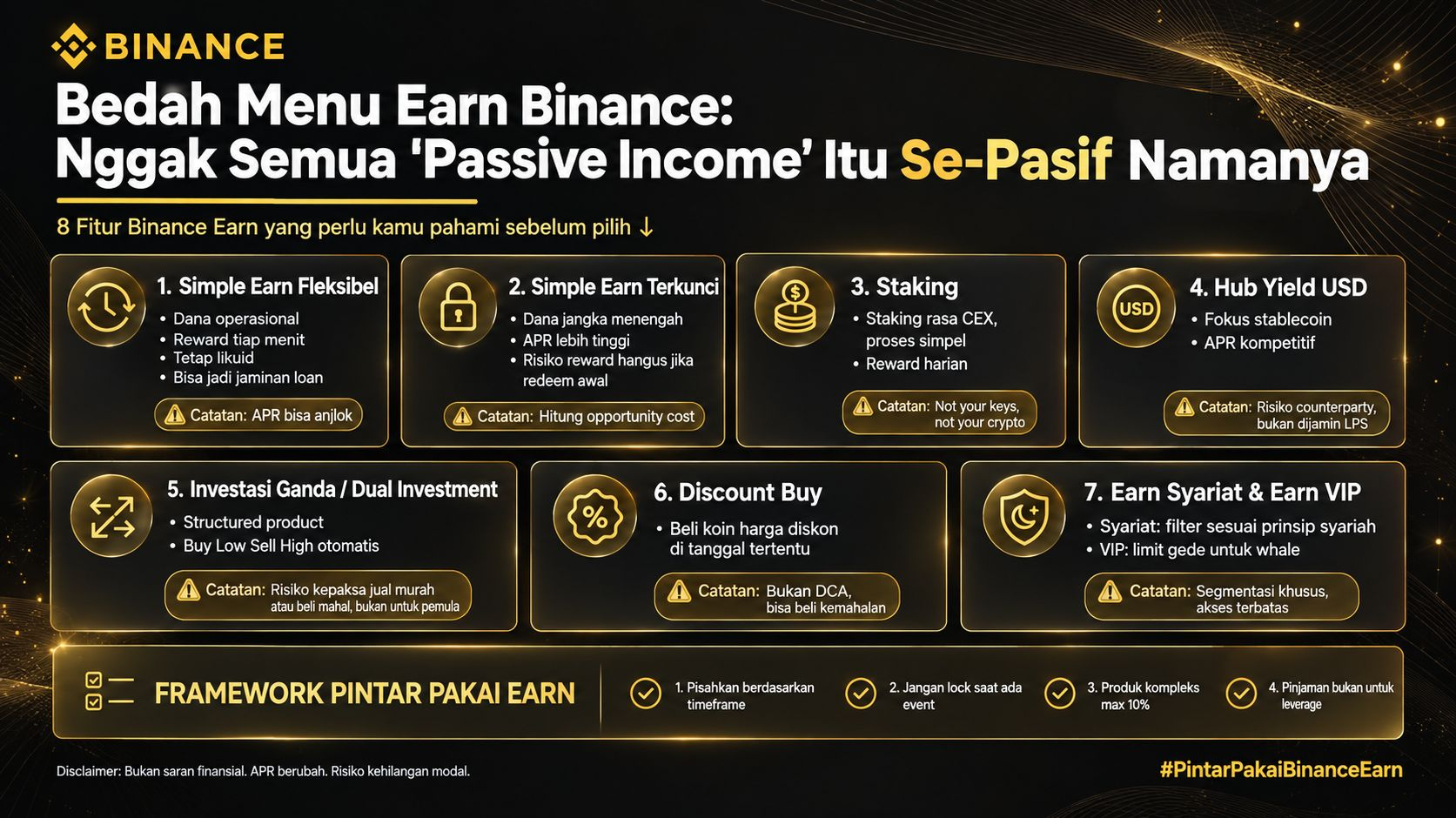
1. Simple Earn: The foundation, but don’t get blinded by APR
This is the most “sensible” menu. There’s Flexible and Locked.
Flexible, suitable for operational funds. You need USDT to scrape for tomorrow, but for now just leave it here. Rewards run every minute. Some assets can even be used as collateral for a Flexible Loan while still earning rewards, or used in Binance Pay.
The good part: you don’t lose liquidity.
The bad part: Flexible APR tiering can drop anytime. Many were shocked by the 10% APR last week—now it’s just 2%. This isn’t a scam; the mechanism is just like that. Lots of user quota, and rewards are split evenly.
Locked for the money you’ve genuinely accepted won’t be touched for 30/60/90 days. Higher APR, but if you redeem early, the reward is forfeited.
My critique: Binance doesn’t account for opportunity cost enough. An 8% APR to lock BNB for 90 days looks huge. But if, during those 90 days, there’s a 5x Launchpool and you can’t withdraw, then you lose out like a trader. So don’t just look at the numbers. Ask: “During this period, is there an event that earns more than the APR difference?”
Then there’s Auto-Subscribe. For people who forget, this is a lifesaver. Idle balances in Spot can automatically enter Flexible at 09.00 & 23.00 WIB. But remember, automatic >≠ autopilot. APR changes, quota runs out, and products can be closed. You still need to check manually once a week.
2. Staking: Staking with a CEX feel
For people who want to stake ETH, SOL, etc., but are too lazy to manage nodes or are afraid of using the wrong chain. The upside: one click, daily rewards, and you can redeem.
The downside: you don’t hold the private keys. “Not your keys, not your crypto” is still true. You also don’t get governance rights like native staking. And if there’s slashing on the chain, Binance takes the hit—but they can still change the profit-sharing terms.
Use this if you’re going for simplicity. Skip it if you’re ideological about decentralization.
3. Hub Yield USD: A stablecoin made to do hard labor
This product focuses on stablecoins like USDT and USDC. The mechanism varies behind the scenes—it can do lending and other strategies. The APR is competitive because of that.
But the critical question is this: “Where does the yield come from?” If it’s from lending, then there’s counterparty risk. If it’s from a delta-neutral strategy, then there’s exchange risk. Binance is big, but 2022 taught us: nothing is too big to fail.
Think of it like a bank deposit, but the bank isn’t guaranteed by LPS. Your allocation should match your tolerance. Don’t put 100% of your emergency funds here just because APR is 6%.
4. Binance Pool: Create a miner, not retail
This is obvious. You have a BTC/ETH mining rig, and you connect it here. This isn’t a “click-click and earn money” product for regular users. So I’ll skip the long explanation. Wrong room if retail FOMO comes in here.
5. Dual Investment: The product that makes the most people cry
The name “Investment” is a bit misleading. This is a structured product. You put in BTC or USDT, set a “price target” and a “settlement date.”
Scenario 1: If the price doesn’t reach the target, you get big rewards and the assets come back intact.
Scenario 2: If the price reaches the target, your assets are sold at the target price.
It sounds like automatic “Buy Low, Sell High.” The problem is, many people use this when the market is in euphoria. Example: You place a Sell High BTC at $70k because you feel “it can’t break through.” Then it breaks to $100k. You are profitable, but you feel bad because the potential gains get cut off.
This is an advanced product. The risk isn’t only “your rewards get burned.” The risk is that “you’re forced to sell when the market is bullish,” or “forced to buy when it’s plunging.” If you don’t understand options, don’t touch it. APR 150% isn’t interest; it’s the premium for your risk.
6. Discount Buy: Buy the Dip—“pay upfront” version
You commit to buying coins at a discounted price on a specific date. If the market price on that date is higher than your discounted price, then you’re lucky. If it’s lower, you still buy at your discounted price—which turns out to be overpriced.
This isn’t DCA. It’s a limit order with extra steps. It fits if you’re truly confident in that support level. Not suitable if you’re just doing FOMO because you see the “5% discount” text.
7. Earn VIP & Earn Syariat: Market segmentation
Earn VIP is just like Simple Earn/Staking, but with a bigger limit and sometimes boosted APR. No special magic. The main benefit is for whales who are too lazy to break up orders.
Earn Syariat is interesting because it offers options for people concerned about riba/gharar. Binance filters its products so they align with sharia principles. A good move in terms of inclusivity.
My criticism: contract transparency. Ordinary users don’t know the details “behind” these sharia products—what’s actually different from the usual ones in terms of smart contract mechanics. If you want to seriously develop the sharia market, the education needs to be more thorough than just a label.
8. Related to Finance: Lending
Simple Earn Flexible can serve as collateral for borrowing. It’s a double-edged sword.
The upside: If you need funds quickly but don’t want to sell BTC, you can borrow USDT. Your BTC still earns rewards.
The downside: This is a gateway to leverage. Many people borrow to go long again, then get liquidated when the market crashes.
Loans are a feature, not a strategy. If you don’t understand how to manage LTV and the health factor, stay away.
So, is Binance Earn good or not?
The upside:
All-in-one: From the most conservative to full-on degens, it’s all there. No need to hop between platforms.
UX: Compared to DeFi, this is already the easiest. Smart contract error risk is smaller because it’s centralized.
BNB utility: BNB in Simple Earn is used to support Launchpool & HODLer Airdrops. So “HODL” on Binance has more value than self-custody. This is a fact, not a gimmick.
The worst part:
CEX risk: you give up custody. If you get hacked, hit by regulation, or go bankrupt, then that’s that. Diversifying into self-custody is mandatory.
Mirage APR: Today’s APR isn’t a guarantee of tomorrow’s APR. Don’t make a 90-day decision just because you saw the APR on day one.
Too many choices = Decision Fatigue: New users see Dual Investment and think it’s savings, but it’s derivatives. Binance’s education about risk is still weaker than its marketing APR.
The illusion of “Passive”: All these products require you to actively think—when to enter, when to exit, and what alternatives exist. The only truly passive thing is leaving your assets in a cold wallet.
My personal framework for using Earn
Separate by timeframe: Money for this week’s market fun = Flexible. Money for 6-month DCA = Locked. Truly idle money = only then take a look at Staking/Hub Yield.
Don’t lock your assets during an event: Want a Launchpool? Don’t lock BNB in a product that isn’t eligible.
Complex products = small allocation: Dual Investment, Discount Buy, max 5–10% of your portfolio. That’s speculative money, not life money.
Don’t use loans for leverage: Loans are used when you’re in a pinch, not to add positions.
Check the 2x per month requirements: APR, quota, and terms can change. Auto-Subscribe helps, but the responsibility is still on you.
In essence, Binance Earn is a toolbox. A hammer can build a house, or it can also be used just to pat yourself on the back.
Stop asking, “Which product makes the most money?”
Start asking: “What is my money supposed to do, and am I able to bear the risks?”
In crypto, it’s not the one with the smallest assets that gets misused. It’s the one whose assets you don’t know what they’ll be used for.
#PintarPakaiBinanceEarn #Binance
Disclaimer: This is my personal opinion, not financial advice. All products have risks, including losing your principal. APR can change. Read the Binance terms & conditions page before using any feature. DYOR.