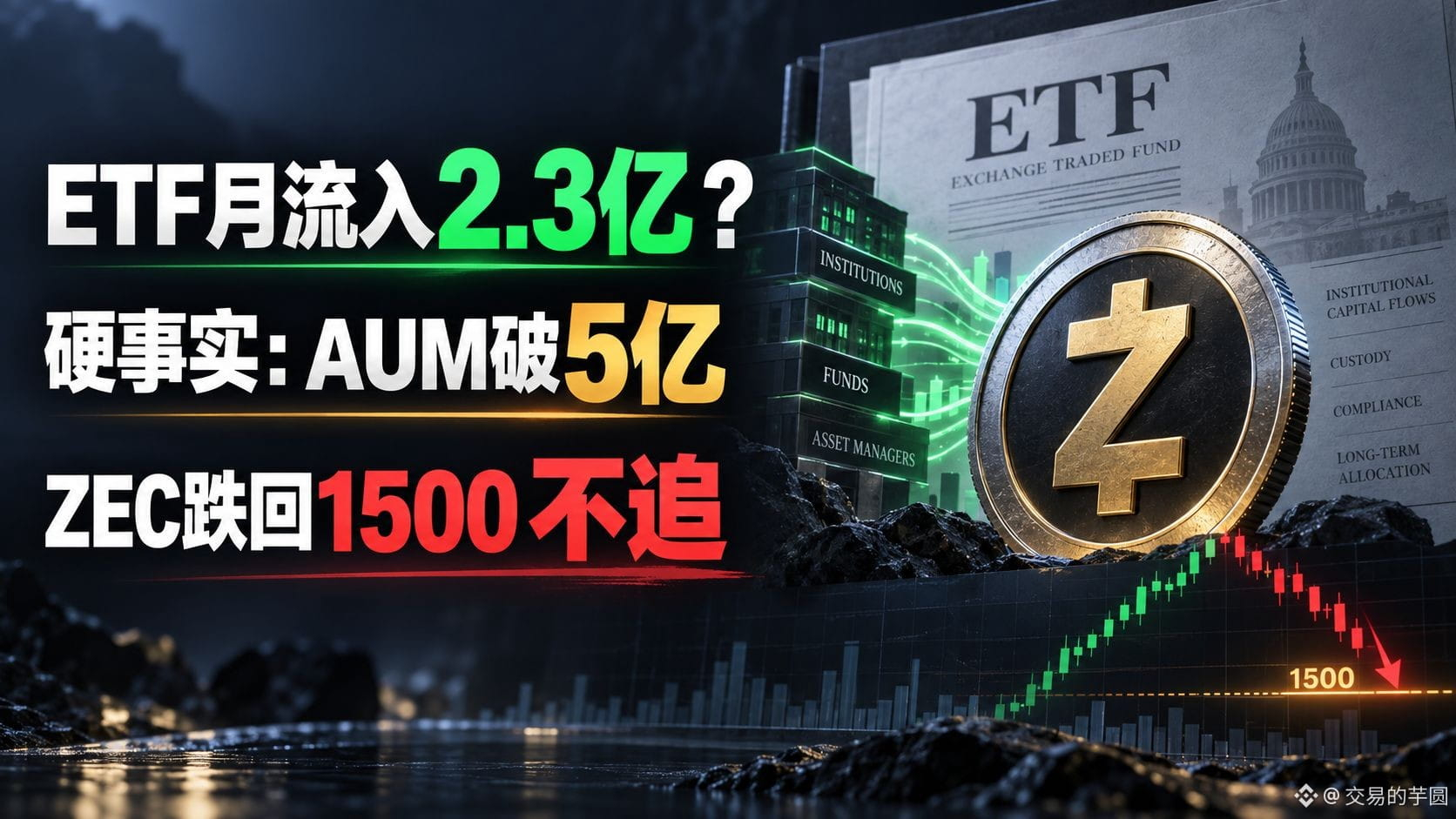
Zcash ETF sees inflows of 230 million yuan and hits the hot chart: the hard facts confirmed by the SEC are that AUM has broken 500 million. ZEC falls back to 1500—I’m not chasing
I’ll put my stance up front: this news is somewhat favorable for ZEC’s mid-term liquidity structure, but in the short term I will still stay on the sidelines. I won’t chase a breakout near 1500 just because a headline mentions “ETF inflows.” Binance Square is discussing #ZcashSpotETFTops$230MMonthlyInflow, and the hot-chart metric claims Zcash’s spot ETF has monthly net inflows of more than 230 million USD. After checking the original documents, I’m more willing to separate “confirmable facts” from “hot-chart statistics.”
SEC filings show that the former Grayscale Zcash Trust was renamed The Zcash ETF on August 24. The registration statement became effective the same day, and NYSE Arca also confirmed approval for its share listing. Trading for the product began on August 25, with the ticker still ZCSH. In the 8-K dated September 8 and the attached press release, it shows that within two weeks the fund’s AUM exceeded 500 million USD. DCG, via authorized participants, exchanged 85,705.32563297 ZEC for approximately 100 million USD worth of fund shares, and ZCSH options have also been launched. AUM growth, institutional in-kind subscriptions, and “monthly net inflows of 230 million USD” are not the same metric. The first two are confirmed by SEC filings; the 230 million figure is a Square hot-chart metric. Without seeing day-by-day subscription/redemption details, I won’t write that all the capital is same-day aggressive buying.
Why does this still matter? First, the ETF lowers custody, compliance-account, and trading time barriers—traditional capital now has another channel to gain ZEC exposure. Second, in-kind share exchanges can bring large amounts of ZEC into the fund structure, theoretically reducing some of the freely circulating supply. Third, after options are listed, institutions can hedge as well; it doesn’t mean every dollar is one-direction bullish. What it improves is participation channels, not a price floor guarantee.
The market has already given a reminder. When OKX published ZEC perpetual records, it was around $1497, with a 24-hour range of $1425.92—$1548.76, funding rate about +0.01%, and open interest equivalent to roughly $194 million. My plan I publicly posted this morning set 1492 as the de-risking line. After that, price fell from $1548.76, with the 15-minute low reaching $1490.17—showing this risk condition has been touched. This is just a review of the old plan; it doesn’t mean I actually filled orders or profited in real trading. Now that 1500 has turned from support back into a boundary requiring confirmation, news momentum is high but the price hasn’t held the higher range in sync, so chasing the move doesn’t offer good odds.
If I were trading for myself, I’m currently staying at 0 position to observe. Bulls only enter if the 15-minute chart re-closes above 1512 and then holds 1504—1509 on the pullback while volume ramps up again; then I would try a long with up to 2% of principal spot. First observation target: 1526—1532; second target: 1548—1555. If, after entry, price falls back to 1498, I’ll cut the position by half. If the 1-hour candle closes below 1488, I’ll exit completely and won’t add to average down. Another scenario: price breaks below 1488 with volume and then fails to reclaim 1495 on the rebound—I would at most use 0.8% of principal with low leverage to try a short first looking at 1477, then 1460—1465. If it closes back above 1506, it means the short thesis is wrong and I’d close immediately. If price keeps ranging between 1490—1512, I’d rather continue waiting than do revenge-style trades driven by hot topics.
$ZEC #ZcashSpotETFTops$230MMonthlyInflow
The above is only my personal market observation and does not constitute investment advice.
I’ll put my stance up front: this news is somewhat favorable for ZEC’s mid-term liquidity structure, but in the short term I will still stay on the sidelines. I won’t chase a breakout near 1500 just because a headline mentions “ETF inflows.” Binance Square is discussing #ZcashSpotETFTops$230MMonthlyInflow, and the hot-chart metric claims Zcash’s spot ETF has monthly net inflows of more than 230 million USD. After checking the original documents, I’m more willing to separate “confirmable facts” from “hot-chart statistics.”
SEC filings show that the former Grayscale Zcash Trust was renamed The Zcash ETF on August 24. The registration statement became effective the same day, and NYSE Arca also confirmed approval for its share listing. Trading for the product began on August 25, with the ticker still ZCSH. In the 8-K dated September 8 and the attached press release, it shows that within two weeks the fund’s AUM exceeded 500 million USD. DCG, via authorized participants, exchanged 85,705.32563297 ZEC for approximately 100 million USD worth of fund shares, and ZCSH options have also been launched. AUM growth, institutional in-kind subscriptions, and “monthly net inflows of 230 million USD” are not the same metric. The first two are confirmed by SEC filings; the 230 million figure is a Square hot-chart metric. Without seeing day-by-day subscription/redemption details, I won’t write that all the capital is same-day aggressive buying.
Why does this still matter? First, the ETF lowers custody, compliance-account, and trading time barriers—traditional capital now has another channel to gain ZEC exposure. Second, in-kind share exchanges can bring large amounts of ZEC into the fund structure, theoretically reducing some of the freely circulating supply. Third, after options are listed, institutions can hedge as well; it doesn’t mean every dollar is one-direction bullish. What it improves is participation channels, not a price floor guarantee.
The market has already given a reminder. When OKX published ZEC perpetual records, it was around $1497, with a 24-hour range of $1425.92—$1548.76, funding rate about +0.01%, and open interest equivalent to roughly $194 million. My plan I publicly posted this morning set 1492 as the de-risking line. After that, price fell from $1548.76, with the 15-minute low reaching $1490.17—showing this risk condition has been touched. This is just a review of the old plan; it doesn’t mean I actually filled orders or profited in real trading. Now that 1500 has turned from support back into a boundary requiring confirmation, news momentum is high but the price hasn’t held the higher range in sync, so chasing the move doesn’t offer good odds.
If I were trading for myself, I’m currently staying at 0 position to observe. Bulls only enter if the 15-minute chart re-closes above 1512 and then holds 1504—1509 on the pullback while volume ramps up again; then I would try a long with up to 2% of principal spot. First observation target: 1526—1532; second target: 1548—1555. If, after entry, price falls back to 1498, I’ll cut the position by half. If the 1-hour candle closes below 1488, I’ll exit completely and won’t add to average down. Another scenario: price breaks below 1488 with volume and then fails to reclaim 1495 on the rebound—I would at most use 0.8% of principal with low leverage to try a short first looking at 1477, then 1460—1465. If it closes back above 1506, it means the short thesis is wrong and I’d close immediately. If price keeps ranging between 1490—1512, I’d rather continue waiting than do revenge-style trades driven by hot topics.
$ZEC #ZcashSpotETFTops$230MMonthlyInflow
The above is only my personal market observation and does not constitute investment advice.