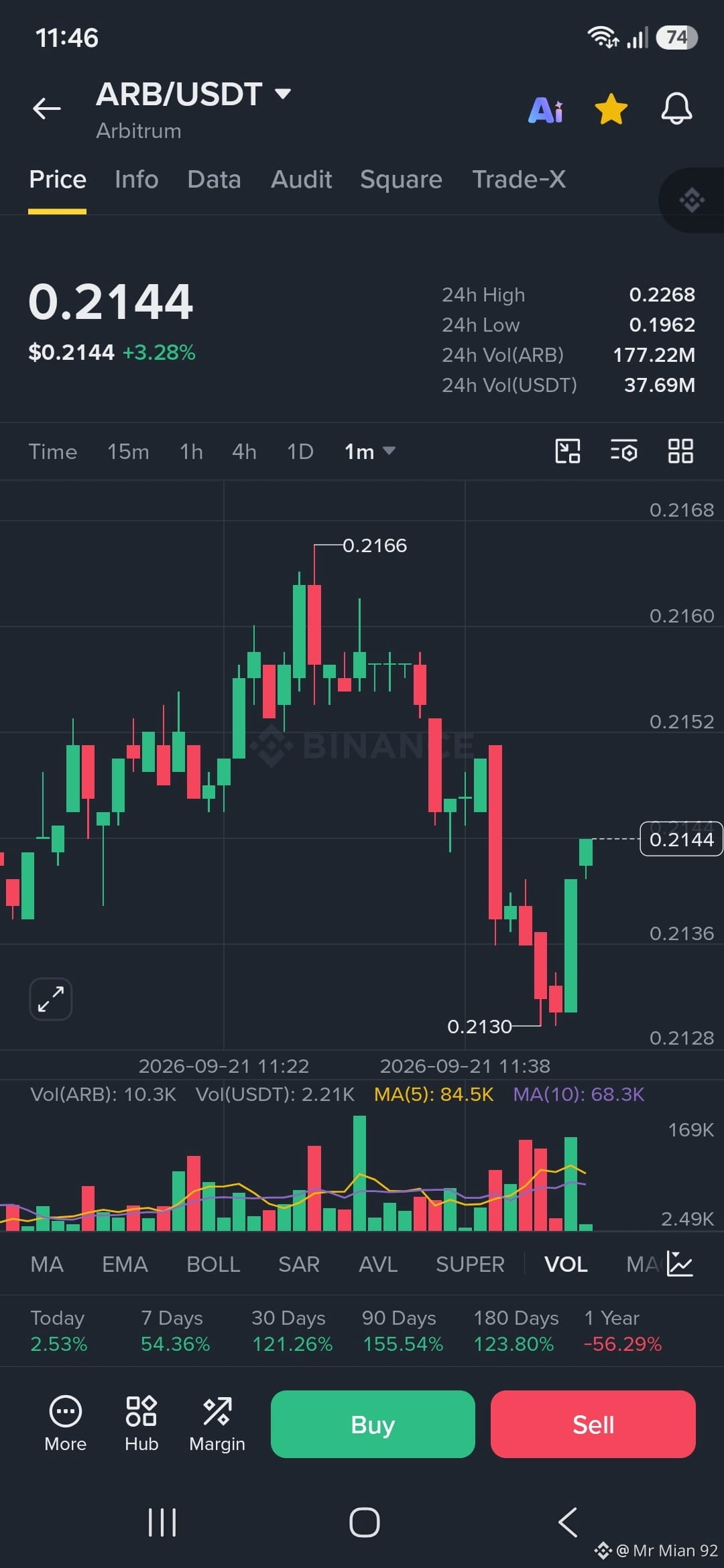
This is classic high-stakes crypto derivatives dynamics playing out in real time. Here is how that setup breaks down for $ARB:
The Anatomy of the Press
Press Pressure at 0.2147: You are sitting right at a high-tension pivot point. When price compresses tightly against a key support or resistance level, volatility isn't dying—it's storing energy like a coiled spring.
The OI Drop (-5%): Open Interest declining alongside steady or compressed price often signals capitulation or derisking by weaker leverage. The smart money or over-leveraged late entries are quietly backing off to avoid the liquidation cascade before the actual move happens.
>60% Bull Positioning: Retail/long dominance sitting above 60% is a classic double-edged sword. If the market maker pushes price up, it fuels a powerful breakout. But if the main force dumps through support, those long positions become instant liquidity (a long squeeze) to fill cheap buy orders lower down.
The "Churn" vs. Breakout: Right now, $ARB is in the churn phase—shaking out impatience, collecting funding rates, and building liquidity pools on both sides of the spread.
Execution Rule: Signal > Prediction
Trying to front-run the main force before the breakout is pure gambling. The edge lies in reaction speed, not forecasting:
Upper Trigger (Bullish Expansion): Wait for a clear high-volume close above the press line with rising Open Interest. A real breakout will aggressively squeeze short positions, triggering market buys as stops get hit.
Lower Trigger (Invalidation): If price breaks down through support, the heavy long bias (>60%) will trigger cascading liquidations. Wait for the liquidation wick to complete before looking for re-entry.
Trading Rule: Never guess the critical point in a compressed market. Let the main force commit first, confirm the volume expansion, and ride the momentum.
The Anatomy of the Press
Press Pressure at 0.2147: You are sitting right at a high-tension pivot point. When price compresses tightly against a key support or resistance level, volatility isn't dying—it's storing energy like a coiled spring.
The OI Drop (-5%): Open Interest declining alongside steady or compressed price often signals capitulation or derisking by weaker leverage. The smart money or over-leveraged late entries are quietly backing off to avoid the liquidation cascade before the actual move happens.
>60% Bull Positioning: Retail/long dominance sitting above 60% is a classic double-edged sword. If the market maker pushes price up, it fuels a powerful breakout. But if the main force dumps through support, those long positions become instant liquidity (a long squeeze) to fill cheap buy orders lower down.
The "Churn" vs. Breakout: Right now, $ARB is in the churn phase—shaking out impatience, collecting funding rates, and building liquidity pools on both sides of the spread.
Execution Rule: Signal > Prediction
Trying to front-run the main force before the breakout is pure gambling. The edge lies in reaction speed, not forecasting:
Upper Trigger (Bullish Expansion): Wait for a clear high-volume close above the press line with rising Open Interest. A real breakout will aggressively squeeze short positions, triggering market buys as stops get hit.
Lower Trigger (Invalidation): If price breaks down through support, the heavy long bias (>60%) will trigger cascading liquidations. Wait for the liquidation wick to complete before looking for re-entry.
Trading Rule: Never guess the critical point in a compressed market. Let the main force commit first, confirm the volume expansion, and ride the momentum.