
A new week begins.
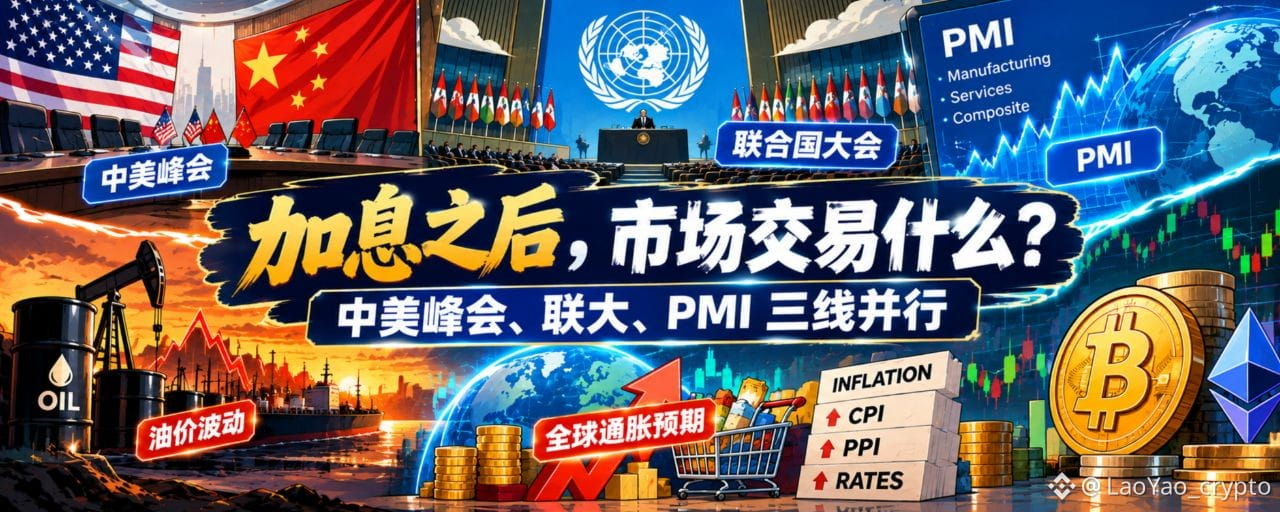
Last week, global markets went through a key event: the Fed’s rate hike.
This week, the market’s focus is shifting:
From “whether to raise rates” to “what happens after rate hikes.”
With no major data releases such as NFP or CPI, the data calendar this week is relatively light. But what really deserves attention is that three pricing storylines are unfolding at the same time:
Geopolitics—China-US summit, the UN General Assembly, and the situation in the Middle East;
Economic fundamentals—whether global PMIs can confirm economic resilience;
Monetary policy—amid high inflation, whether the Fed still has room to continue raising rates.
So the market’s core this week is no longer just “the rate hike itself,” but:
- After rate hikes, will the economy continue to remain resilient?
- Will inflation re-accelerate?
- Can geopolitical risk show a path toward easing?
These three questions will determine how capital re-allocates in the next phase.
Key words this week: U.S.-China summit | inflation | the Fed | crude oil | inflation
🧱 Geopolitical maneuvering: from “war premium” to “diplomatic premium”
The situation in the Middle East remains an important variable in global asset pricing.
Houthi attacks on Saudi Arabia’s capital Riyadh, affecting Saudi energy facilities.
Meanwhile, Trump is expected to meet during the week in New York with leaders or senior officials from the member states of the GCC, and during the UN General Assembly, Middle East issues will also become an important agenda item.
More notably, China has also been reported to be pushing Iran to restrain the Houthis, to prevent further expansion of energy transportation risks in the Red Sea.
This means the Middle East market is trading two possibilities at the same time:
On one side, escalating conflict brings energy-related risks;
On the other side is a path of easing opened up by negotiations, mediation, and post-war arrangements.
For capital markets, is the market starting to see a path that can lead to an end?
If the probability of a diplomatic solution rises, then some of the “war premium” that was previously priced into oil prices, inflation expectations, and risk assets could be repriced.
Therefore, what’s worth watching in the Middle East market this week is not only whether it will continue to “fight,” but also:
Is there a signal of shifting from military games to diplomatic games?
🌏 U.S.-China summit and the UN General Assembly
——Geopolitics enters a dense window
Another important storyline this week is the UN General Assembly and high-level diplomatic activities surrounding it.
During the UN General Assembly, Trump will hold a series of bilateral meetings; Middle East issues, Russia-Ukraine, and relations among major powers could all become negotiation topics.
For financial markets, the importance of events like this is not in the meeting itself, but in:
Among major global economies, whether new signals of policy coordination and risk easing appear.
Therefore, this week’s geopolitical trading is expanding from a single “war risk” to:
War → negotiations → trade → energy → global capital flows.
What needs watching this week is:
Changes in geopolitical relations ultimately determine whether capital’s judgments about inflation, interest rates, and growth change.
📅 This week’s global economic and financial data preview
September 21 | Monday China: LPR quotes
The market’s focus remains on whether rates will be adjusted and the policy stance toward economic growth.
Japan: market holiday
September 22 | Tuesday
Japan continues to be closed for the holiday.
At the same time, the UN General Assembly enters a key window. Trump will carry out a series of diplomatic activities in New York, and the Middle East situation and relations among major powers are worth watching.
September 23 | Wednesday
Initial global S&P Global PMI
Germany, France, the eurozone, the UK, and the U.S. will release manufacturing, services, and composite PMI data clustered together.
This is the most important macro data window of the week.
Key to watch:
- Will growth continue to remain resilient?
- Will manufacturing and services keep diverging?
- Whether Europe’s recession risk will expand further;
- Is the U.S. economy starting to show cooling signals after rate hikes?
September 24 | Thursday
Part of the Asian markets, such as China, Taiwan, and South Korea, are closed for holidays, affecting trading tempo.
The market’s focus is returning to:
PMI data → Fed policy path → U.S. Treasury yields → risk assets.
💸 Web3 roundup
Over the past 24 hours, the crypto market has been in a back-and-forth game between long and short positions. The market has gradually shifted from the “wait-and-see boot effect of macro policy landing” to a dual-engine drive of “institutional capital positioning at high levels” and “expectations of compliance bills landing.” Overall, the total market capitalization of crypto assets has rebounded to about $2.86 trillion.
$BTC : holds the 80.5K level, with longs continuing to break through;
$ETH : 2620 level, gently tracking BTC, with liquidity in the ecosystem accumulating;
At present, the focus of the crypto market is on:
Repricing between U.S. Treasury yields, U.S. dollar liquidity, oil prices, and risk appetite.
What BTC is truly facing this week is:
——A renewed balance of global capital costs and risk appetite.
🧘 Coin-circle mindset study:
After the previous week’s rate-policy decisions of major economies were implemented,
Global financial markets have entered a new phase: repricing after rate hikes.
In the past, the market asked: “Will the Fed raise rates?”
Now the market asks: “After rate hikes, what happens to the economy?”
In the past, the market traded: “Will the war escalate?”
Now the market starts trading: “Is there a path for the war to end?”
What the market trades is never only “what happens,” but “what happens after it happens.”
So, rate hikes are not the end point.
What will determine asset prices in the next phase is: inflation × growth × geopolitics × liquidity
After four variables are recombined, what kind of capital pricing will form.
This is also what the market truly starts trading “after the rate hikes.”
LaoYao (@wisebon )
Observe capital through mindset study, and read trends through the cycle;
Find certainty in uncertainty, and anchor value amid volatility.