
🔴 Futures Trading for Beginners
In Spot Trading, you can actually buy and hold crypto. Futures Trading is slightly different.
In futures, you are not directly buying and holding crypto; instead, you trade a contract based on the price movement of crypto.
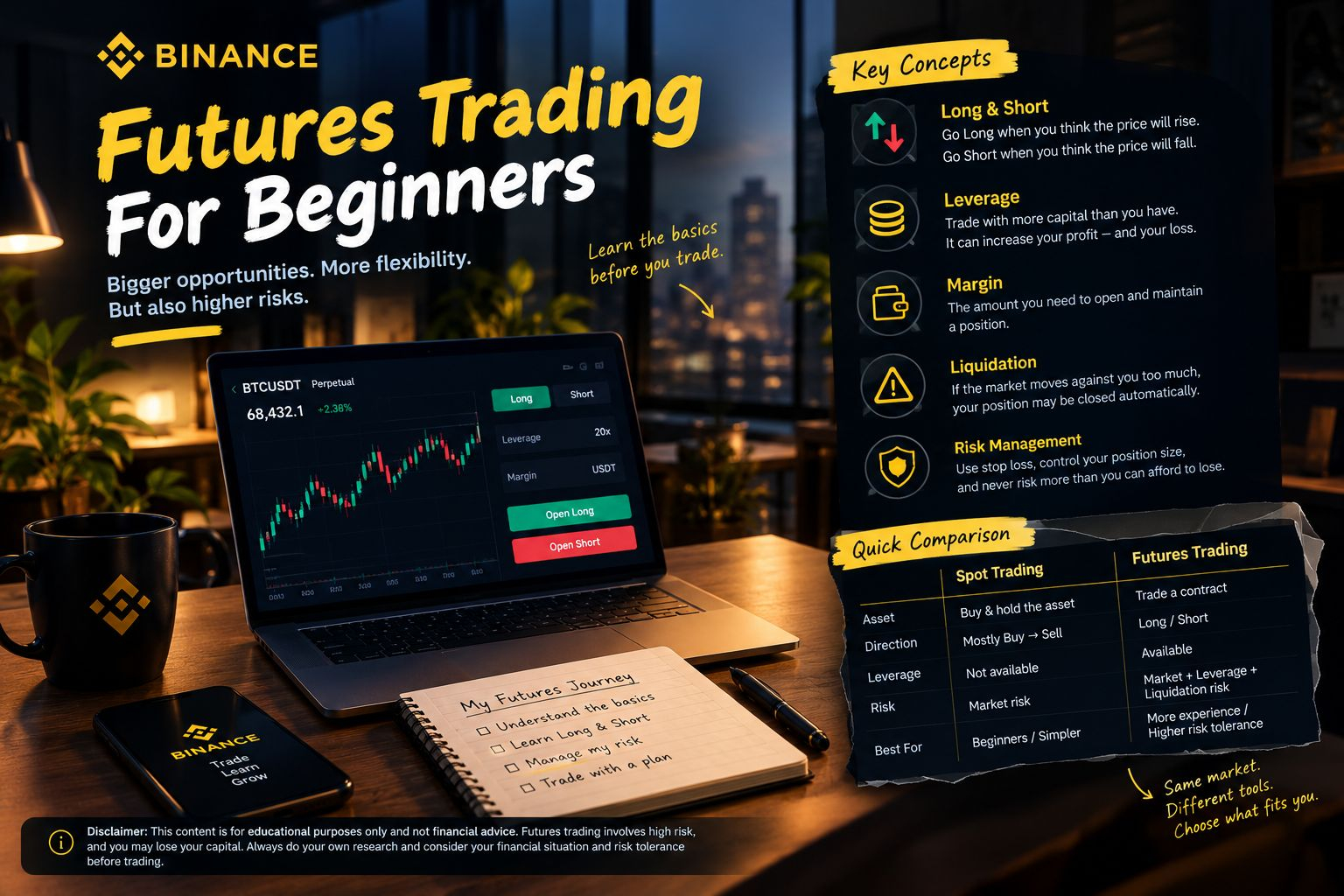
So when you start learning futures, it’s important to understand the basic concepts first: Long, Short, leverage, margin, and liquidation.
💡 What is Futures Trading?
In simple terms, futures trading is trading the movement of whether an asset’s price will go up or down.
For example, if you believe BTC price will go up, you can open a Long position. If you expect BTC price to go down, you can open a Short position.
Spot usually means buying and holding an asset, while futures means opening a position based on price direction.
----
📈 What is Long?
Long is when you open a position expecting the price to go up.
Example
If you go Long on BTC at $60,000 and the price rises to $65,000, your position can be profitable.
However, if the price moves against your expectations and goes down, you may incur a loss.
Long = Expecting the price to go up
----
📉 What is Short?
One interesting thing about futures is that you can trade even when the price is falling.
When you expect the price to go down, you can open a Short position.
For example, if you go Short on BTC at $60,000 and the price drops to $55,000, your position can be profitable.
But if the price goes back up, you can still incur a loss.
Short = Expecting the price to go down
----
⚡ What is leverage?
One of the most important things in futures trading is leverage.
Leverage helps you control a position that is larger than the capital you have.
For example, if you have $100 and use leverage, you can open a position larger than $100.
But the important thing here is that
Leverage doesn’t only increase profit. It can also increase losses quickly.
So for beginners, it’s more important to understand the risks of leverage first than to use leverage at high levels.
---
💰 What is margin?
Margin is the fund (capital) you use to open a futures position.
For example, if you use $100 as margin and open a futures position, that $100 is the base capital for the position.
When using leverage, the total size of your position can be larger than your margin.
So the larger your position size is, the more even small price movements in the market can affect your P&L.
----
⚠️ What is liquidation?
For beginners in futures, liquidation is something you must understand.
If the market moves extremely against your position and there is no enough margin to keep the position open, the exchange may automatically close the position according to its rules.
This is called liquidation.
As leverage gets higher, liquidation can happen faster, so risk management in futures is especially important.
----
🆚 What’s the difference between Spot and Futures?
Spot Trading
- You can buy crypto directly
- Typically you can hold the asset
- No need for a Long/Short position style
- You can trade without using leverage
- Simpler structure
Futures Trading
- Trade the contract
- You can do both Long and Short
- Leverage is available
- Margin is required
- There is liquidation risk
- Higher risk than spot
🧠 What should a beginner know?
When starting to learn futures, don’t just focus on making a profit—also understand how losses can happen.
Before you open a trade
1. Why are you entering this position?
Make sure you clearly understand your trading idea.
2. How much risk will you take?
Control your position size so it matches your capital.
3. Where should you stop the loss?
If needed, use a Stop Loss to set your risk in advance.
4. How much leverage will you use?
Higher leverage doesn’t mean you’ll definitely make more profit. It also means higher risk.
5. Trade with only the money you can afford to lose.
If the market in futures moves against your expectation, losses can happen quickly.
----
🚨 Common mistakes beginners often make
Entering a trade out of FOMO (Fear Of Missing Out)
Entering a Long position impulsively when you see the price rising.
Using extremely high leverage
Using a lot of leverage without considering that the bigger the position size, the higher the risk becomes.
Position gets larger in order to get the loss back
After experiencing a loss, increasing the trade size with “this time I’ll get it back.”
Not setting a Stop Loss
Holding onto the loss while expecting the market to turn around.
Trading without understanding
Starting to trade with real money without knowing futures’ margin, leverage, or liquidation.
----
🎯 How should you start learning futures?
As a beginner, study the basic steps first: Long/Short → Margin → Leverage → Liquidation → Risk Management.
Then you can learn hands-on by using a demo to open and close positions and see how P&L changes.
Futures trading is not enough to just guess in order to make a profit. It’s more important to understand market risk and to control your positions.
⚠️ Disclaimer: This content is for educational purposes only and is not financial advice. Futures Trading is high risk, and while leverage can lead to profits, losses can also occur quickly, and liquidation is possible. Before trading, study the relevant product details, fees, funding, leverage, margin, liquidation mechanism, terms, and risks yourself, and make decisions based on your own financial situation and risk tolerance.
#FutureTrading #Falcon #Beginnersguide