
Gm, #学堂日报 , September 21 Market Overview
1️⃣ Market Overview
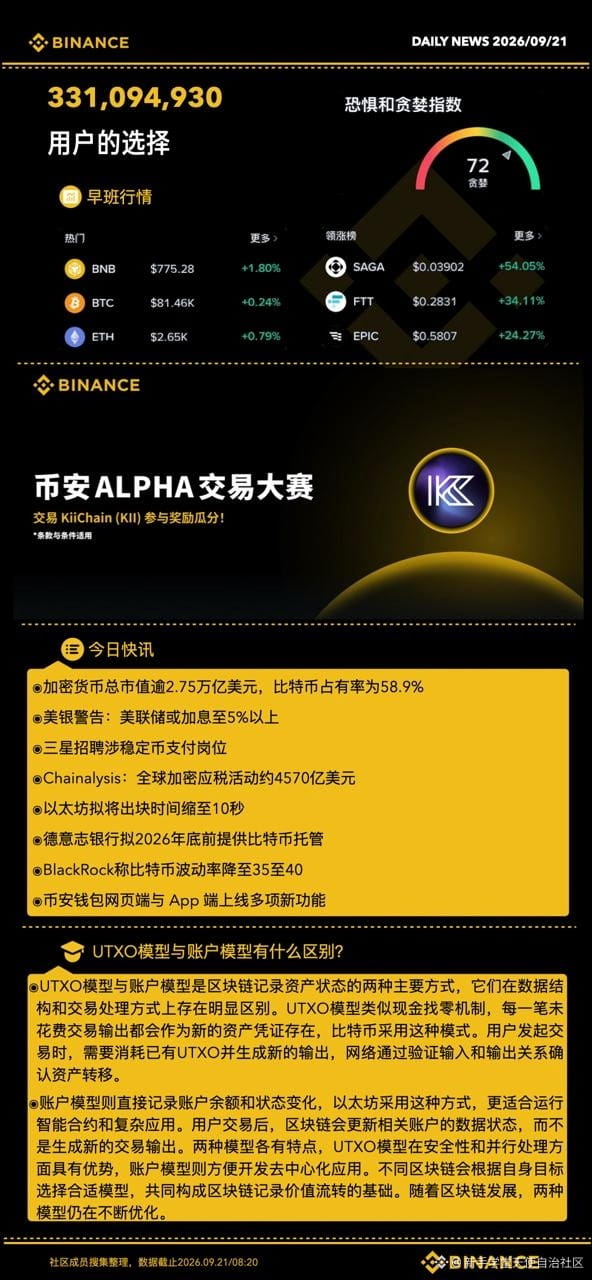
▪ The total market capitalization of cryptocurrencies is approximately $2.75 trillion, with Bitcoin’s market share at 58.9%.
▪ The Fear & Greed Index is 72 (Greed). Market sentiment remains relatively strong.
2️⃣ Binance Updates
▪ Binance Alpha launches the KiiChain (KII) trading competition. Users can earn rewards by participating in trading.
▪ The Binance Wallet web and app platforms have launched multiple new features, continuing to optimize the on-chain trading and asset management experience.
▪ Binance continues to update its Alpha and Wallet products, expanding new project participation and Web3 use cases.
3️⃣ Industry Hot Topics
▪ Bank of America warns that if inflation persists, the Federal Reserve’s potential rate hike magnitude could reach above 5%.
▪ Samsung is hiring for roles related to stablecoin payments, while traditional tech companies continue to expand their digital payment offerings.
▪ Chainalysis data shows that the global scale of crypto-tax related activities is about $457 billion.
▪ Ethereum plans to shorten block time to 10 seconds, further improving network efficiency.
▪ Deutsche Bank plans to provide Bitcoin custody services by the end of 2026.
▪ BlackRock states that Bitcoin’s recent volatility has fallen to around the 35–40 range, with market volatility gradually converging.
4️⃣ Today’s Quick Lesson: What’s the Difference Between the UTXO Model and the Account Model?
🔸 What is the UTXO Model?
▪ UTXO can be understood as a set of “digital vouchers that have not yet been spent.”
▪ Each time a user makes a transfer, they consume existing UTXOs and create new ones. This is the model used by Bitcoin.
🔸 What is the Account Model?
▪ The account model is more like a traditional bank account—it directly records each account’s current balance and status.
▪ Platforms like Ethereum, which support smart contracts, commonly use this approach because it makes handling complex applications easier.
🔸 The biggest differences
▪ The UTXO model focuses on “which funds have not yet been spent”;
▪ The account model focuses on “how much balance the account currently has and what state it’s in.”
🔸 What are the advantages of each?
▪ The UTXO structure is clear, suitable for parallel processing, and makes it easier to track fund movements.
▪ The account model’s logic is more intuitive and better suited for complex smart contract applications such as DeFi, NFTs, and lending.
Follow @新手学堂天使自治社区 to learn more 🚀
1️⃣ Market Overview
▪ The total market capitalization of cryptocurrencies is approximately $2.75 trillion, with Bitcoin’s market share at 58.9%.
▪ The Fear & Greed Index is 72 (Greed). Market sentiment remains relatively strong.
2️⃣ Binance Updates
▪ Binance Alpha launches the KiiChain (KII) trading competition. Users can earn rewards by participating in trading.
▪ The Binance Wallet web and app platforms have launched multiple new features, continuing to optimize the on-chain trading and asset management experience.
▪ Binance continues to update its Alpha and Wallet products, expanding new project participation and Web3 use cases.
3️⃣ Industry Hot Topics
▪ Bank of America warns that if inflation persists, the Federal Reserve’s potential rate hike magnitude could reach above 5%.
▪ Samsung is hiring for roles related to stablecoin payments, while traditional tech companies continue to expand their digital payment offerings.
▪ Chainalysis data shows that the global scale of crypto-tax related activities is about $457 billion.
▪ Ethereum plans to shorten block time to 10 seconds, further improving network efficiency.
▪ Deutsche Bank plans to provide Bitcoin custody services by the end of 2026.
▪ BlackRock states that Bitcoin’s recent volatility has fallen to around the 35–40 range, with market volatility gradually converging.
4️⃣ Today’s Quick Lesson: What’s the Difference Between the UTXO Model and the Account Model?
🔸 What is the UTXO Model?
▪ UTXO can be understood as a set of “digital vouchers that have not yet been spent.”
▪ Each time a user makes a transfer, they consume existing UTXOs and create new ones. This is the model used by Bitcoin.
🔸 What is the Account Model?
▪ The account model is more like a traditional bank account—it directly records each account’s current balance and status.
▪ Platforms like Ethereum, which support smart contracts, commonly use this approach because it makes handling complex applications easier.
🔸 The biggest differences
▪ The UTXO model focuses on “which funds have not yet been spent”;
▪ The account model focuses on “how much balance the account currently has and what state it’s in.”
🔸 What are the advantages of each?
▪ The UTXO structure is clear, suitable for parallel processing, and makes it easier to track fund movements.
▪ The account model’s logic is more intuitive and better suited for complex smart contract applications such as DeFi, NFTs, and lending.
Follow @新手学堂天使自治社区 to learn more 🚀