




Now’s AI and tomorrow’s AI
If we divide the AI industry chain into upstream equipment, midstream cloud providers, and large model companies, then the downstream is application companies. Currently, almost all the profits in the industry are concentrated in the upstream. For example, just Nvidia (NVDA.US) plus the four major storage manufacturers take nearly 70% of the industry’s profits.
This kind of profit distribution shows the typical characteristics of the early stage of a new technology revolution. But let’s think: in the future, the charging entry points for the AI industry won’t be cloud providers or downstream application companies—so will profit distribution still look like this?
Taking a mature internet industry as an example, the approximate proportions of economic profit distribution are:
Upstream: equipment / technology: about 20%–30%
Midstream: networking / cloud / telecom carriers: about 10%–20%
Downstream platforms and applications: about 50%–70%
Obviously, the closer you are to the user entry point, the higher the profit share.
In recent years, the large capital expenditures of cloud vendors essentially front-load a portion of future cloud vendors’ profits today as the profits of upstream hardware companies. As for future revenues in the AI industry, they will mainly flow into downstream applications and cloud vendors.
As the growth rate of capital expenditures slows down, and as AI revenue itself grows, profit distribution across the entire industry chain will increasingly converge toward that of mature internet industries—continuing to concentrate upstream cloud vendors and downstream applications.
The total market cap of the AI industry chain in U.S. listed markets is about $2.5 trillion. Among this, upstream (including compute chips, semiconductor equipment, storage, and communication equipment) accounts for 47%; midstream cloud providers account for 50%; and downstream applications account for only 3%, leaving huge room.
If you’re investing in AI this year, then of course you should continue to invest in compute power. But if you’re investing in the future of AI, then there’s no doubt you should focus more on downstream applications. In the past three years, the upstream saw countless stocks multiply by 10x, but after the peak in capital expenditure, more of the profit distribution stays in the mid-to-downstream. The probability of finding 10x winners may be higher.
Previously, people felt that the uncertainty around AI applications was too high. In fact, it was mainly because the scale of native AI revenues domestically was still too small. But in the U.S., it’s different: clear paths have already emerged for AI applications, and a group of highly investable companies has appeared. This article still uses publicly listed U.S. AI application companies as examples to map out several key directions.
Compute power: look at industry momentum; applications: look at business models
AI applications are not a homogeneous segment. In 2026, there will be extremely sharp internal differentiation: infrastructure-type software boosted by AI workloads (including data platforms, observability, and security) will significantly outperform. “Go long on infrastructure software and limit SaaS exposure” has become the consensus strategy for investing in U.S. software right now.
But not all SaaS software can justify killing valuations. Looking at the interim reports, many software stocks have rapidly growing AI revenue, while at the same time many software infrastructure companies have extremely high valuations.
Compute power: look at industry momentum; applications: look at business models. There are three key variables to judge the pros and cons of sub-segments:
1) Pricing model: billing based on usage/consumption is naturally positively correlated with AI workloads. It can hedge the risk of fewer seats, unlike a pure seat-based model, which is under more pressure;
2) Position in the enterprise AI execution chain: platforms that control core data, permissions, and workflow entry points may be revalued from application software to enterprise AI infrastructure;
3) Is AI revenue incremental? The market pays only for trackable AI ARR/ACV/workload metrics—not for an AI strategy.
Based on these three criteria, AI applications can be divided into three tiers and seven segments.
First category: data platform
Suppose there is now a large e-commerce company that decides to AII in AI—after that, it hires as few people as possible, letting AI Agents run the company themselves.
This can’t be solved just by building a couple of Agent entry points. The first step—something every company needs to do—is to build an AI data platform. For AI to make decisions and execute, it must first know what happened in the past and what is happening now.
Previously, employees were the executors of company business, so data could be scattered anywhere: user data in CRM, orders in e-commerce databases, inventory and financial data in ERP, customer service records in customer service systems, product information in PIM, ad data in Meta and Google, employee data in HR systems, meeting minutes on each employee’s computer and email—plus more data in employees’ minds and chat logs (if it’s a Chinese company)…
At execution time, employees search and integrate these data from different channels. For example, if the boss asks, “Why did profits in the Shanghai region decline over the past three months?” you can log into different systems to check. If you don’t know, you ask coworkers directly—and then you can analyze.
Likewise, a truly working Agent must know all the data above at the same time. Without data, AI is just a very smart outsourced worker—but it doesn’t know what’s happening inside the company.
So the first thing in an AI transformation is to convert all kinds of company information into data that AI can understand, query, and call—everything you can migrate.
In the future, every meeting on a project, every communication among coworkers, and even every message from an employee will be synchronized and recorded digitally, becoming AI’s analysis data and training corpus—so that AI decisions can be based on real-time information of business operations.
In the U.S., the best performers are $Snowflake (SNOW.US)$ and $MongoDB (MDB.US)$—and there’s also a less typical but better-known company, $Palantir (PLTR.US)$.
$Snowflake (SNOW.US)$ has evolved from a single data warehouse service provider into a full AI data cloud platform. It launched a series of native AI products such as Cortex Code and Snowflake Intelligence, simplifying customer data migration, catalyzing consumption of core data business, and forming a powerful growth flywheel.
Companies in this category charge based on usage/consumption. AI workloads are naturally positively correlated. The interim report shows product revenue growth accelerated continuously for three quarters, reaching 37% in Q2. The company raised its full-year product revenue guidance to $6.07 billion (+36%). This validates that the “flywheel of AI-driven core platform consumption” has entered the realization phase.
However, this type of company also has extremely high valuation. SNOW trades at nearly 20x PS, with a market cap close to $120 billion, including higher future expectations. The market’s skepticism is about its cooperative competitive relationships with cloud giants like AWS, Microsoft, and Google.
Second category: observability
As more and more of this company’s business is handled by AI, it discovers a serious problem: it doesn’t know what the AI actually did. Are the consumed tokens really worth it? Which parts of the business can be optimized?
Previously, companies had a comprehensive system to record, evaluate, and assess employees’ work—most typically KPI management. Even though there were many negative reviews, it could ensure a company with tens of thousands of people ran automatically according to process. But AI work is a “black box.” AI can also slack off and do “busywork,” but its workflows may be completely different from humans’. Traditional KPIs will fail, so human employees need to continuously see what the AI actually did.
That’s the problem observability applications solve. It’s like AI’s HR—can humans use it to see what tools an AI Agent called? Which API did it call? How many Tokens did it use? Why did it make that decision? Which step went wrong? Which Agent performed better? Which Agent caused the loss?
A representative company in this segment is Datadog (DDOG.US). It can provide real-time monitoring of performance metrics for customers’ cloud, hybrid, or on-prem servers, containers, networks, and other traditional APM work. It can also offer code-level distributed tracing to help customers dig into performance bottlenecks in applications and microservices. Additionally, it can collect, process, and analyze massive log data from systems and applications for troubleshooting and performance analysis.
For this kind of application, the charging model is also consumption-based. DDOG Q2 revenue grew +36%, accelerating growth for four consecutive quarters, and it also raised its full-year performance guidance significantly. However, the valuation of this segment is extremely high too, making the stock price easy to be affected by negative narratives about the software sector.
Third category: cybersecurity
Cybersecurity was already an existing category in the traditional software era, but in the AI era its importance has surged. Because AI attacks are not limited to your systems—they can also be used to bait you as a hacker.
At its core, AI is a substitute for employees. Its permissions are greater than those of most employees. It can not only access databases, modify data, and send emails, but also carry out high-risk actions like transferring funds—sometimes even write code, deploy programs, and effectively “invade” your employees’ brains, “conspiring” with employees against the system.
Agents have reasoning, data-access, and action capabilities at the same time. Therefore, permissions, identity, audit trails, and tool-call controls will all become new security issues.
There are already many companies of this kind—network and cybersecurity concept names (LIST2570.US)—so I won’t list examples.
Among the three segments, security has the highest level of priority. The reason is mainly that its demand is more deterministic. Combined with the lag between AI spending and security-AI spending, the outlook for future revenue growth is strongly positive.
These three categories—data services, predictability, and cybersecurity—can be collectively referred to as the digital infrastructure of AI applications. They are the required “three-piece set” for every enterprise that will implement an AI strategy in the future. Spending is both front-loaded and ongoing, so these areas are the first to surge within the applications.
Built on these three types of digital infrastructure is the “execution layer” of applications—i.e., the various work interfaces in enterprises. I divide it into two categories: one is various Workflow / Agent platforms, and the other is AI programming.
Fourth category: Workflow/Agent platforms
After you have data and permissions, how exactly does this e-commerce company’s Agent work?
There are currently two types of solutions. The first type, on top of existing workflows, uses AI Agents together with various industry software to carry out work. This is called a “Workflow / Agent platform.”
For example, when this e-commerce company processes customer returns, the traditional workflow is reviewed by customer service: check orders, determine the reason, inspect inventory, issue refunds, handle logistics, notify the warehouse, and so on. Each step is software operated by humans.
In the “Workflow / Agent platform” model, the process is still the same; it’s just handled automatically by a dedicated Customer Agent.
In this model, besides the large model itself, the more important part is how to embed tool calls, permissions, and human approvals appropriately within the original workflow. The difficulty lies in collaboration between employees and Agents.
So, these application companies are basically software vendors transforming themselves—for example $Salesforce (CRM.US)$, $ServiceNow (NOW.US)$, $Microsoft (MSFT.US)$, and so on. Their pricing model also uses a dual structure: “seat + Token billing.”
But these non-native AI application vendors are also questioned for two main reasons: first, does their business growth really come from AI or from non-AI drivers? Second, for the pricing model, can incremental charges from added traffic make up for the decline in traditional seat-based fees?
Companies that are transforming more aggressively—for example $ServiceNow (NOW.US)$—now even position their platform as enterprise AI infrastructure that connects data, workflows, and AI Agents. Their platform can connect external data such as $SAP SE (SAP.US)$, $Salesforce (CRM.US)$, $Snowflake (SNOW.US)$, Databricks, and more.
If “Workflow / Agent platforms” represent the pattern of AI-driven traditional software, then “AI programming” means writing a program from scratch to get the job done.
Fifth category: AI programming
This is actually the B2B scenario where large models first got it working, triggering a huge spike in ARR in the first half of the year.
In theory, AI Agents would call existing software. But in practice, a large amount of software has no interfaces. Ironically, this is exactly where large models excel: writing programs. If you run into this kind of problem, it’s better to write a program yourself to solve it. This is how large models evolved from code completion to conversational programming, and finally to programming agents.
This category includes GitHub Copilot, Cursor, as well as Claude Code and Codex released by large-model labs.
I’m more inclined to distinguish AI programming from the functions of traditional software and AI large models. If you truly want to transform an enterprise with AI, you must fully step out of the existing workflow, and instead produce your own “production tools,” breaking the boundary between labor and production tools—only then can you genuinely improve work efficiency and create companies with trillion-dollar market caps like Anthropic.
This type of software has completely shifted from seat-based fees to Token-based billing. It goes directly into the application layer and forms direct competition with the earlier “Workflow / Agent platform.” Who will become the mainstream AI work model in the future may very well give birth to 10x stocks.
Sixth category: vertical industry and advertising AI
Among the first five categories of AI applications, they are all infrastructure and production tools in general workplace scenarios. The sixth category targets specific commercial scenarios. General-purpose large models struggle to meet compliance and accuracy requirements in these particular industries, which gives vertical software deeper moats.
This kind of “AI application” is actually built on top of the first five layers. The most mature today is the advertising AI from $Meta Platforms (META.US)$ / $Google-A (GOOGL.US)$ / $Applovin (APP.US)$.
Advertising was the earliest commercial use case to take off with AI. AI pushes eCPM/ROAS higher by increasing user time on site, improving targeted conversion rates, and boosting creative CTR.
Meta FY26Q1 ad revenue rose 33%. It claims impressions grew +19% and the price per unit increased +12%, attributing it to AI. Even more convincing is Google: FY26Q1 search revenue rose +19%, with queries hitting a record high—breaking the notion that AI search weakens ad resilience.
When investing in this kind of application company, the hardest part is determining whether AI-driven business growth is truly real. Many AI application companies that rely primarily on advertising revenue have a very small portion of revenue coming from AI. They also face the risk of being disrupted by AI. By contrast, companies like AppLovin—native AI advertising applications—derive nearly every dollar of revenue from AI-driven ads. Even if the valuation is on the high side, the incremental upside potential may still be underestimated.
Besides advertising, AI application progress in vertical industries—such as healthcare, tax/finance, education, and design—has been faster. These industries often have ROI that’s easier to quantify, and customers have strong willingness to pay for AI. However, investing is better approached using a perspective based on the relevant vertical industry analysis.
The disrupted: SaaS and IT services
For e-commerce companies that are “All in AI,” they previously had to spend millions buying large enterprise software each year, because each employee needed a seat license for the software they used frequently. But after AI arrived, once each employee gets a bunch of Agents, they realize they don’t need so many.
This is “models devouring software.” It’s not just a narrative—it’s something that is actually happening in the software industry. Large models can replicate SaaS functions faster and more cheaply, and by replacing employees they reduce the number of seats needed. Gartner expects that by 2030 at least 40% of enterprise SaaS spending will shift to usage/Agent/result-based billing, and seat-based revenue will fall to less than one-fifth. This forward-looking repricing compresses valuations before software earnings deteriorate. Intuit, Adobe, and Workday are the three weakest stocks among the Nasdaq 100 in the first half of 2026—all are software stocks.
Of course, by the second half of 2026, reality is no longer simply “SaaS is doomed.” It’s instead a distinction between AI transformers and AI laggards:
Companies like $Salesforce (CRM.US)$ are turning AI Agents into a new consumption/usage-based charging method. For now, they are safe—so I’ve placed them in the earlier fourth category, “Workflow / Agent platforms.” As for companies like Intuit, Adobe, and Workday, their AI initiatives are unlikely to accelerate growth in the near term. For now, they are listed outside the six categories of applications as a candidate group of “disrupted ones.”
More dangerous than SaaS is the IT services industry—this is a domain where disruption is happening.
Previously, this e-commerce company had to spend several million dollars every year on IT services companies like Accenture, IBM, and Infosys to purchase services such as system implementation, software development, data migration, ERP maintenance, and IT consulting.
Clearly, although there may be concerns about replacing employees with AI, there’s no obstacle to replacing IT outsourcing like this.
Accenture’s FY2026 Q3 revenue came in below expectations and it lowered its full-year growth guidance; the stock fell about 18% in a single day. The deeper reason is that enterprises sharply cut budgets for traditional software upgrades and system services to secure AI compute hardware. IBM has faced similar issues too.
Morgan Stanley’s 2Q26 CIO survey shows that the expected growth rate of IT services budgets in 2026 is only +1.8%, lower than +2.1% in 2025. Even as overall IT budgets improve, AI is still absorbing discretionary spend.
If the problem for SaaS companies is that software itself may be redefined by Agents, then the problem for IT services is that human roles may be replaced by Agents. The latter is clearly an even bigger headache.
Of course, these IT services companies also have new business. Customers may have difficulties achieving AI ROI, which creates new demand for AI services, just like how cloud migration creates new service needs. The question is whether they can replace the shrinkage of their existing business.
Summary
Traditional software can arguably be the first industry to be shattered by AI. It’s also the earliest booming area for native AI applications. At first, the market divided software companies into AI and non-AI. Now, the categorization is winners, losers, and “undetermined status.” Most are in the “undetermined status” group.
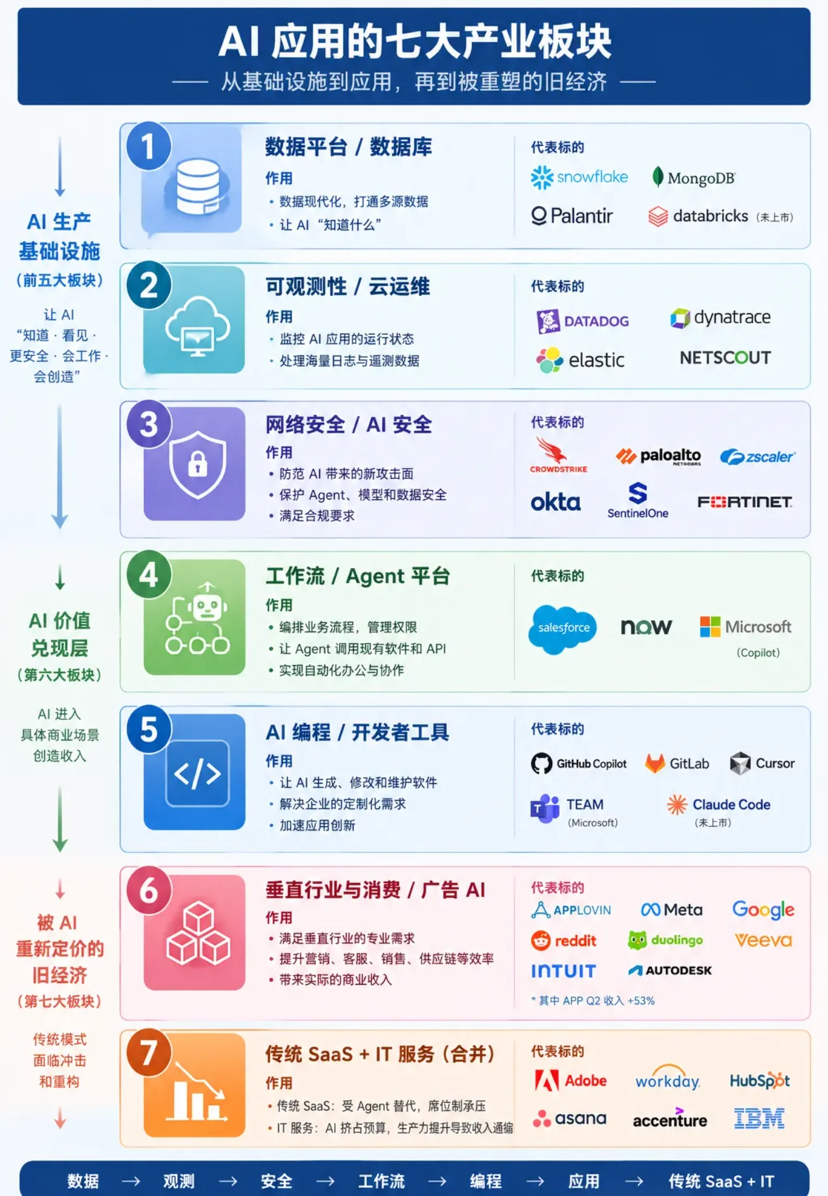
Among the seven application categories above, the first three are “winners.” They are data services, predictability services, and cybersecurity. Their common feature is that the demand is structural. The more AI spreads, the more complex systems become, and the more demand increases.
For the fourth and fifth categories—Workflow/Agent platforms and AI programming—status is still “undetermined.” But as AI becomes more widespread, their role becomes bigger, and they can even become a new enterprise operating system, fundamentally changing the business model of the software industry.
For the sixth category of vertical applications, the differentiation is extreme. You need to identify case by case: which ones are truly AI-driven businesses, and which are “pseudo-AI” wrapped in concept packaging.
Finally, the class that gets disrupted—what looks like the “losers” today. As AI becomes more widespread, old business models become more dangerous, but opportunities are not completely gone either.
AI-driven software applications are no longer a single industry. Especially for native applications like programming, it completely overturns the way enterprises produce work. In the future, software valuation frameworks should not focus only on revenue growth and profit margins; they should also consider AI call volume, task execution volume, the penetration rate of automated workflows, the degree of Agent dependency, and the progress of pricing architecture migration.
