


Author: Claude, Deep Tide TechFlow
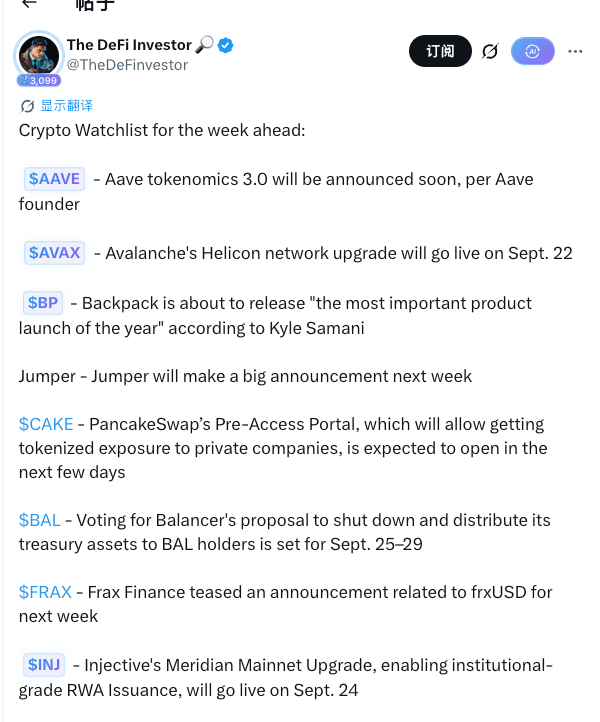
Deep Tide Intro: Crypto KOL @TheDeFiInvestor has compiled a list of this week’s catalysts.
The biggest headline is that Balancer’s shutdown proposal will be up for Snapshot voting from September 25 to 29. If it passes, this former flagship DEX will be gradually shut down, distributing at least $9 million in treasury assets proportionally to BAL holders who burn BAL. Aave founder Stani Kulechov has teased Aavenomics 3.0, proposing to upgrade weekly $1 million in committee buybacks into fully automatic protocol-level buybacks, with details to be announced during the upcoming quarterly calls in the next few weeks. Avalanche’s Helicon upgrade goes live on September 22, cutting the minimum validator lockup period from 14 days to 48 hours. The Binance Wallet has approved a Pre-Access subscription channel via PancakeSwap, giving users tokenized exposure to companies that are not yet listed. Injective’s Meridian mainnet upgrade is scheduled to go live on September 24, focusing on institutional-grade RWA issuance.
BAL: Balancer shutdown proposal to be voted on September 25; $9 million treasury left for the people who will burn the token
A well-known old-school DEX that once had TVL of over $3 billion is now voting on how to handle its own funeral.
According to a proposal released on September 14 by the governance forum, Marcus Hardt, a member of the Balancer treasury committee and former CEO of Balancer Labs, proposed an orderly shutdown of the protocol: stop new business development, and dissolve the DAO within the bounds of what is legally feasible. Treasury assets would be distributed proportionally in kind to holders of BAL who will be used for burning. The treasury manager kpk estimated the treasury’s current value at at least $9 million, including about $400 thousand reserved for liquidation fees. The previously approved BAL buyback plan would be canceled.
The trigger was the attack event on November 3, 2025. The attacker exploited a rounding vulnerability in the upscale function to withdraw more than $128 million from multiple v2 stable pools across several chains. Balancer Labs was already shut down in March this year; the protocol has been kept alive with a leaner architecture, but the revenue has not returned. According to DefiLlama data, monthly protocol revenue fell from $1.13 million before the attack to $56.8 thousand in August this year. “The product is built, but can’t be sold,” Hardt wrote on X. He admitted he underestimated the ongoing drag on adoption caused by the attack.
If the vote passes, liquidity providers must withdraw before October 30. The liquidity pool will then move to a withdraw-only mode. The first redemption window opens at the end of May 2027 for six months, and BAL will be burned in exchange for a share of the treasury. If rejected, the protocol continues operating under the existing lean architecture. BAL’s current price is about $0.11, down 99.85% from its historical peak of $74.92 in May 2021; its market cap is about $7 million, smaller than the treasury.
AAVE: Founder teases Aavenomics 3.0—buybacks change from “committee decision” to “protocol default”
According to The Defiant, Aave founder Stani Kulechov on September 18 previewed on the X platform Aavenomics 3.0: it will replace existing committee buybacks with automated, non-discretionary on-chain mechanisms. The protocol will be jointly funded by governance revenue and GHO stablecoin income. It will run continuously unless a governance vote calls it off.
The current mechanism is Aavenomics Phase 1 approved by governance in early 2025: the Aave finance committee buys back $1 million worth of AAVE on the secondary market each week, with an annualized value of about $50 million. The committee can adjust or pause at any time. The difference in version 3.0 is that the buybacks are built into the protocol’s economic architecture, eliminating the need for committee approval each cycle.
The background is the Aave Will Win framework passed in April this year: 100% of revenue from the Aave protocol, GHO and Aave App, Aave Pro, Swaps, and other branded products goes to the DAO treasury, while Aave Labs only receives a development budget. Kulechov said this revenue is currently about $134 million per year. According to DefiLlama, the circulating supply of GHO is about $599 million, and Aave’s historical cumulative protocol fees exceed $2.2 billion.
The full specifications and governance timeline will be announced at Aave’s next quarterly call, Kulechov said it will be “in the next few weeks.” After the news broke, AAVE surged from $79 to $98 at one point, and has since fallen back to around $89. The weekly gain is about 20%.
AVAX: Helicon upgrade activates on September 22; validator lockup period reduced from 14 days to 48 hours
According to the Avalanche official developers’ blog, the Helicon mainnet upgrade is scheduled to be activated at 11:00 AM Eastern Time on September 22 (UTC 15:00). Validators must upgrade to AvalancheGo v1.15.0 before that, otherwise they cannot follow the new chain. This is the first technical milestone after the conclusion of the Avalanche Summit New York conference.
The upgrades bundle six community proposals. Of the three that impact ordinary token holders the most: First, the shortest validation period is reduced from 336 hours to 48 hours. Coupled with auto-renewal staking, validators can stake once and continue producing blocks, while rewards are automatically re-staked (auto-compounded) according to a set proportion. Second, the reward threshold for the new cycle increases from an 80% uptime requirement to 90%. If you don’t meet it, there are no rewards for that cycle, but the principal is not slashed or forfeited. Third, the minimum consumption rate linearly decreases from 10% to 7.5% over 90 days. The official model estimates that annualized rewards for the shortest cycle drop by about 1.3 percentage points, and the annual inflation rate falls by 0.5% to 1%.
On the technical side, ACP-194 decouples consensus and execution on the C-Chain. Blocks are first accepted by consensus and then enter a parallel execution flow, with the goal that peak traffic no longer clogs the execution stage. Delegated staking does not get auto-renewal; each delegation must fit within a single validator cycle.
CAKE: Binance Wallet teams up with PancakeSwap to launch Pre-Access; retail users can subscribe to tokenized exposure to unlisted companies
According to an official announcement by Binance Wallet on September 20, the Pre-Access subscription event is hosted by PancakeSwap. Users participate via self-custody accounts in Binance Wallet, and the subscription quota is linked to Binance Alpha points, bStocks on-chain trading volume, and holdings. The first project has not yet been disclosed; the issue price, implied valuation, redemption mechanism, and legal structure are all still unknown.
The mechanism itself needs to be clearly explained: PancakeSwap provides the event entry; a third-party service provider manages the underlying tokenized exposure; and users’ assets remain in their self-custody wallets. After the event ends, users proceed to the redemption or refund flow according to the rules. This isn’t buying stocks. Binance Research points out that most tokenized pre-IPO tools are contractual claims on private company shares. Holders could be creditors, indirect beneficiaries, or derivatives holders, and may not be able to get into the company’s shareholder registry.
The other side of market demand is already heating up. According to Binance Research data, the open interest for pre-IPO perpetual contracts of Anthropic and OpenAI exceeded $160 million in September, up from only about $1 million in April. Meanwhile, the tokenized pre-IPO products from Republic and PreStocks combined have a market value of only $41 million. Binance is choosing to enter from the subscription side. The company names and token structures disclosed in the first phase will determine whether this track can turn from speculative trading in perpetual contracts into a real equity channel.
INJ: Meridian mainnet upgrade lands on September 24, targeting compliant RWA issuance
According to the Injective governance page, if the Meridian upgrade is passed by vote, the chain will pause at block height 184,394,000 at around 15:00 UTC on September 24, and resume after upgrading to v1.20.4.
The upgrade includes three components: regulated token implementation—supporting compliant tokenized issuance of real-world assets; unifying RWA perpetual markets so these assets trade in a single order flow; and launching a private RFQ (request for quote) test to connect institutional participants to on-chain quotes, laying the groundwork for the subsequent privacy platform CypherOS. INJ serves as the settlement asset for these activities. The chain pause window before and after the upgrade is a period that short-term traders should avoid.
Other catalysts at a glance
BP: Backpack teases “the year’s most important product launch.” Kyle Samani says Backpack is about to release the most important product this year. He joined Backpack US’s board of directors on September 2, after making his biggest personal angel investment in July. Backpack went live on September 1 with four stock perpetual contracts and enabled a shared margin pool for real U.S. stocks and crypto derivatives. Samani’s exact words were: “will reshape the nature of trading on-chain and off-chain.” The specific product form has not been disclosed.
Jumper: major announcement next week. Cross-chain aggregator Jumper teases that it will publish major news next week; the content is unknown and the signal-to-noise ratio is low.
FRAX: frxUSD-related announcements to be released next week. Frax Finance has previewed that there will be announcements next week related to the frxUSD stablecoin, without providing details.