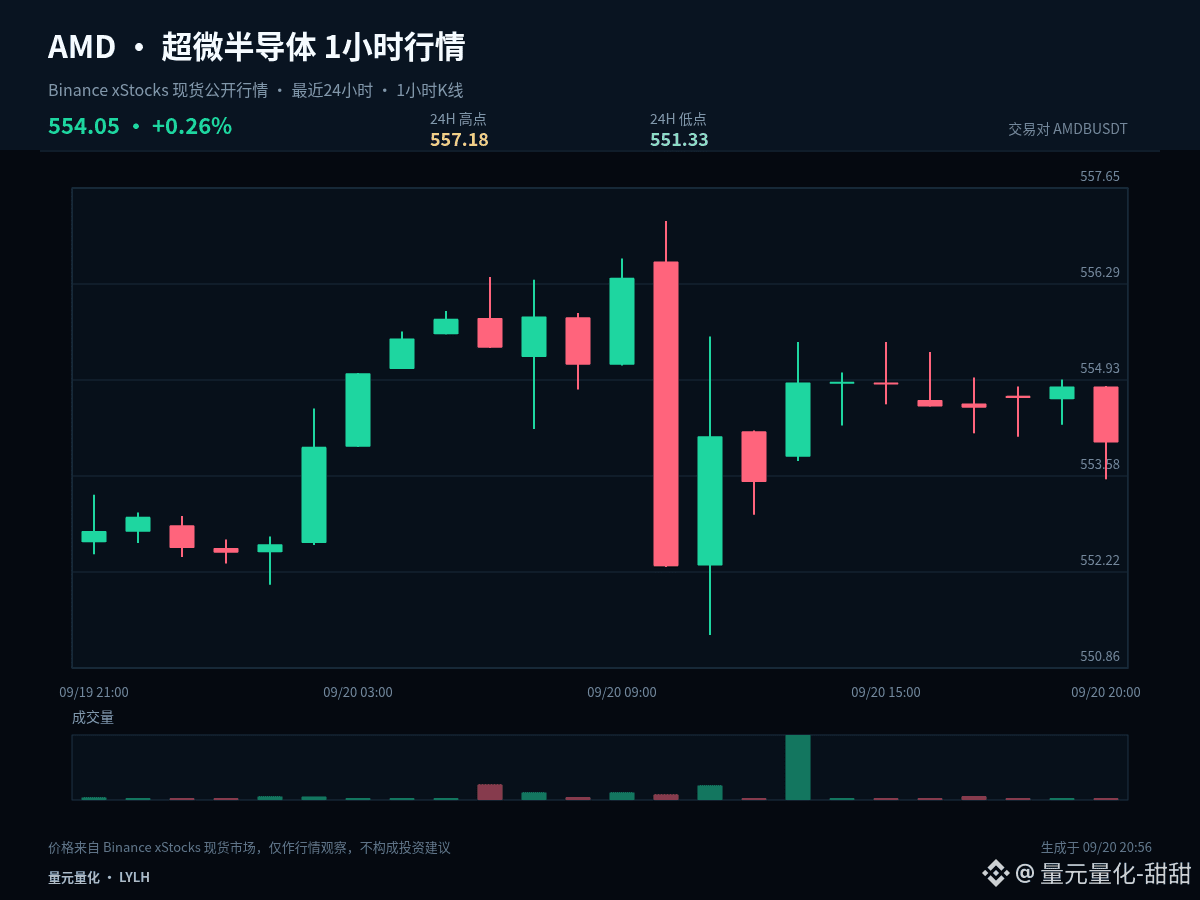
$AMDB #AMD It currently looks more like range trading and turnover; you don’t need to explain every single 1-hour candlestick as a new trend. Current price: 554.05; 1 hour: -0.14%, 24 hours: +0.27%.
With the current 1-hour change at -0.14% and 24-hour change at +0.27%, the two timeframes have not formed sufficiently clear directional alignment. In range conditions, the tolerance for chasing or cutting is lower. It’s better to use confirmation above the upper boundary and confirmation of support below the lower boundary. The midline should only be treated as a line separating strength and weakness.
Upper boundary: 557.18, lower boundary: 551.33, midline: 554.255. Observe breakout quality near the upper boundary; observe support near the lower boundary. Around the midline, reduce frequent trading, because price isn’t far enough from either side—both direction and risk-reward are unclear.
The signals truly worth acting on are: after a breakout, price is willing to stay in the new range; or after probing the boundary, price quickly pulls back. Without such confirmation, continue treating the market as consolidating. Don’t change the overall plan based on brief intraday fluctuations.
Existing positions can be handled in segments based on key levels, avoiding making all decisions at once. Those with no position should wait for breakout confirmation or for a retest to stabilize. For US stocks and related instruments, also watch for volatility caused by trading session transitions. Your plan should be based on price conditions—don’t let emotions replace execution.
Your trading plan must include invalidation conditions. If the judgment is correct, you can scale in and realize gains in stages. If the judgment is wrong, you must allow yourself to exit—don’t use adding positions to mask the fact that the original logic has changed. The market will update, and your viewpoint should adapt according to new price evidence.
#HKCompletesFirstHKDStablecoinUseCase
With the current 1-hour change at -0.14% and 24-hour change at +0.27%, the two timeframes have not formed sufficiently clear directional alignment. In range conditions, the tolerance for chasing or cutting is lower. It’s better to use confirmation above the upper boundary and confirmation of support below the lower boundary. The midline should only be treated as a line separating strength and weakness.
Upper boundary: 557.18, lower boundary: 551.33, midline: 554.255. Observe breakout quality near the upper boundary; observe support near the lower boundary. Around the midline, reduce frequent trading, because price isn’t far enough from either side—both direction and risk-reward are unclear.
The signals truly worth acting on are: after a breakout, price is willing to stay in the new range; or after probing the boundary, price quickly pulls back. Without such confirmation, continue treating the market as consolidating. Don’t change the overall plan based on brief intraday fluctuations.
Existing positions can be handled in segments based on key levels, avoiding making all decisions at once. Those with no position should wait for breakout confirmation or for a retest to stabilize. For US stocks and related instruments, also watch for volatility caused by trading session transitions. Your plan should be based on price conditions—don’t let emotions replace execution.
Your trading plan must include invalidation conditions. If the judgment is correct, you can scale in and realize gains in stages. If the judgment is wrong, you must allow yourself to exit—don’t use adding positions to mask the fact that the original logic has changed. The market will update, and your viewpoint should adapt according to new price evidence.
#HKCompletesFirstHKDStablecoinUseCase