
This week, global financial markets continue to revolve around interest-rate hikes, inflation, and geopolitical risks.
The Federal Reserve and the Bank of Japan both raised interest rates in succession.
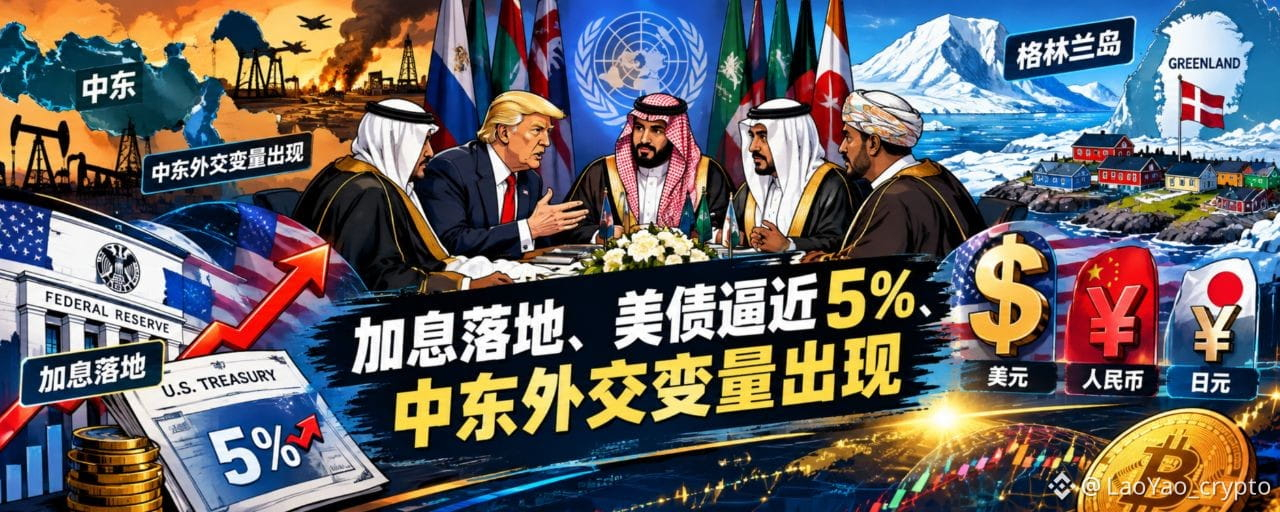
On September 16, the Federal Reserve raised interest rates by 25 basis points, lifting the target range for the federal funds rate to 3.75%–4.00%. This was the first rate hike in more than three years;
At the same time, policy signals indicate that there is still a possibility of further tightening later in the year.
On September 18, the Bank of Japan also raised its policy rate to 1.25%, reaching a 31-year high.
However, after the rate hike, the yen weakened instead. Two members voted against further hikes, and the market began to reassess Japan’s subsequent policy path.
A rate hike is delivered, yet interest rates are not the market’s only answer.
U.S. long-end Treasury yields remain elevated. The 10-year U.S. Treasury yield at one point even touched around 5%;
Japan’s long bond yields are also at high levels.
At the same time, although oil prices have pulled back from their highs, they are still in a high-range trading band.
Meanwhile, new diplomatic variables have also emerged in the Middle East situation.
Trump plans to hold meetings in New York during the UN General Assembly on September 22 with leaders or senior officials from members of the Gulf Cooperation Council to discuss the next phase of the Iran war and the postwar Middle East arrangements.
This means what the market is starting to focus on may no longer be just “whether the war will continue,” but rather:
What happens after the war?
If the Middle East situation gradually shifts from military standoff to diplomatic talks, then the energy risk premium that kept building up may be subject to重新定价 (re-pricing).
And that is precisely the variable most worth watching in the current market.
🧱 Geopolitical maneuvering: New diplomatic variable emerges in the Middle East
Next Tuesday, Trump is expected to meet in New York with leaders or senior officials from the six Gulf Cooperation Council countries—Saudi Arabia, the UAE, Qatar, Bahrain, Kuwait, and Oman.
Based on currently available public reporting, the focus of this meeting is not only the current conflict itself, but also the next phase of the Iran war and the postwar Middle East order. The scope of participation may also expand further.
This gives the market a variable that was previously not sufficiently considered:
The Middle East situation may have the possibility of shifting from military risk toward diplomatic solutions.
Of course, this doesn’t mean the conflict has already ended.
But for capital markets, the very existence of an “end-path” is information that needs to be repriced.
Energy prices are a key transmission variable for global inflation.
If geopolitical risk falls, the war premium embedded in oil prices could gradually shrink;
If the conflict continues to escalate, energy prices could again become an important force driving inflation.
Next, what the market truly needs to watch is not just the absolute level of oil prices, but:
Is the risk premium behind oil prices expanding or shrinking?
🌍 A major diplomatic breakthrough from Trump: the Greenland–Denmark agreement
Over the weekend, Trump announced that the United States has reached an agreement with Denmark and Greenland on new security arrangements.
This is a major diplomatic achievement for the Trump administration.
The strategic value of Greenland, the world’s largest island, has been upgraded from the Cold War era “early-warning outpost” to a hub for controlling shipping lanes, missile defense, resource competition, and great-power games.
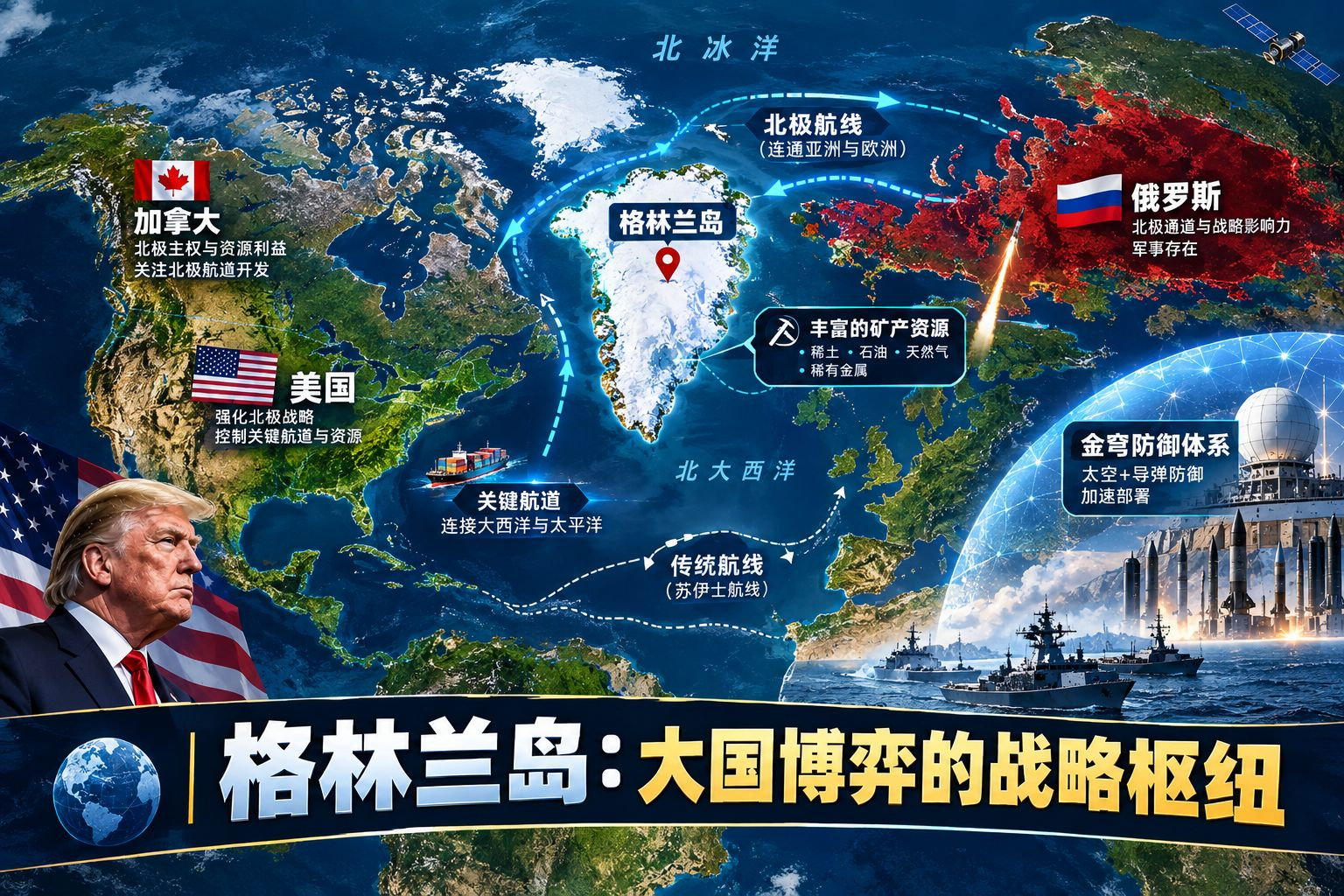
According to currently available public information, the arrangement mainly involves the United States’ security and military presence in Greenland, while limiting other non-NATO countries from establishing military bases there or carrying out certain strategic activities;
Denmark and Greenland emphasized that the agreement would not change local sovereignty and territorial integrity, and that subsequent approval procedures are still involved.
For the Trump administration, this also provides diplomatic and security policy achievements it can showcase domestically.
For the market, geopolitics is no longer just a standalone risk variable.
But rather:
Energy → Inflation → Interest rates → U.S. Treasuries → U.S. dollar → Risk assets
This asset-pricing chain.
📊 Global Asset Panorama
This week was a combination of "rate hike delivered + oil prices surged high and then stayed range-bound at elevated levels": U.S. stock tech held up while cyclicals faced pressure; in Asia, Japan outperformed Hong Kong; U.S. Treasury yields approached 5%; gold stopped falling, while crude oil churned in a high-range.
📈 Bond market: U.S. Treasury yields rise, nearing a key psychological level
The 10-year U.S. Treasury yield closed near 5%. During the week it even stood above 5%, the highest level in recent years
The 30-year U.S. Treasury yield rose to 5.34%
The 2-year U.S. Treasury yield rose to 4.76%; the front end faced similar pressure.
Japan’s 10-year government bond yield broke above 3% intraday, the first time since 1996
Japan’s 30-year government bond yields continue to refresh historical highs
📈 U.S. stocks: Divergent performance—tech and the cycle diverge
Nasdaq: up 0.7% for the week
S&P 500: down 0.1% for the week
Dow Jones: down 1.7% for the week, marking a third consecutive week of decline
🥇 Precious metals: Gold ended its streak of declines and saw its first weekly rise in about four weeks
Gold: up about 0.45% for the week
Silver: outperforms more strongly, up about 3%–4% for the week
💵 Forex: After the rate hike, the yen surprisingly weakened instead.
This is one of the most worth-watching “counterintuitive trends” this week.
The Bank of Japan raised its rate to 1.25%, but the yen did not strengthen—instead it clearly weakened.
Two members voted against the rate hike, leading the market to doubt the certainty of the Bank of Japan raising rates further.
This once again shows: a rate hike ≠ hawkish.
What markets trade is never just an isolated interest-rate number, but:
Interest rates + the policy path + policy credibility + future expectations.
💸 Web3 Review
Over the past 24 hours, the crypto market staged a short squeeze rebound characterized by "bad news already priced in + regulators stepping in". A large number of short positions were liquidated; earlier regulatory negative news was absorbed. With spillover from tech sentiment in U.S. equities, crypto still managed a relatively independent move despite U.S. Treasury yields staying elevated.
After BTC surged above $81,000 and the total market cap briefly reached about $2.78–$2.88 trillion, most major coins saw a slight pullback in Sunday’s early trading. Sentiment remained greedy (Fear & Greed around 73). Trading volume over the weekend was relatively light, shrinking noticeably versus Friday.
$BTC : Retraced to the 80.5K area, giving back part of Saturday’s gains;
$ETH : Around 2580—slightly weaker than BTC;
🧘 Crypto mind-principle: a set of counterintuitive trends
This week, major central banks including the Fed and the Bank of Japan all raised rates one after another, while the bond market was range-bound at high levels;
The BOJ hikes rates—yet the yen falls instead; U.S. long-end Treasury yields approach 5%—crypto rebounds;
The yuan, however, unexpectedly appreciated, breaking through the 6.7 level. These moves are worth taking apart:
First, a rate hike does not equal hawkishness. Both BOJ members who voted against the hike were nominated by Hayami [Sanae] Takashi, so the market began to suspect there was limited room for further hikes afterward, weakening the certainty of the policy path.
Second, the overlap of timing. A crypto rebound and a weaker yen appeared at the same time. It could be coincidence, but it also can’t be ruled out as another mapping between long-term battles over fiat-credit expectations and crypto assets.
Third, what the strengthening of the yuan signals. The yuan exchange rate is guided by the central parity mechanism. This time, the appreciation exceeded expectations, possibly related to shaping market sentiment before next week’s U.S.-China summit.
Fourth, trade the "after." What the market prices is not “what happens,” but “what happens after.” This is the biggest difference between investing and reading the news. The market will not believe the same story forever; capital will continuously search for higher risk-adjusted returns. When global capital re-prices the risk–return tradeoff, the real question worth asking is: why did capital choose to reselect it?
📌 LaoYao (@LaoYao_crypto )
Use mind-principle to view capital; discern trends by cycles.
Find certainty in uncertainty; anchor value amid volatility.