



Many people know very clearly in their hearts that the ultimate end for all pure speculation, no ecosystem, no real deployment “hot” altcoins and MEME coins is only one thing — going to zero.
But just because you see huge short-term gains, the order book is severely overbought, and the valuation is completely bubble-like, you then subjectively think “a drop is inevitable.” So you go short, hold your position, and even add more, trying to profit from a top reversal.
The cruel reality is: this kind of coin will ultimately indeed end up at zero, but your principal will never make it to the day it reaches zero.
Today, combining the recent order-book logic behind a host of “doubled” hot coins like ZEC, Pippin, Lab, BR, and even the lobster, I’ll explain it fully: why popular manipulated altcoins can only be traded long — and absolutely never short.
Actually, the most correct approach is to not touch it at all—staying away from these trash fake altcoins is the way out.
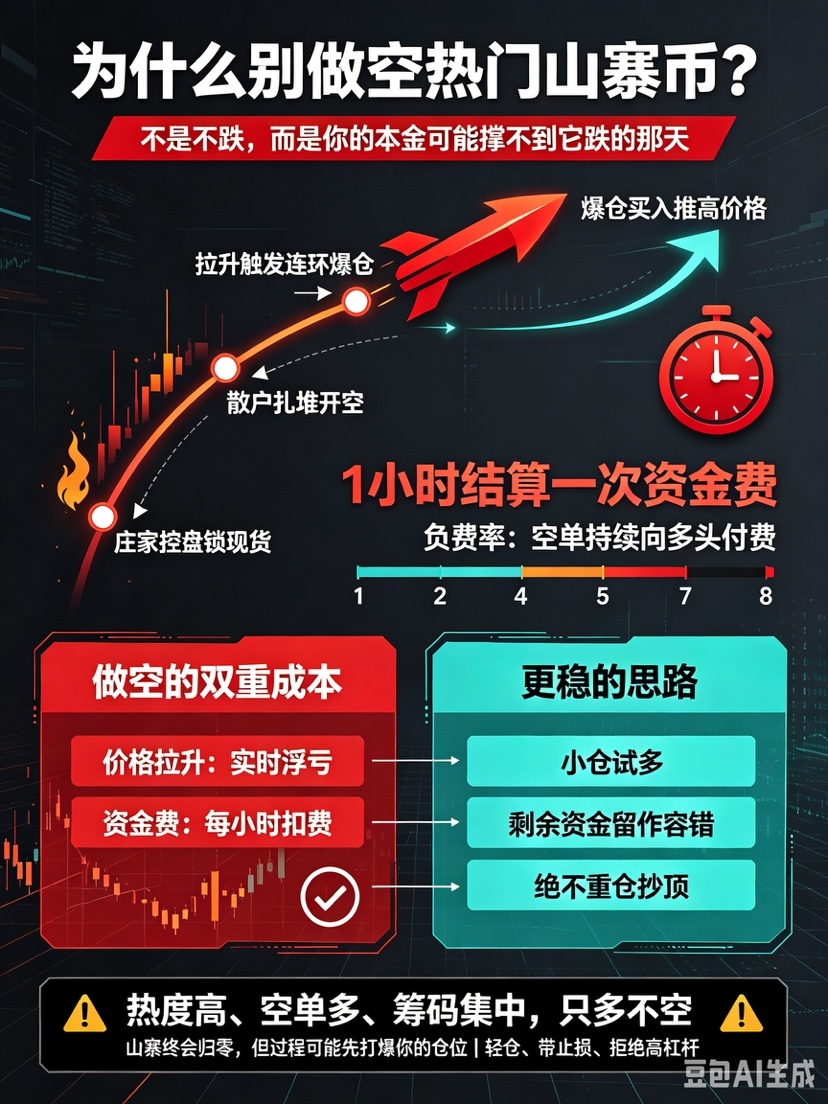
1. For all the breakout “hottest” fake coins, the unified feature is: strong whales, extreme liquidity control
None of the popular fake coins that recently surged by multiple times is an exception—every one of them is extreme liquidity control:
Liquidity is highly concentrated in the project team and the core market-maker group. The amount of retail liquidity truly circulating in the market is extremely small. The market maker holds a huge base of low-priced spot—fully in control of price-setting.
Many people don’t understand this core logic:
A fake altcoin’s decline requires sell pressure; but a fake altcoin’s rise only requires that the market maker doesn’t want it to fall.
As long as the main force doesn’t distribute and doesn’t dump, even if the rise has already doubled or gone several times and market cap is surging, the price won’t fall.
Even if the entire world thinks it’s expensive, thinks it’s overvalued, and thinks it should correct—none of that matters.
For mainstream coins, price rises and falls depend on market consensus and funding/leveraged-game dynamics;
For popular fake alts, whether they go up or down only depends on whether the market maker wants to harvest the longs or harvest the shorts.
And at this stage, the only goal of every popular, wildly hyped fake is: to blow up shorts, wash out shorts, and eat up the shorts’ positions.
2. The biggest misconception in shorting fake alts: you’re betting on the endpoint, while the market maker plays the process
I won’t deny it: all worthless hype fake alts and MEME coins have no long-term holding value.
Without technical support, without ecosystem enablement, without institutional involvement—only heat and emotion-driven hype. When time stretches, it will be 100% to zero.
This is absolute truth, but the biggest root cause of retail traders’ losses is right here:
You’re betting on the ultimate result of going to zero. What the market maker harvests from you is the violent pumping process before it reaches zero.
A fake altcoin can become completely worthless in three months or six months;
But before it reaches zero, under the boosts of hype, liquidity control, and concentrated positioning, it can keep pumping continuously, doubling and doubling again—creating an extreme short-crushing rally.
Your principal, your leverage, and your position tolerance are completely unable to withstand the market maker’s short-washing process.
The complete “death process” of retail shorting:
1. If a coin suddenly skyrockets in the short term and you think the bubble is too big, go short with the trend;
2. Liquidity is concentrated + hype explodes, and the market maker starts washing shorts at specific points;
3. Small pump → triggers liquidations of small short positions;
4. Liquidation orders automatically buy to close, pushing the price even higher;
5. The higher the price goes, the faster it rises—forming a chain-reaction liquidation, a “fireworks” market where longs and shorts squeeze each other;
6. You keep holding through losses, add margin, and even add more to try to catch the top—then you get force-liquidated across the board.
The cruelest truth in crypto: you may be right about the endpoint (it will eventually go to zero), but you die in the process (violent pump).
Even if the market eventually truly drops back to the mud and goes to zero, before that happens the market maker will definitely wash clean all shorts at low, mid, and high levels.
3. Retail traders’ biggest blind spot! The market maker’s “high-frequency funding fee double harvest”
Most retail traders only guard against price surges causing them to be liquidated—but they die to the scariest hidden harvest happening right now: popular fake alts and MEME demon coins. They’ve long changed from the traditional 8-hour funding fee to a mechanism that settles funding fees every 1 hour!
This is the biggest trick in today’s futures market, and it’s the core key to why shorting must lose:
1. The market maker can control the funding fee rate
The funding rate is determined by the price difference between spot and derivatives.
The market maker holds more than 90% of the spot liquidity. As long as they lock positions without dumping, and only lightly prop the price, the order book will always show a positive premium—funding rates stay persistently extremely high and negative to the extent that longs pay heavily.
2, charged once per hour — high-frequency blood-sucking
Mainstream coins charge a fee once every 8 hours, so losses are limited.
Popular pump-and-dump fakes: every 1 hour, the shorts automatically pay the longs.
During the short-washing cycle, the annualized funding fee can easily reach several thousand percent. It’s like holding your position for one hour and losing a round of fees—deducted nonstop all day long.
3. Shorting = continuous losses in both directions
- Price rises: unrealized losses keep expanding in real time
- Settles every hour: forcibly deducts massive funding fees
The longer you hold and the steadier your position is—especially the more you refuse to cut losses—the more funding fees you get harvested. The more the market maker’s “ammo” for pumping becomes.
Many people didn’t get liquidated by the move itself—they were literally liquidated by an enormous funding fee charged once every hour, losing everything and even their principal.
4. Why do popular fake alts get more outrageous the easier it is to blow up shorts?
Many people are confused: valuations are obviously completely distorted—pure bubble—so why does it get crazier the more it rises?
The core underlying logic can be summed up in one sentence: the rise of popular fake alts isn’t driven by value—it’s driven by shorts being forced into liquidation.
Highly controlled coins: the market maker has spot liquidity at zero cost, with zero sell pressure.
Once market heat rises, retail traders collectively form a unified mood of “fear of heights, trying to top out, and shorting.” A large number of short positions pile up—this is the same as delivering fuel to the market maker.
The more shorts there are in the market and the more疯狂 retail traders chase tops to short, the stronger the incentive for the market maker to push the price up.
Every time the price rises, it’s basically eating up a batch of shorts;
Every liquidation leads to an even stronger wave of passive buy pressure.
That’s why many fake alts don’t look at the broader market, don’t look at sentiment, and don’t look at technicals—they carve out independent, super-sized moves.
It’s not following a trend—it’s liquidating all short contracts inside the clearing arena.
Sometimes, the market maker even runs a situation of both sides getting liquidated:
First they pump to liquidate all shorts at high levels, then they dump to harvest the chased longs—taking in retail traders’ capital the whole time.
In this kind of extreme liquidity-controlled setup, shorting has the lowest win rate, the highest risk, and the worst risk-reward ratio.
5. Retail traders’ best solution: go long with small position sizes in the same direction, and never try to touch the top against the trend
Once you understand this logic, your trading mindset becomes completely clear:
We’re not smart people who predict the top and bottom. We only follow the trend with steadiness.
We know it will go to zero sooner or later, but we don’t short to fight the controlling main player;
Because we know clearly that short-term sentiment and the controlled liquidity can crush all rational valuation models.
A relatively steady playbook:
With a trading account principal of 10,000, you only use a small position of 1,000 to test by going long on these popular fake alts characterized by “concentrated liquidity, active hype, and piled-up shorts.”
Keep 90% of your principal in reserve—never go all-in, never max leverage, and never hold against your will in a position that goes against the trend.
The advantages of this approach are very obvious:
1. Risk is controllable: try with a small position size—if the market suddenly reverses, any single loss can be ignored and won’t damage your principal.
2. Follow the main force: follow the market maker’s short-washing trend and profit from a predictable liquidation-driven move against shorts;
3. Room for returns is ample: once a popular fake alt starts a short-crushing rally, the short-term blowout gains far exceed the cost of a small-stop loss;
4. Avoid fatal risks: completely eliminate the tragedy of “right about the endpoint, losing your entire principal, getting killed by high-frequency funding fees.”
Worthless fake alts will eventually go to zero, but your leverage and principal can’t survive the double blow of its madness before zero + the high-frequency funding fee mechanism every hour.
Don’t use a long-term “it will go to zero” logic to place short positions against the trend in the short term.
6. Follow the trend—this is how fake altcoin trading survives
Trading fake alts and MEME coins is never value investing—it’s purely a game of capital and liquidity.
For all popular coins that experience sustained, explosive rallies, behind them is highly concentrated liquidity—along with a deliberate scheme to harvest shorts. Retail traders try to fight the controlling “pump master” with the common-sense idea of “the more it pumps, the more it must drop.” In the end, they only become fuel for the market, and cash fodder for the scheme.
Remember the core trading iron law: for popular fake alts with heat, with shorts, and with concentrated liquidity—only go long, never short.
Give up the obsession with shorting against the trend. Discard rigid traditional trading thinking. Use small position sizes to follow the main force’s trend, avoid all shorting traps, and only then can you achieve long-term, stable profits in the high-risk derivatives market for fake alts—avoiding repeated losses and being harvested by the market.
Final reminder: fake altcoin market moves are extremely volatile, and liquidity-control risk is extremely high. Also, most current popular fake alts use a high-frequency funding fee mechanism settling every 1 hour, and the “blood-sucking” intensity is very strong. All trading must strictly control position size, set stop losses, refuse to go heavy, refuse high leverage, and refuse to fight the market against the trend. Trading should always put principal safety first as the top core priority.