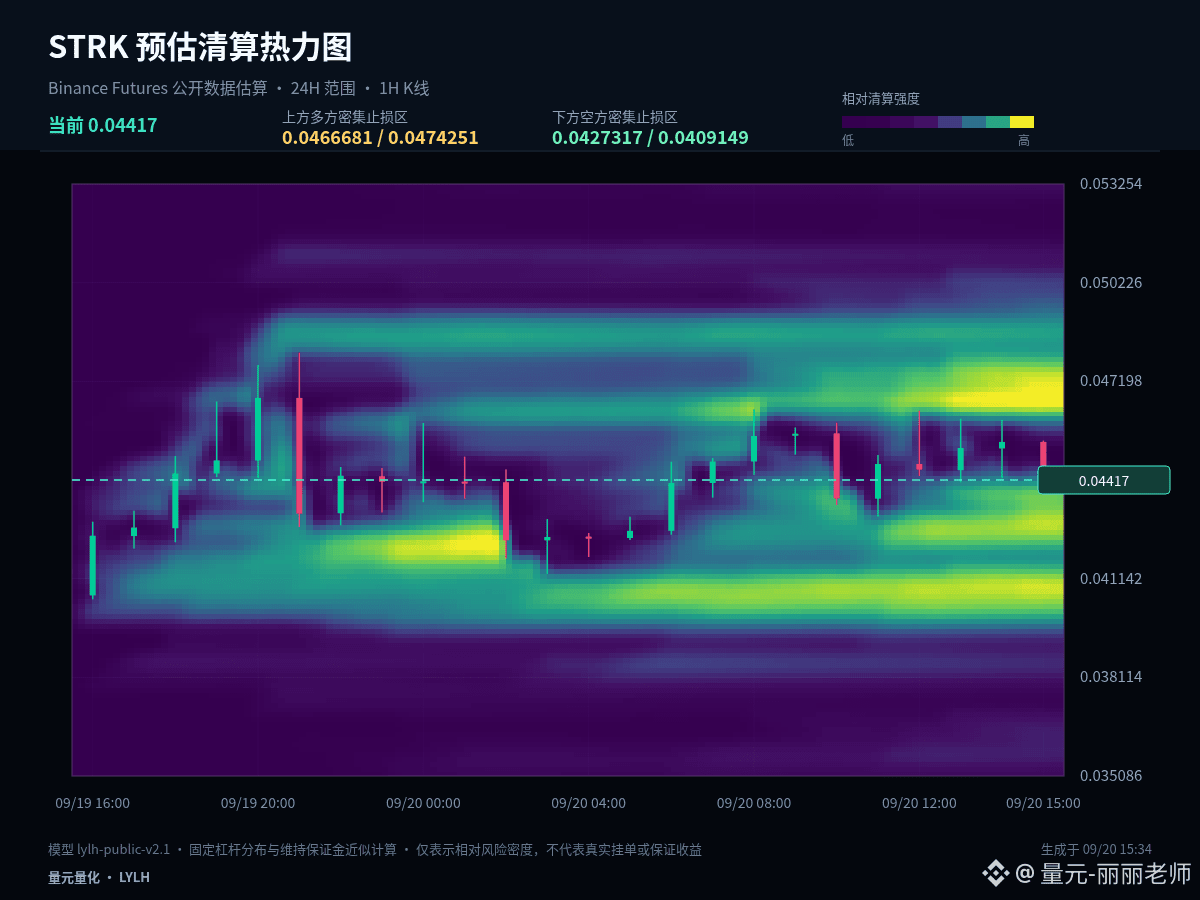
$STRK #STRK Over the past 24 hours, the high-low amplitude is about 17.1%. The current price is 0.04412. This is not a quiet market suitable for taking positions on the fly. When volatility expands, you should adjust your position size first, and only then discuss direction.
$STRK #STRK There is clearly noticeable sell pressure in the short term, with the 1-hour price change at -2.60%. Before the downward momentum slows down, any rebound needs confirmation at key levels.
In terms of cycle relationships, the 1-hour performance of -2.60% is weaker than the 24-hour +10.5%, and short-term risk is concentrated and being released. Whether the selling is truly stopping cannot be decided by watching only a single rebound candlestick. Instead, you need to observe whether the low points stop moving lower, whether the rebound can reclaim the midline, and whether sell pressure continues to intensify when price revisits the area.
For key price levels, 0.044295 is the midline that a weak recovery must reclaim. If price cannot stand back above it, rebounds should still be treated as technical repairs. Below, 0.04053 still has a possibility of being tested again. Only after reclaiming the midline does it become appropriate to further consider 0.04806.
The execution principle during high-volatility phases is to reduce single-trade exposure, avoid chasing prices back and forth in the middle of a range, and write the failure conditions before entering. If price does not provide confirmation, it’s better to do fewer trades than to compensate for uncertainty with a larger position.
For the next path, there are three ways to handle it: if price effectively holds above 0.04806, wait for a pullback to hold and then reassess for continuation; if price breaks down below 0.04053, prioritize risk control and wait for new support; if price continues to oscillate around 0.044295, treat it as range rotation (turnover) and do not repeatedly chase direction in the middle.
The focus of the contract is not to predict every candlestick, but to ensure that entries, trimming, and exits are based on evidence. If there is no confirmation, trade less; if key levels fail, redo the plan. First control single-trade risk, then discuss the potential ahead.
#VietnamPlansFirstCryptoLicensesIn2026
$STRK #STRK There is clearly noticeable sell pressure in the short term, with the 1-hour price change at -2.60%. Before the downward momentum slows down, any rebound needs confirmation at key levels.
In terms of cycle relationships, the 1-hour performance of -2.60% is weaker than the 24-hour +10.5%, and short-term risk is concentrated and being released. Whether the selling is truly stopping cannot be decided by watching only a single rebound candlestick. Instead, you need to observe whether the low points stop moving lower, whether the rebound can reclaim the midline, and whether sell pressure continues to intensify when price revisits the area.
For key price levels, 0.044295 is the midline that a weak recovery must reclaim. If price cannot stand back above it, rebounds should still be treated as technical repairs. Below, 0.04053 still has a possibility of being tested again. Only after reclaiming the midline does it become appropriate to further consider 0.04806.
The execution principle during high-volatility phases is to reduce single-trade exposure, avoid chasing prices back and forth in the middle of a range, and write the failure conditions before entering. If price does not provide confirmation, it’s better to do fewer trades than to compensate for uncertainty with a larger position.
For the next path, there are three ways to handle it: if price effectively holds above 0.04806, wait for a pullback to hold and then reassess for continuation; if price breaks down below 0.04053, prioritize risk control and wait for new support; if price continues to oscillate around 0.044295, treat it as range rotation (turnover) and do not repeatedly chase direction in the middle.
The focus of the contract is not to predict every candlestick, but to ensure that entries, trimming, and exits are based on evidence. If there is no confirmation, trade less; if key levels fail, redo the plan. First control single-trade risk, then discuss the potential ahead.
#VietnamPlansFirstCryptoLicensesIn2026