All your technical analysis is no match for long-term holding of BNB
Today, a traditional boss asked me: If you could configure some coins to hold long term, do you have any recommendations?
My answer is: BNB
Whether you can hold long term depends on whether the platform’s business, your holding rights and interests, and on-chain applications can be sustained over the long run.
When chatting with my boss, I used an angle he was more familiar with to judge whether a company is worth holding long term. Usually, we look at product demand, whether customers are willing to stay, and whether the operator can continuously solve problems.
Let’s expand this question around BNB.
Why would users want to stay on Binance?
My recognition of Binance starts with what matters most: how it prioritizes user needs. Whether the platform listens to feedback, improves the user experience, and enhances trading experience will all affect users’ willingness to stay or leave. By continuously observing its product updates and service changes, you can continuously assess this.
In terms of scale, Binance ranks first among spot exchanges in overall categories, with the best liquidity depth. In Q2 2026, among the top 10 centralized spot exchanges, Binance’s trading volume share was 38.7%.
The data shows Binance has a strong trading base. But for the long term, what matters is whether it can turn that scale into services that users will keep using.
Trading, wallets, wealth management products, and payment services—all relate to this question. And BNB’s utility is built on top of these services.
If you hold BNB, what actual benefits can you get?
When holding a coin long term, you need to look at holding rewards, product incentives, activity opportunities, and the products you can use.
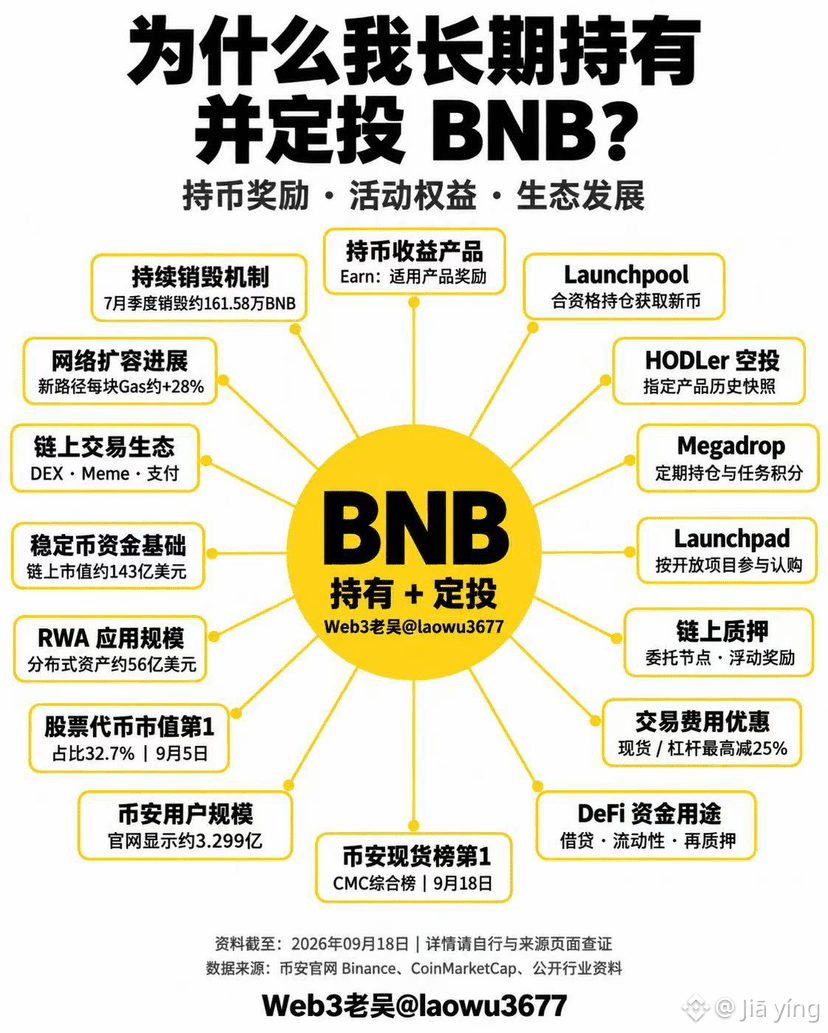
When conditions are met, BNB can participate in Earn, Launchpool, HODLer airdrops, and Megadrop. They involve, respectively, holding rewards for the applicable products, allocation of token distribution for new projects, historical holding snapshot, and holding plus task points.
Here’s a real case: For example, in January 2024, if you bought one BNB at a price of $313 and held it until the end of Q1 2025, and participated in these activities. Excluding token price appreciation, you could earn $226. Including BNB’s price appreciation, the total would reach $553. That’s a one-year investment return rate of as high as 177%, with a monthly return of 11.8%.
Besides that, in trading and on-chain usage, BNB can also be used to offset trading fees, pay grid fees, participate in staking, and—on supported protocols—be used for lending and for providing trading.
$BNB
Today, a traditional boss asked me: If you could configure some coins to hold long term, do you have any recommendations?
My answer is: BNB
Whether you can hold long term depends on whether the platform’s business, your holding rights and interests, and on-chain applications can be sustained over the long run.
When chatting with my boss, I used an angle he was more familiar with to judge whether a company is worth holding long term. Usually, we look at product demand, whether customers are willing to stay, and whether the operator can continuously solve problems.
Let’s expand this question around BNB.
Why would users want to stay on Binance?
My recognition of Binance starts with what matters most: how it prioritizes user needs. Whether the platform listens to feedback, improves the user experience, and enhances trading experience will all affect users’ willingness to stay or leave. By continuously observing its product updates and service changes, you can continuously assess this.
In terms of scale, Binance ranks first among spot exchanges in overall categories, with the best liquidity depth. In Q2 2026, among the top 10 centralized spot exchanges, Binance’s trading volume share was 38.7%.
The data shows Binance has a strong trading base. But for the long term, what matters is whether it can turn that scale into services that users will keep using.
Trading, wallets, wealth management products, and payment services—all relate to this question. And BNB’s utility is built on top of these services.
If you hold BNB, what actual benefits can you get?
When holding a coin long term, you need to look at holding rewards, product incentives, activity opportunities, and the products you can use.
When conditions are met, BNB can participate in Earn, Launchpool, HODLer airdrops, and Megadrop. They involve, respectively, holding rewards for the applicable products, allocation of token distribution for new projects, historical holding snapshot, and holding plus task points.
Here’s a real case: For example, in January 2024, if you bought one BNB at a price of $313 and held it until the end of Q1 2025, and participated in these activities. Excluding token price appreciation, you could earn $226. Including BNB’s price appreciation, the total would reach $553. That’s a one-year investment return rate of as high as 177%, with a monthly return of 11.8%.
Besides that, in trading and on-chain usage, BNB can also be used to offset trading fees, pay grid fees, participate in staking, and—on supported protocols—be used for lending and for providing trading.
$BNB