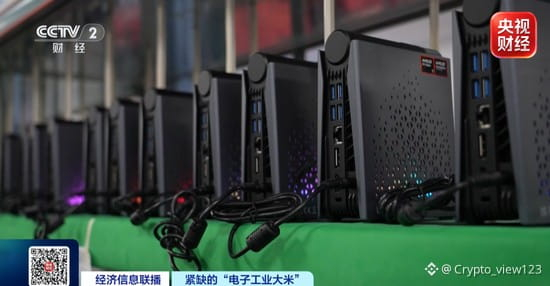
A circuit board needs to fit hundreds of capacitors, and nobody ever treated that as news. Now, the most widely used part can rise sevenfold in a single month.
The price-increase notices were initiated overseas by leading companies. Japan’s Murata, Taiyo Yuden, and South Korea’s Samsung Electro-Mechanics have all sent letters: for high-capacity multilayer ceramic capacitors used in AI servers, the price hikes by original manufacturers are generally 15% to 35%.
In Shenzhen’s Huaqiangbei, spot prices are far more aggressive than the original manufacturers. Starting in June, prices moved on a “one price per day” basis, and in some cases even “one price per hour.” For certain popular models, prices increased seven to eight times within a month, and spot stock was even bid up to two to ten times the original price. By early July, consumer-category prices first pulled back a bit.
A retailer gave an example using the most common part number: in the second quarter, one thousand units were about five yuan; by the end of June peak, they sold for as much as thirty yuan; now they’ve fallen back to around ten yuan. Within the same month, for high-capacity variants targeting AI servers and automotive-grade applications, shortages and price increases are still ongoing.
The demand mix has also changed. When a piece of equipment was upgraded from a standard mini PC to an AI workstation, capacitor usage increased by two to three times. Orders for the third quarter for high-speed optical module companies doubled year over year. Some manufacturers’ orders for AI high-end specifications are already booked through the second quarter of 2027, and the material lead times have stretched from six to eight weeks to sixteen weeks.
People buying components have started reserving production capacity three to six months in advance—based on their judgment about next year. It’s more tangible than any research report.
What’s lacking isn’t capacitors; it’s the production lines capable of producing high-end ones.
#MLCC #AI服务器
The price-increase notices were initiated overseas by leading companies. Japan’s Murata, Taiyo Yuden, and South Korea’s Samsung Electro-Mechanics have all sent letters: for high-capacity multilayer ceramic capacitors used in AI servers, the price hikes by original manufacturers are generally 15% to 35%.
In Shenzhen’s Huaqiangbei, spot prices are far more aggressive than the original manufacturers. Starting in June, prices moved on a “one price per day” basis, and in some cases even “one price per hour.” For certain popular models, prices increased seven to eight times within a month, and spot stock was even bid up to two to ten times the original price. By early July, consumer-category prices first pulled back a bit.
A retailer gave an example using the most common part number: in the second quarter, one thousand units were about five yuan; by the end of June peak, they sold for as much as thirty yuan; now they’ve fallen back to around ten yuan. Within the same month, for high-capacity variants targeting AI servers and automotive-grade applications, shortages and price increases are still ongoing.
The demand mix has also changed. When a piece of equipment was upgraded from a standard mini PC to an AI workstation, capacitor usage increased by two to three times. Orders for the third quarter for high-speed optical module companies doubled year over year. Some manufacturers’ orders for AI high-end specifications are already booked through the second quarter of 2027, and the material lead times have stretched from six to eight weeks to sixteen weeks.
People buying components have started reserving production capacity three to six months in advance—based on their judgment about next year. It’s more tangible than any research report.
What’s lacking isn’t capacitors; it’s the production lines capable of producing high-end ones.
#MLCC #AI服务器