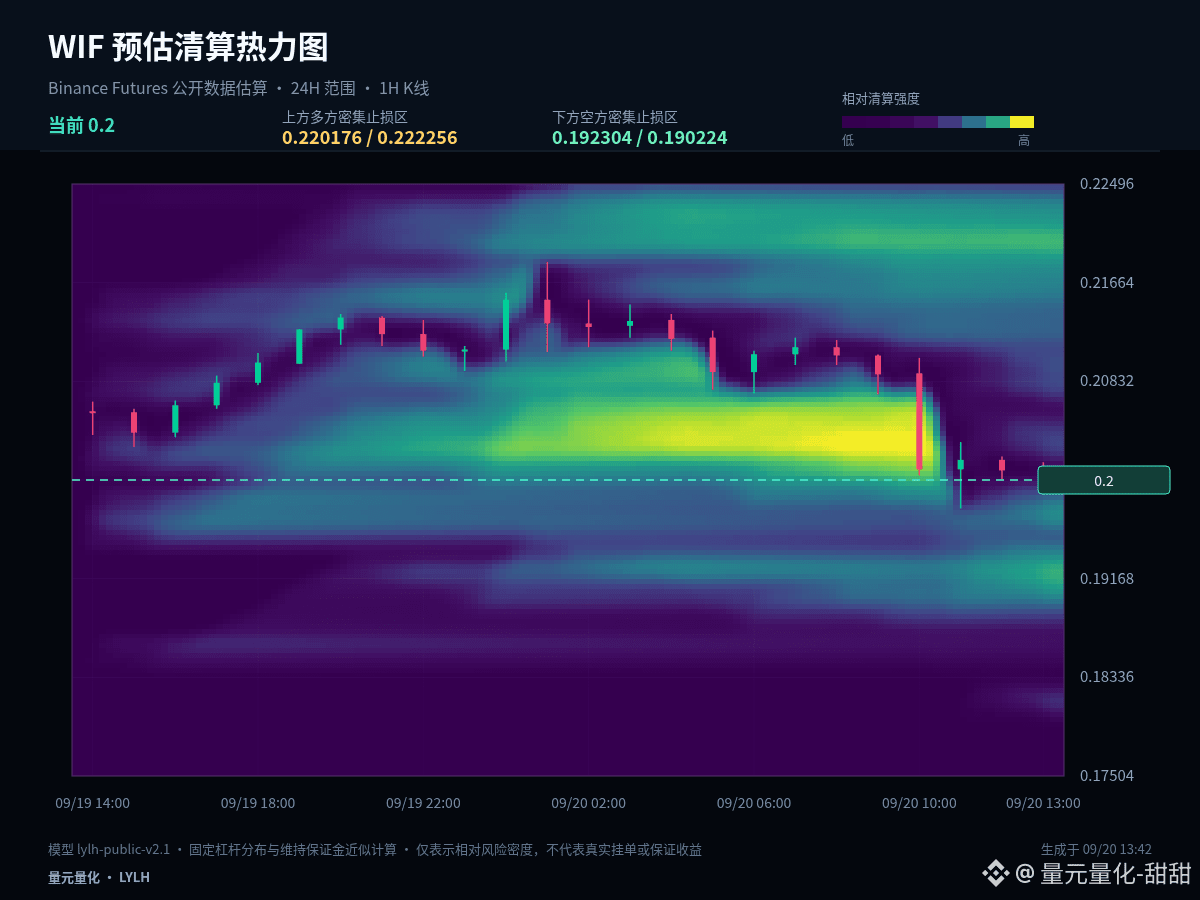
$WIF #WIF In a strong trend, pullbacks often reveal real buying support better than an accelerated rally. The current 1-hour change is -0.45% and the 24-hour change is -3.42%, so the key question is whether this is a normal cooling-off or a weakening structure.
The current price is close to the lower end of the past 24-hour range, with the 1-hour change at -0.45% and the 24-hour change at -3.42%. The core of low-level analysis is not to buy the bottom in advance, but to observe whether the price can quickly reclaim after breaking below. A quick reclaim means selling pressure has been absorbed; staying below the lower boundary for a sustained period indicates the weakness has not yet ended.
A pullback has already appeared on the 1-hour chart, so first watch whether 0.1978 can form stable support. If the price can quickly reclaim 0.20815, the pullback is still manageable; if the rebound lacks strength and the lows continue to move lower, then the strong-trend logic can no longer be used.
There are three possible ways to handle the next path: if it moves up and holds above 0.2185, wait for a retest before evaluating continuation; if it breaks below 0.1978, prioritize risk control and wait for a new support level; if it continues to fluctuate around 0.20815, treat it as range rotation and do not keep chasing direction in the middle of the range.
For those already holding positions, the focus should be on managing whether support fails, rather than being led by every fluctuation; for those without positions, prioritize waiting for a breakout retest or support confirmation. Spot positions can be accumulated in batches, while contracts should shorten the decision chain: first determine the stop-loss level, then decide whether to participate.
A trading plan must include invalidation conditions. If the judgment is correct, profits can be taken in stages; if the judgment is wrong, allow yourself to exit. Do not use adding to a losing position to cover up the fact that the original logic has already changed. The market will update, and your view should also adjust according to price evidence.
#BuffettStepsDownAsBerkshireChairman
The current price is close to the lower end of the past 24-hour range, with the 1-hour change at -0.45% and the 24-hour change at -3.42%. The core of low-level analysis is not to buy the bottom in advance, but to observe whether the price can quickly reclaim after breaking below. A quick reclaim means selling pressure has been absorbed; staying below the lower boundary for a sustained period indicates the weakness has not yet ended.
A pullback has already appeared on the 1-hour chart, so first watch whether 0.1978 can form stable support. If the price can quickly reclaim 0.20815, the pullback is still manageable; if the rebound lacks strength and the lows continue to move lower, then the strong-trend logic can no longer be used.
There are three possible ways to handle the next path: if it moves up and holds above 0.2185, wait for a retest before evaluating continuation; if it breaks below 0.1978, prioritize risk control and wait for a new support level; if it continues to fluctuate around 0.20815, treat it as range rotation and do not keep chasing direction in the middle of the range.
For those already holding positions, the focus should be on managing whether support fails, rather than being led by every fluctuation; for those without positions, prioritize waiting for a breakout retest or support confirmation. Spot positions can be accumulated in batches, while contracts should shorten the decision chain: first determine the stop-loss level, then decide whether to participate.
A trading plan must include invalidation conditions. If the judgment is correct, profits can be taken in stages; if the judgment is wrong, allow yourself to exit. Do not use adding to a losing position to cover up the fact that the original logic has already changed. The market will update, and your view should also adjust according to price evidence.
#BuffettStepsDownAsBerkshireChairman