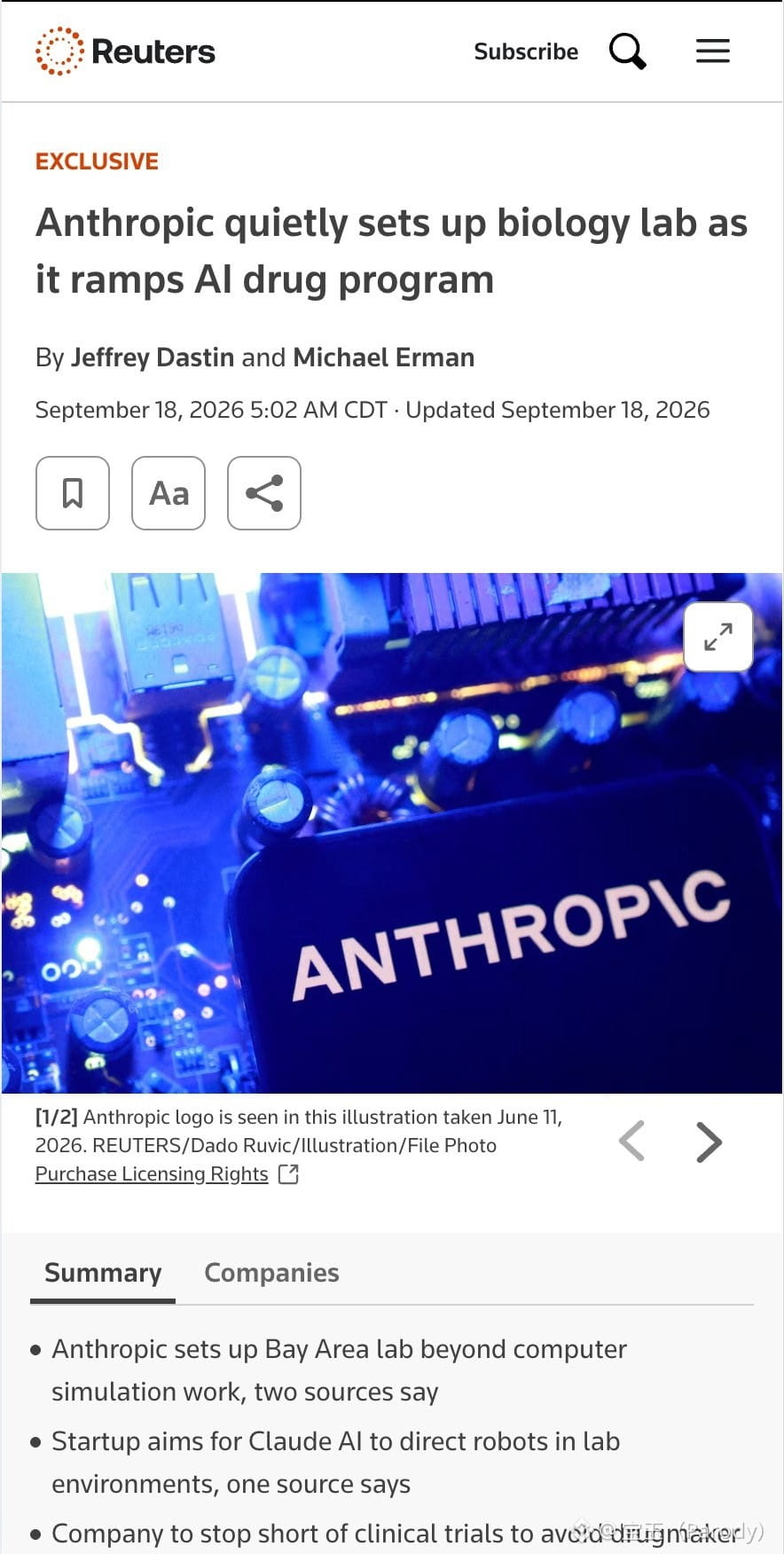
Anthropic quietly built a bio lab
According to an exclusive report by Reuters, Anthropic has completed a wet lab (a physical laboratory where real biochemical experiments can be carried out) in the San Francisco Bay Area, formally extending AI’s reach from software into drug discovery.
Eric Kauderer-Abrams, head of life sciences at Anthropic, confirmed the news in an interview. His reasoning: for biological research, the ultimate standard still comes down to real lab work—computer simulations alone are not enough. Some experiments are done in-house, and some are carried out with external partners, which is how most biotech companies operate.
This isn’t a whim. Over the past few months, Anthropic has been moving fast: it spent about $400 million in a stock acquisition of a startup called Coefficient Bio to build drug-discovery tools; brought Novartis CEO Vas Narasimhan onto its board; released software called Claude Science; and in June publicly announced in San Francisco plans to launch a drug-development program. On LinkedIn, it has also been hiring for roles including procurement and operations leaders and experts in protein and nucleic acid characterization, with recruitment posts stating the goal is to “increase the pace of progress in the life sciences by an order of magnitude.” Kauderer-Abrams said life sciences is already one of Anthropic’s biggest areas of investment in terms of people and resources.
Anthropic is targeting areas that traditional pharmaceutical companies consider “undruggable”—rare diseases that are overlooked because the targets are too difficult or commercial returns are too low. They believe AI can accelerate the discovery of complex molecules such as bispecific and even trispecific antibodies. These drugs can attack multiple targets at the same time, and their design is extremely challenging—yet AI is good at handling such complexity. CEO Dario Amodei feels this pain personally: his father died from a disease, and a cure appeared only years later.
However, Anthropic has drawn a clear line for now: it will only do preclinical research, not clinical trials, and it won’t compete with pharmaceutical companies for business. This is also meant to ease a real trust issue—big pharma companies that use Claude (including Genentech, Bristol Myers Squibb, and Novo Nordisk) are likely to worry about what Anthropic might learn from their data.
Worth noting is the timing: all of this is happening right before Anthropic prepares for an IPO with a valuation of about $2 trillion, and amid intensifying AI safety controversy. Just within the past two weeks, Anthropic’s own researchers warned that AI could lead to human extinction, and the company also found risks that its systems could be used for biological weapon development. Pressing the accelerator while pulling the handbrake—this tension is an accurate snapshot of Anthropic right now.
For comparison, Isomorphic Labs, a Google subsidiary, has been doing AI drug discovery for years and originally planned to enter the clinic by the end of 2026, though it has already been delayed once. The reality of drug development is simply this: from discovering a molecule to getting a drug approved for market usually takes many years, and most drugs fail during clinical trials. Anthropic’s ambitions are huge, but the road ahead is still long.
According to an exclusive report by Reuters, Anthropic has completed a wet lab (a physical laboratory where real biochemical experiments can be carried out) in the San Francisco Bay Area, formally extending AI’s reach from software into drug discovery.
Eric Kauderer-Abrams, head of life sciences at Anthropic, confirmed the news in an interview. His reasoning: for biological research, the ultimate standard still comes down to real lab work—computer simulations alone are not enough. Some experiments are done in-house, and some are carried out with external partners, which is how most biotech companies operate.
This isn’t a whim. Over the past few months, Anthropic has been moving fast: it spent about $400 million in a stock acquisition of a startup called Coefficient Bio to build drug-discovery tools; brought Novartis CEO Vas Narasimhan onto its board; released software called Claude Science; and in June publicly announced in San Francisco plans to launch a drug-development program. On LinkedIn, it has also been hiring for roles including procurement and operations leaders and experts in protein and nucleic acid characterization, with recruitment posts stating the goal is to “increase the pace of progress in the life sciences by an order of magnitude.” Kauderer-Abrams said life sciences is already one of Anthropic’s biggest areas of investment in terms of people and resources.
Anthropic is targeting areas that traditional pharmaceutical companies consider “undruggable”—rare diseases that are overlooked because the targets are too difficult or commercial returns are too low. They believe AI can accelerate the discovery of complex molecules such as bispecific and even trispecific antibodies. These drugs can attack multiple targets at the same time, and their design is extremely challenging—yet AI is good at handling such complexity. CEO Dario Amodei feels this pain personally: his father died from a disease, and a cure appeared only years later.
However, Anthropic has drawn a clear line for now: it will only do preclinical research, not clinical trials, and it won’t compete with pharmaceutical companies for business. This is also meant to ease a real trust issue—big pharma companies that use Claude (including Genentech, Bristol Myers Squibb, and Novo Nordisk) are likely to worry about what Anthropic might learn from their data.
Worth noting is the timing: all of this is happening right before Anthropic prepares for an IPO with a valuation of about $2 trillion, and amid intensifying AI safety controversy. Just within the past two weeks, Anthropic’s own researchers warned that AI could lead to human extinction, and the company also found risks that its systems could be used for biological weapon development. Pressing the accelerator while pulling the handbrake—this tension is an accurate snapshot of Anthropic right now.
For comparison, Isomorphic Labs, a Google subsidiary, has been doing AI drug discovery for years and originally planned to enter the clinic by the end of 2026, though it has already been delayed once. The reality of drug development is simply this: from discovering a molecule to getting a drug approved for market usually takes many years, and most drugs fail during clinical trials. Anthropic’s ambitions are huge, but the road ahead is still long.