
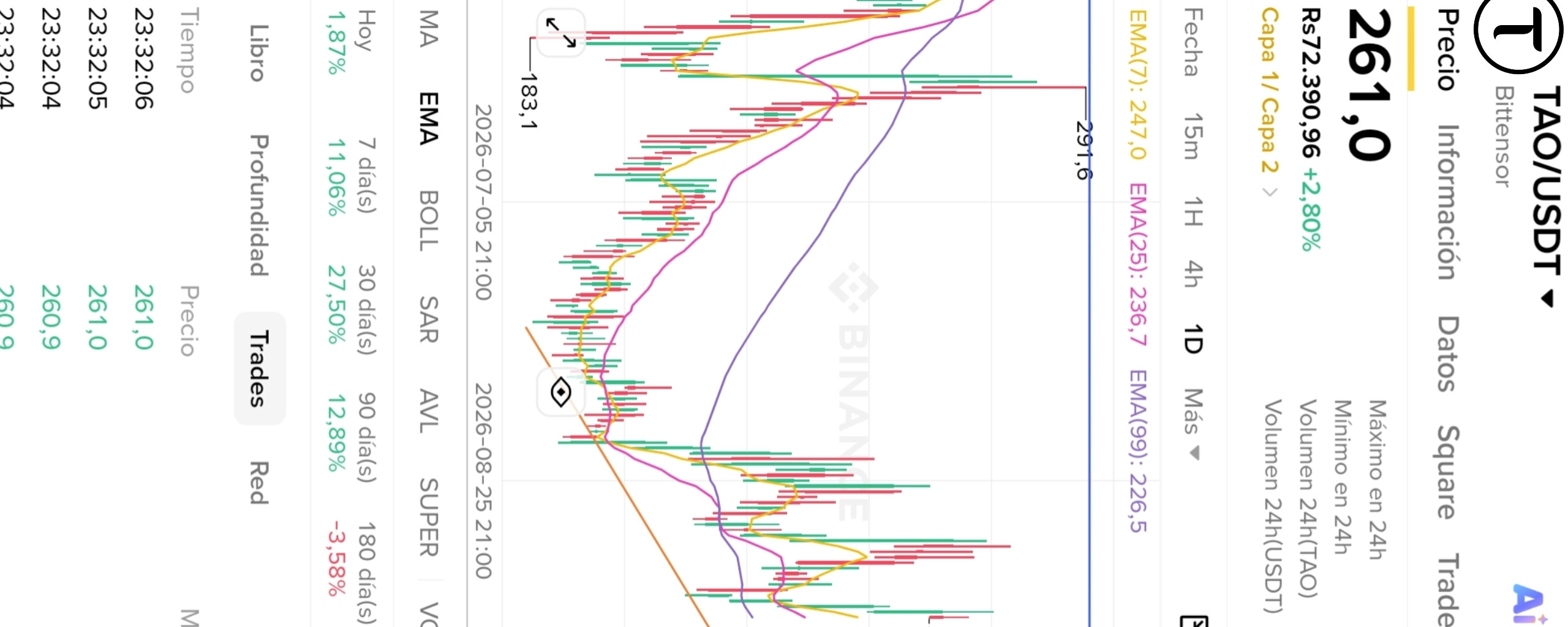

The thesis is not that TAO is a good crypto because it uses AI.
That would be too superficial.
Our thesis is much more specific:
“Bittensor tries to build a decentralized market where different types of digital intelligence compete for capital and economic incentives, and TAO is the asset that coordinates that economy.”
Models, inference, data, predictions, storage, computing, and other services can compete within different specialized markets called subnets.
But we’re still waiting to prove something much more important:
«Can that incentivized activity turn into external economic utility—and above all, can that utility ultimately be captured in TAO?»
That last point is the heart of our thesis.
---
1. What are we really buying?
We’re not buying a company.
We’re buying a programmable economic network.
The structure can be simplified like this:
TAO → incentives → subnets → miners/validators → intelligence production → users → demand → valuation → new resource allocation
Each subnet functions like a specialized market. Participants compete to produce what the validation mechanisms consider valuable.
This completely changes our unit of analysis.
We don’t ask:
«“Does TAO have utility?”»
We ask:
«“Is an economy emerging around TAO whose activity needs TAO?”»
That’s a much more demanding question.
---
2. The machine is still being built
Bittensor has a particularly interesting feature for an investor:
the market is trying to design its own architecture while it’s working.
The introduction of Dynamic TAO (dTAO) in 2025 added native tokens for the subnets and TAO/Alpha markets, making prices participate in the allocation of emissions.
During 2026, the protocol continued modifying those mechanisms.
This doesn’t prove that the system is failing.
It shows that it’s still looking for an efficient way to coordinate:
capital + talent + incentives + demand.
That’s why our position shouldn’t be interpreted as buying a finished economic machine.
It’s more like buying an option on a machine that still has to prove it works.
---
3. So what are its fundamentals?
We can’t use exactly the same language as for a company.
We don’t just have:
income → margins → FCF → ROIC.
We have to look at other variables:
Utilization:
Does anyone actually use what the subnets produce?
Quality:
Do participants produce something useful, or do they simply optimize to capture emissions?
External demand:
Do users and companies pay for those results outside the incentives system?
Committed capital:
Is hardware, talent, and capital coming in because there’s an expectation of economic value?
Allocation efficiency:
Does the protocol direct resources toward the subnets that really produce value?
And finally, the decisive variable:
«Does the growth of Bittensor’s economy increase the economic value captured by TAO?»
Because the ecosystem can grow massively and TAO may not capture that growth proportionally.
That’s where our thesis could be wrong.
---
4. Dynamic TAO: the experiment we’re most interested in
dTAO tries to answer a fundamental question:
«Who decides which subnet deserves resources?»
Rather than relying only on validators’ internal decisions, it introduces markets where the price of subnets participates in the distribution of emissions.
The intuition is powerful:
more demand → higher valuation → more resource allocation → more capacity to produce value → potentially more demand.
In other words:
«Bittensor tries to use the market as a mechanism for allocating capital within an intelligence economy.»
This is probably one of the most interesting parts of the thesis.
A traditional company decides how much capital each division receives.
Bittensor tries to make incentives and prices help decide between multiple markets.
But there’s a question we still can’t skip:
«Is the market discovering real value or simply redistributing speculation?»
---
5. The scenario we want to see
Let’s imagine that within 5–10 years there are hundreds of subnets.
Some produce:
- inference,
- specialized models,
- predictions,
- data,
- search,
- computation,
- agents,
- business intelligence.
The best attract capital and talent.
The worst lose resources.
Developers create new markets.
Companies use their products.
And participating economically in all of that system creates a structural demand for TAO.
Then a real flywheel appears:
demand → value → capital → talent → production → more utility → more demand.
Not because there’s some magical “network effect.”
Instead, because we can observe an economic mechanism working.
---
6. The trap we must avoid
The mistake would be to think:
«“The potential market is enormous, therefore TAO will be enormous.”»
No.
The potential size of the economy doesn’t demonstrate value capture.
We could even observe:
many subnets + lots of talent + lots of activity + lots of utilization
without necessarily there being:
structural demand for TAO.
That’s probably the biggest conceptual risk in our thesis.
---
7. Incentives are not the same as demand
This point can summarize the whole analysis.
A miner can participate because:
«“I can earn TAO.”»
That doesn’t prove:
«“Someone needs it and is willing to pay for what I produce.”»
The first situation can create a circular economy:
emissions → participants → production → more emissions.
The second creates a productive economy:
real need → users → revenue → economic value → incentives.
And we need to see how the second one ends up connecting with TAO.
Because that’s the real bet:
«We’re not just betting that AI grows.»
«We’re betting that Bittensor will manage to turn digital intelligence into a competitive economy and that TAO captures a significant share of the value generated by it.»
That still needs to be proven.
And precisely because of that, the thesis is interesting.