From +2.43% to zero: Why moving the Stop to Breakeven saved this futures trade in $XRP
80% of traders give back their profits over the weekend due to the same mistake: not locking in gains during the expansion and allowing a winning position to turn into a loss.
Yesterday we saw the perfect example in the perpetual futures of $XRP :📊 Quantitative Execution Breakdown:
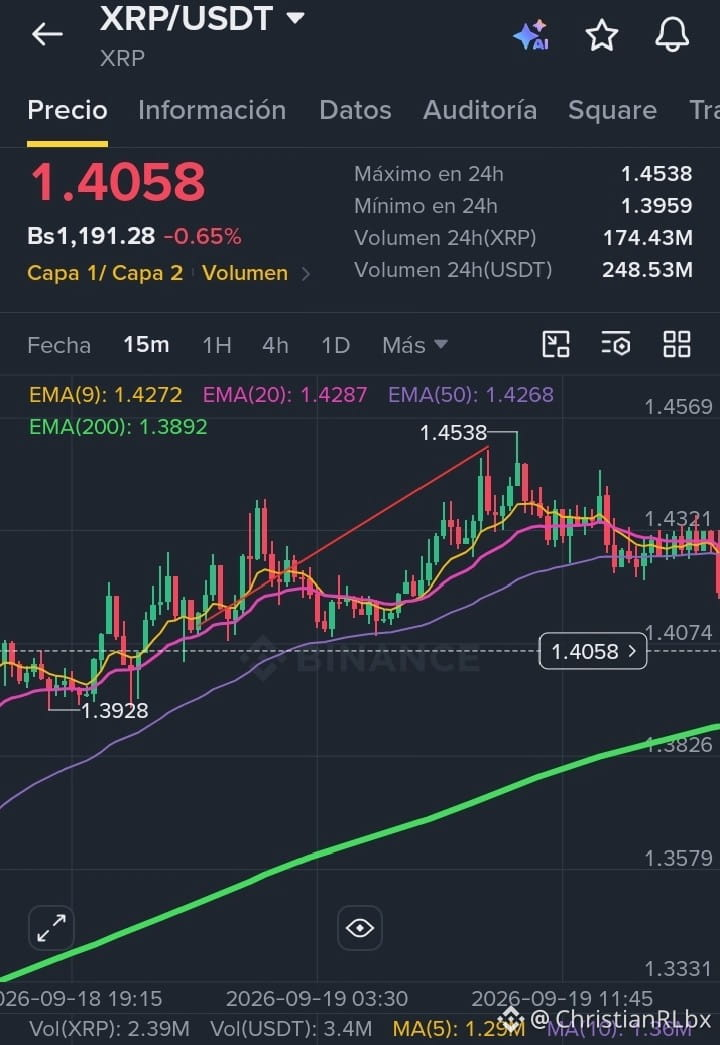
• Setup: Long $XRPUSDT Perp (Dynamic M15 pullback + Bullish H1 bias)
• Entry: 1.4115 USDT
• Initial Stop Loss: 1.3944 USDT (-1.21% / 2.0x ATR)
• Target 1 (1.4286): ✅ Hit (+1.21%) ➔ Take 50% and move Stop to Breakeven.
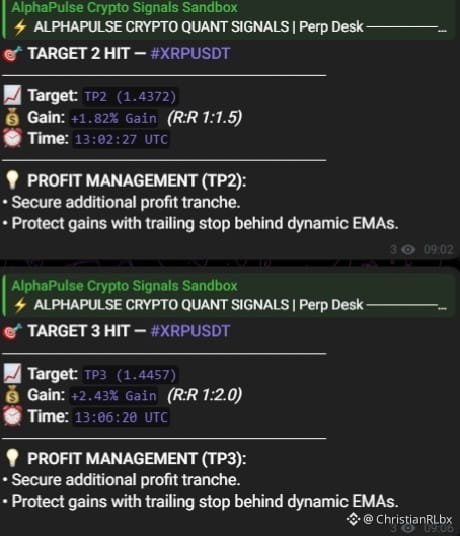
• Target 2 (1.4372): ✅ Hit (+1.82%)
• Target 3 (1.4457): ✅ Hit (+2.43% / R:R 1:2.0) ➔ Additional profits secured. 📉 What happened next:
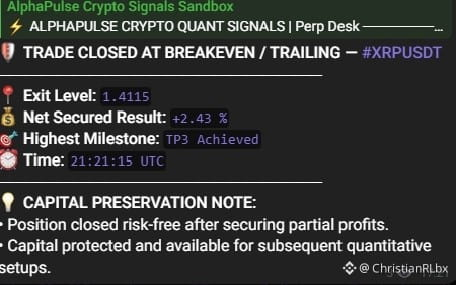
After reaching the TP3 target at 13:06 UTC, buy volume ran out and the market started a correction lasting more than 8 hours, which ended up sweeping through the entry price. What’s the result for a retail trader without algorithmic management? A trade that had accumulated more than 2.4% profit ends up touching the original Stop Loss or closing in panic with a red balance. What’s the result of the quantitative engine? Automatic closure at Breakeven at 21:21 UTC with a protected net result of +2.43% on the account. 💡 The Mathematical Rule:
In derivatives markets, your statistical advantage (edge) lies in removing the desk risk after the first impulse. Securing partials and moving the Stop Loss to the entry price turns the trade into a risk-free asset (risk-free). If the market continues to TP5, you maximize profits; if it reverses due to lack of liquidity, your capital remains intact. 💬 Question for the community:When trading futures, do you prefer taking fixed partials in R:R ratios 1:1 and 1:2, or do you let the full position run, assuming the risk that it will come back to the entry? I read you in the comments.
👇#TradingQuant #XRP #RiskManagement #Quantitativetrading #TradingSignals
80% of traders give back their profits over the weekend due to the same mistake: not locking in gains during the expansion and allowing a winning position to turn into a loss.
Yesterday we saw the perfect example in the perpetual futures of $XRP :📊 Quantitative Execution Breakdown:
• Setup: Long $XRPUSDT Perp (Dynamic M15 pullback + Bullish H1 bias)
• Entry: 1.4115 USDT
• Initial Stop Loss: 1.3944 USDT (-1.21% / 2.0x ATR)
• Target 1 (1.4286): ✅ Hit (+1.21%) ➔ Take 50% and move Stop to Breakeven.
• Target 2 (1.4372): ✅ Hit (+1.82%)
• Target 3 (1.4457): ✅ Hit (+2.43% / R:R 1:2.0) ➔ Additional profits secured. 📉 What happened next:
After reaching the TP3 target at 13:06 UTC, buy volume ran out and the market started a correction lasting more than 8 hours, which ended up sweeping through the entry price. What’s the result for a retail trader without algorithmic management? A trade that had accumulated more than 2.4% profit ends up touching the original Stop Loss or closing in panic with a red balance. What’s the result of the quantitative engine? Automatic closure at Breakeven at 21:21 UTC with a protected net result of +2.43% on the account. 💡 The Mathematical Rule:
In derivatives markets, your statistical advantage (edge) lies in removing the desk risk after the first impulse. Securing partials and moving the Stop Loss to the entry price turns the trade into a risk-free asset (risk-free). If the market continues to TP5, you maximize profits; if it reverses due to lack of liquidity, your capital remains intact. 💬 Question for the community:When trading futures, do you prefer taking fixed partials in R:R ratios 1:1 and 1:2, or do you let the full position run, assuming the risk that it will come back to the entry? I read you in the comments.
👇#TradingQuant #XRP #RiskManagement #Quantitativetrading #TradingSignals