Solana is pushing the block production time unit from 400 milliseconds down to 200 milliseconds, and it’s currently at the 250-millisecond level.
One slot is Solana’s most basic block production unit; its length determines how long a transaction has to wait before it’s up for the next confirmation. The upgrade plan, SIMD-0525, splits this into four phases: first 400 ms to 350 ms, then to 300 ms, then to 250 ms, and only at the end does it push to 200 ms. The 250 ms level is special—after it, there’s only one more step. The proposal doesn’t just move the clock forward; it also shifts the accounting for each slot downward, reducing the computation budget, the write-account limit, and the data-sharding limit, so that the number of “live” workload attempts sent to validator nodes per second doesn’t effectively double. Anza’s feature-flag documentation splits 250 and 200 into two tiers, meaning each time it moves up a level it keeps time set aside to see which aspect breaks first; the tiering itself already admits that speeding up comes with a cost.
With faster block production, confirmation latency gets shorter, and the time a block producer controls its production window also shrinks. Oracle and market-making institutions care most about this—newer state means they can post prices closer to the mark. The 150 milliseconds cut from the 400 ms baseline isn’t small when viewed across the entire network scale. Market makers are the most sensitive to this kind of change; with a bit less slippage, they can tighten quotes further. But 250 milliseconds isn’t final confirmation—getting things truly settled requires crossing more than one slot.
Speed is a selling point Solana has marketed for years. This time, it puts the cost on the table as well. The real test isn’t in the proposal—it’s whether the nodes can handle it.
Move the clock forward by one slot, and the hardware has to move one step too.
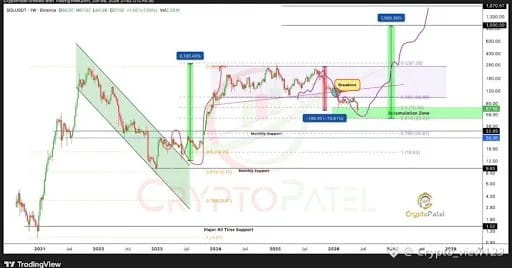
#SOL up about 10% #Solana
One slot is Solana’s most basic block production unit; its length determines how long a transaction has to wait before it’s up for the next confirmation. The upgrade plan, SIMD-0525, splits this into four phases: first 400 ms to 350 ms, then to 300 ms, then to 250 ms, and only at the end does it push to 200 ms. The 250 ms level is special—after it, there’s only one more step. The proposal doesn’t just move the clock forward; it also shifts the accounting for each slot downward, reducing the computation budget, the write-account limit, and the data-sharding limit, so that the number of “live” workload attempts sent to validator nodes per second doesn’t effectively double. Anza’s feature-flag documentation splits 250 and 200 into two tiers, meaning each time it moves up a level it keeps time set aside to see which aspect breaks first; the tiering itself already admits that speeding up comes with a cost.
With faster block production, confirmation latency gets shorter, and the time a block producer controls its production window also shrinks. Oracle and market-making institutions care most about this—newer state means they can post prices closer to the mark. The 150 milliseconds cut from the 400 ms baseline isn’t small when viewed across the entire network scale. Market makers are the most sensitive to this kind of change; with a bit less slippage, they can tighten quotes further. But 250 milliseconds isn’t final confirmation—getting things truly settled requires crossing more than one slot.
Speed is a selling point Solana has marketed for years. This time, it puts the cost on the table as well. The real test isn’t in the proposal—it’s whether the nodes can handle it.
Move the clock forward by one slot, and the hardware has to move one step too.
#SOL up about 10% #Solana