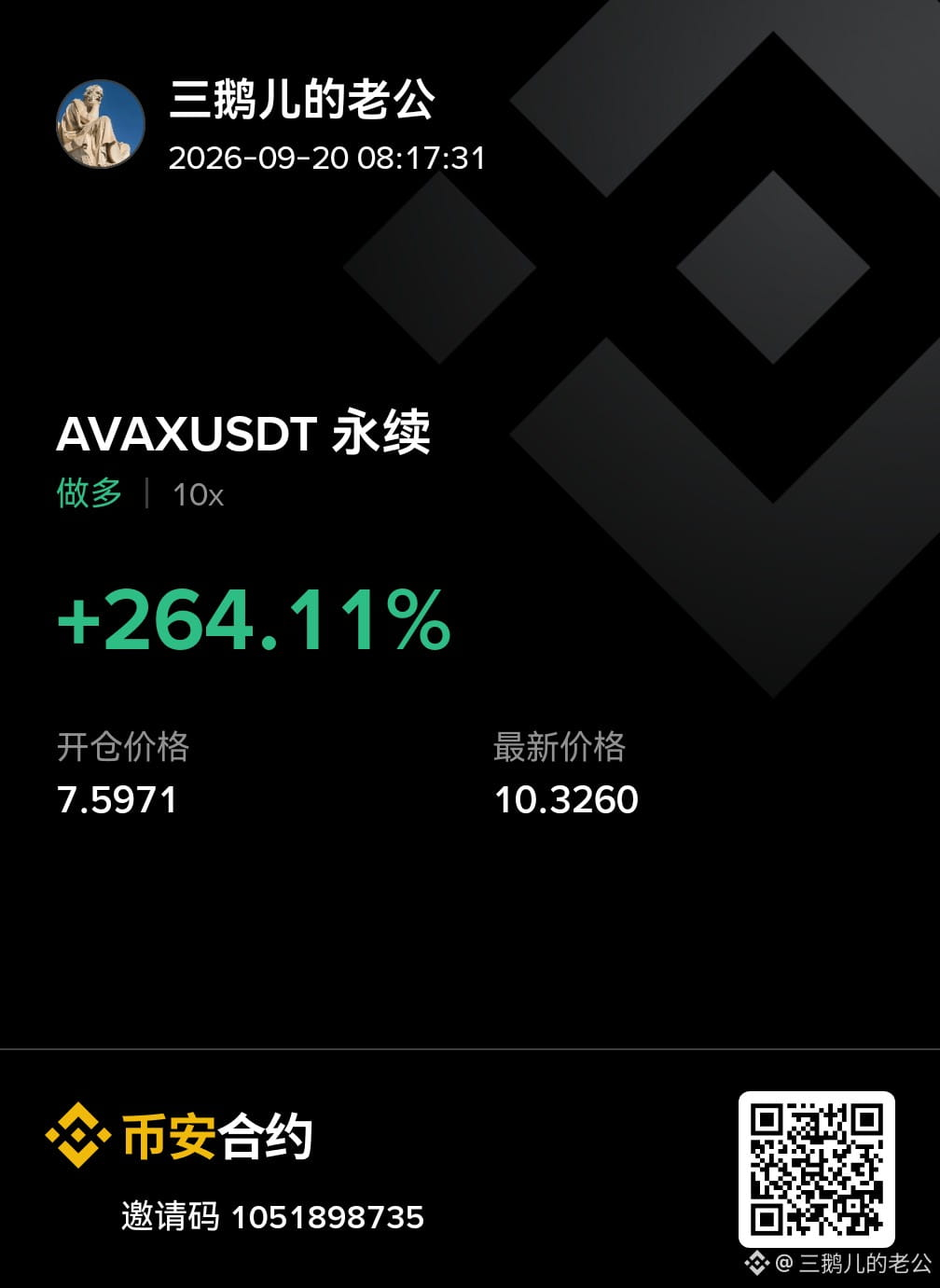
$AVAX Here’s my recap of AVAX again to share with everyone. It’s mainly for new followers; old friends can take a quick look too. Original post: $AVAX A longtime friend asked for an AVAX update, so today I’ll explain to everyone comprehensively the different coins, so that some beginners can understand the crypto ecosystem in detail. In the crypto market, there are only 2 coins in the first tier: BTC and ETH—this is an accepted fact, so there’s not much more to say. The second tier is SOL, BNB, and LINK. Their recognition is also very high; many people hold them as spot assets. Why am I recommending LINK today? Because it already shows signs of starting up, and that’s why I’m bringing it to everyone’s attention. The third tier is privacy coins like ZEC, XMR, and DASH. In bear markets, they often perform very well and very impressively. ZEC is the most typical example. The AVAX mentioned here by my old friend belongs to the category of coins that are stronger than ordinary small caps, but not as strong as the aforementioned coins. AVAX’s price is currently close to $7.4. In a bear-market scenario, it may hover around $8 to $12, or even just trade in long-term ranges. But in a bull market—this is the situation I believe is most likely—RWA continues to advance, and Avalanche sees more real-world adoption. Then I think a target of $20 to $35 is fairly realistic; that’s already a 3x to 5x move. The most optimistic bull-market scenario is: a full bull run for Bitcoin, continuous inflows of institutional capital, and Avalanche becoming one of the main infrastructure layers for institutions and RWA. In that case, a range of $50 to $80 is discussable, but getting above $100 would require the fundamentals to be fulfilled very fully. I won’t treat $100+ as the baseline prediction. This AVAX analysis post can be comprehensively saved. If you plan to trade this coin, the price changes I mentioned will likely be realized in the future. For now, it’s suitable to build your position slowly. Your holding period should be through the bull market. Don’t put in too much capital—large funds should go to the first tier, which is more stable.

Post

--
Disclaimer: Includes third-party opinions. No advice. Binance AI may be used without guarantee. See T&Cs.