Bitcoin is slowly becoming harder to find.
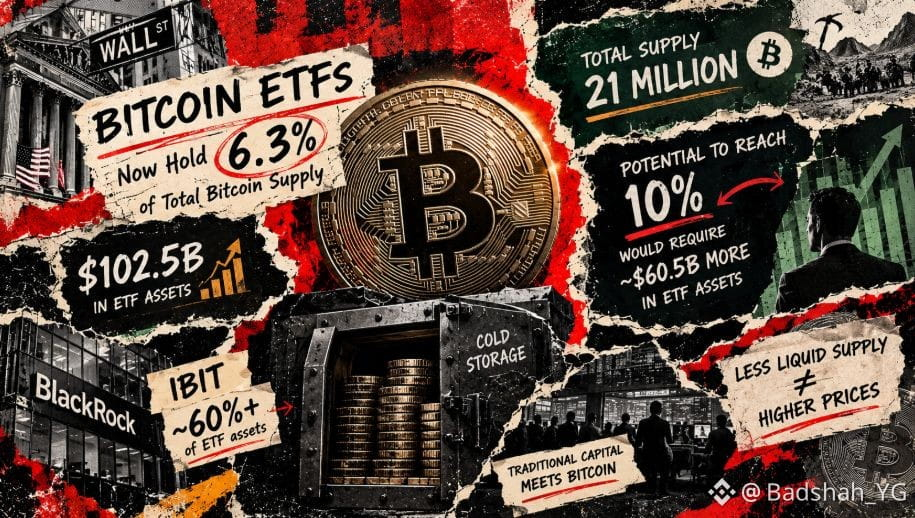
One number caught my attention: U.S. spot Bitcoin ETFs now control roughly 6.3% of Bitcoin’s total supply.
That sounds like just another ETF statistic.
But the bigger story is what happens to BTC when large amounts move into long-term custody.
Around 1.27–1.32 million BTC are now held by U.S. spot ETFs, representing roughly $102.5B in assets based on the figures in the source.$AKE
Bitcoin has a maximum supply of 21 million coins.
And the headline supply number can be misleading.
Some BTC is believed to be permanently lost or dormant, meaning the amount actually available for active trading is already smaller than 21 million.
Now imagine ETF ownership moving toward 10% of total supply.
That would mean an even larger portion of Bitcoin sitting inside investment vehicles rather than circulating through exchanges.
But there’s an important nuance:
Less liquid supply does not automatically mean higher prices.$CELR
Price still depends on demand, investor behavior, macro conditions, and whether ETF holders continue accumulating or eventually sell.
What has changed, though, is the access point.
Bitcoin exposure no longer requires every traditional investor to deal directly with wallets, private keys or crypto custody. ETFs created a bridge between traditional capital markets and Bitcoin.
So perhaps the more interesting question isn't:
“How high can Bitcoin go?”
It is:$BANK
“What happens to a fixed-supply asset when an increasing share of it moves into long-term financial products?”
The supply story is getting more interesting by the year.
#Badshah_YG #BTC #ETFs
One number caught my attention: U.S. spot Bitcoin ETFs now control roughly 6.3% of Bitcoin’s total supply.
That sounds like just another ETF statistic.
But the bigger story is what happens to BTC when large amounts move into long-term custody.
Around 1.27–1.32 million BTC are now held by U.S. spot ETFs, representing roughly $102.5B in assets based on the figures in the source.$AKE
Bitcoin has a maximum supply of 21 million coins.
And the headline supply number can be misleading.
Some BTC is believed to be permanently lost or dormant, meaning the amount actually available for active trading is already smaller than 21 million.
Now imagine ETF ownership moving toward 10% of total supply.
That would mean an even larger portion of Bitcoin sitting inside investment vehicles rather than circulating through exchanges.
But there’s an important nuance:
Less liquid supply does not automatically mean higher prices.$CELR
Price still depends on demand, investor behavior, macro conditions, and whether ETF holders continue accumulating or eventually sell.
What has changed, though, is the access point.
Bitcoin exposure no longer requires every traditional investor to deal directly with wallets, private keys or crypto custody. ETFs created a bridge between traditional capital markets and Bitcoin.
So perhaps the more interesting question isn't:
“How high can Bitcoin go?”
It is:$BANK
“What happens to a fixed-supply asset when an increasing share of it moves into long-term financial products?”
The supply story is getting more interesting by the year.
#Badshah_YG #BTC #ETFs