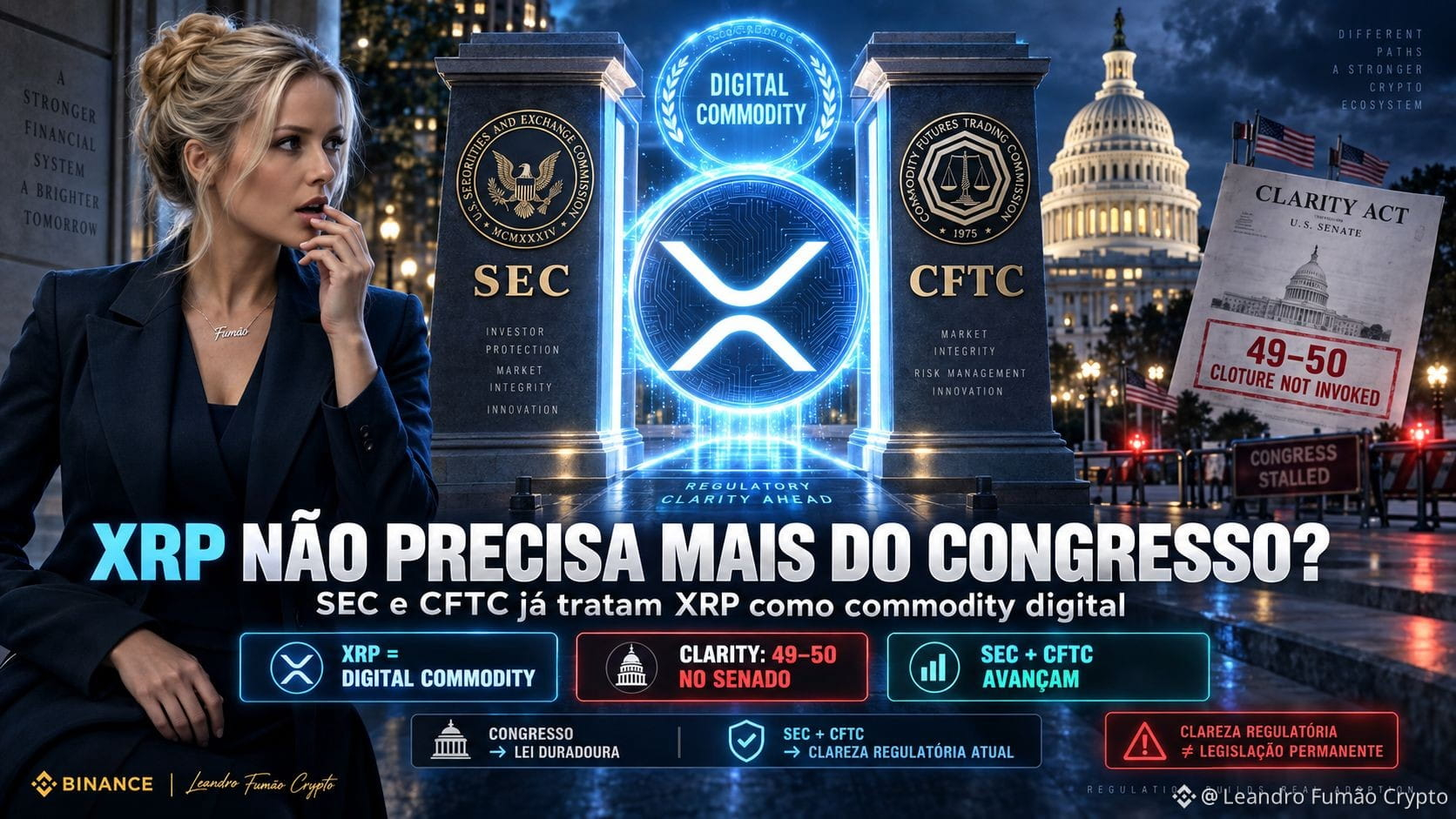
🤷 A CRYPTO $XRP DOESN'T NEED CONGRESS ANYMORE❓
The CLARITY Act suffered an important setback in the U.S. Senate on September 15: the vote to advance the bill failed to reach the 60 votes required and ended 49 to 50.
But for XRP, a significant part of the regulatory clarity already exists outside of Congress.
In March 2026, the SEC, with the participation of the CFTC, published a formal interpretation creating a taxonomy for cryptoassets. Within that framework, XRP was explicitly identified as a “digital commodity” and not as a security itself.
🔥 And this week brought another shift.
On September 17, the SEC launched its “Innovation Exemption” call, allowing, under specific conditions for five years, that certain tokenized actions be traded on-chain through AMMs without these platforms being treated the same way as traditional exchanges.
On the same day, the CFTC also granted a no-action position for certain passive software providers, reducing some registration barriers under specific conditions.
This shows that the SEC and CFTC are moving forward using regulatory powers they already have, even while legislation struggles in the Senate.
⚠️ But There’s a Crucial Detail:
regulatory guidance doesn’t have the same staying power as a law passed by Congress.
The CLARITY Act could still define much more durably who regulates what—especially exchanges, custody, and the spot market.
So maybe the question has changed👇
$XRP do we need the CLARITY Act to exist for regulatory clarity, or does it now need to exist mainly to consolidate that clarity?
#xrp #Ripple
The CLARITY Act suffered an important setback in the U.S. Senate on September 15: the vote to advance the bill failed to reach the 60 votes required and ended 49 to 50.
But for XRP, a significant part of the regulatory clarity already exists outside of Congress.
In March 2026, the SEC, with the participation of the CFTC, published a formal interpretation creating a taxonomy for cryptoassets. Within that framework, XRP was explicitly identified as a “digital commodity” and not as a security itself.
🔥 And this week brought another shift.
On September 17, the SEC launched its “Innovation Exemption” call, allowing, under specific conditions for five years, that certain tokenized actions be traded on-chain through AMMs without these platforms being treated the same way as traditional exchanges.
On the same day, the CFTC also granted a no-action position for certain passive software providers, reducing some registration barriers under specific conditions.
This shows that the SEC and CFTC are moving forward using regulatory powers they already have, even while legislation struggles in the Senate.
⚠️ But There’s a Crucial Detail:
regulatory guidance doesn’t have the same staying power as a law passed by Congress.
The CLARITY Act could still define much more durably who regulates what—especially exchanges, custody, and the spot market.
So maybe the question has changed👇
$XRP do we need the CLARITY Act to exist for regulatory clarity, or does it now need to exist mainly to consolidate that clarity?
#xrp #Ripple