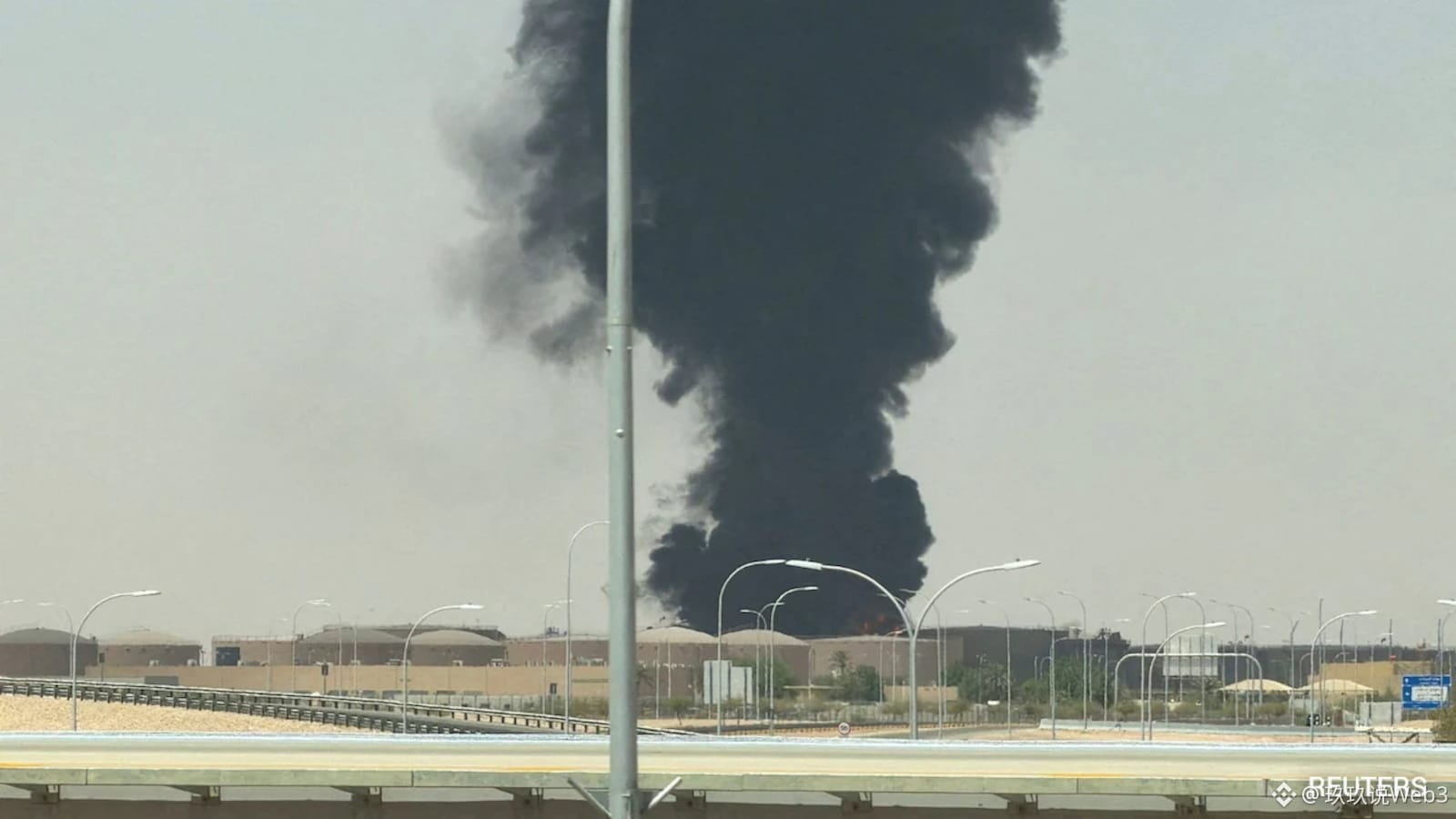
🚨 An Aramco fuel tank burned near Riyadh Airport, yet Bitcoin is still standing above $80,000
Group: 点击进入玖玖的粉丝群
On Saturday, Yemen’s Houthi forces said they used large numbers of ballistic missiles, cruise missiles, and drones to strike two targets—one being a “sensitive target” in Saudi Arabia’s capital, Riyadh, and the other the Aramco facilities in the Red Sea port city of Yanbu. Late at night, Saudi authorities issued air-defense alerts for Riyadh, Jeddah, and Yanbu—marking the first time since this month’s escalation of fighting between Yemen and Saudi Arabia. The fire reportedly started at a fuel tank marked with the Aramco logo, at an oil depot near the airport. Only after firefighters arrived was the blaze put out.🛢️
Look one layer deeper. This month alone, the Houthis have repeatedly seized the port of Mokha in the Bab el-Mandeb strait, the Perim island, and the various small Hanish Islands in the Red Sea. The Bab el-Mandeb is the throat for crude oil and natural gas traffic—once it’s tested again and again, the geopolitical premium embedded in oil prices must be recalculated. On Friday, the UN Security Council also spoke out, which is rare, condemning the Houthis’ continued attacks on Saudi Arabia and explicitly citing that their strikes have hit both civilian and energy infrastructure.
What’s interesting is that the flight-tracking website FlightRadar24 at one point listed King Khalid International Airport in Riyadh as the highest disruption level, before it later returned to normal. Honestly, the attack didn’t immediately disrupt production, and oil prices didn’t spike straight up—so some people say this is just more weekend noise.⚠️
There’s some truth to that. A single strike really can’t change supply and demand. And to be blunt, Yanbu is a key refining and export port on Saudi Arabia’s west coast, while the Strait of Hormuz and the Bab el-Mandeb have recently both been probed to their limits. Once oil prices start rising, inflation is hard to bring down, and rate cuts have to be pushed back. And when liquidity tightens, the first assets to get sold are always risk assets.
So what’s truly worth watching isn’t the cloud of smoke over Riyadh tonight—it’s whether it turns into a risk premium in oil prices, and then filters through via interest rates into Bitcoin. One camp says it’s just geopolitical noise; the other says it’s inflation rearing its head again. Which side are you on?👀
Click the profile picture to watch the live stream + join the Jiujiu chat group for daily strategy 🚀
#原油 #全球市场 #比特币 #BTC
Group: 点击进入玖玖的粉丝群
On Saturday, Yemen’s Houthi forces said they used large numbers of ballistic missiles, cruise missiles, and drones to strike two targets—one being a “sensitive target” in Saudi Arabia’s capital, Riyadh, and the other the Aramco facilities in the Red Sea port city of Yanbu. Late at night, Saudi authorities issued air-defense alerts for Riyadh, Jeddah, and Yanbu—marking the first time since this month’s escalation of fighting between Yemen and Saudi Arabia. The fire reportedly started at a fuel tank marked with the Aramco logo, at an oil depot near the airport. Only after firefighters arrived was the blaze put out.🛢️
Look one layer deeper. This month alone, the Houthis have repeatedly seized the port of Mokha in the Bab el-Mandeb strait, the Perim island, and the various small Hanish Islands in the Red Sea. The Bab el-Mandeb is the throat for crude oil and natural gas traffic—once it’s tested again and again, the geopolitical premium embedded in oil prices must be recalculated. On Friday, the UN Security Council also spoke out, which is rare, condemning the Houthis’ continued attacks on Saudi Arabia and explicitly citing that their strikes have hit both civilian and energy infrastructure.
What’s interesting is that the flight-tracking website FlightRadar24 at one point listed King Khalid International Airport in Riyadh as the highest disruption level, before it later returned to normal. Honestly, the attack didn’t immediately disrupt production, and oil prices didn’t spike straight up—so some people say this is just more weekend noise.⚠️
There’s some truth to that. A single strike really can’t change supply and demand. And to be blunt, Yanbu is a key refining and export port on Saudi Arabia’s west coast, while the Strait of Hormuz and the Bab el-Mandeb have recently both been probed to their limits. Once oil prices start rising, inflation is hard to bring down, and rate cuts have to be pushed back. And when liquidity tightens, the first assets to get sold are always risk assets.
So what’s truly worth watching isn’t the cloud of smoke over Riyadh tonight—it’s whether it turns into a risk premium in oil prices, and then filters through via interest rates into Bitcoin. One camp says it’s just geopolitical noise; the other says it’s inflation rearing its head again. Which side are you on?👀
Click the profile picture to watch the live stream + join the Jiujiu chat group for daily strategy 🚀
#原油 #全球市场 #比特币 #BTC